TL;DR
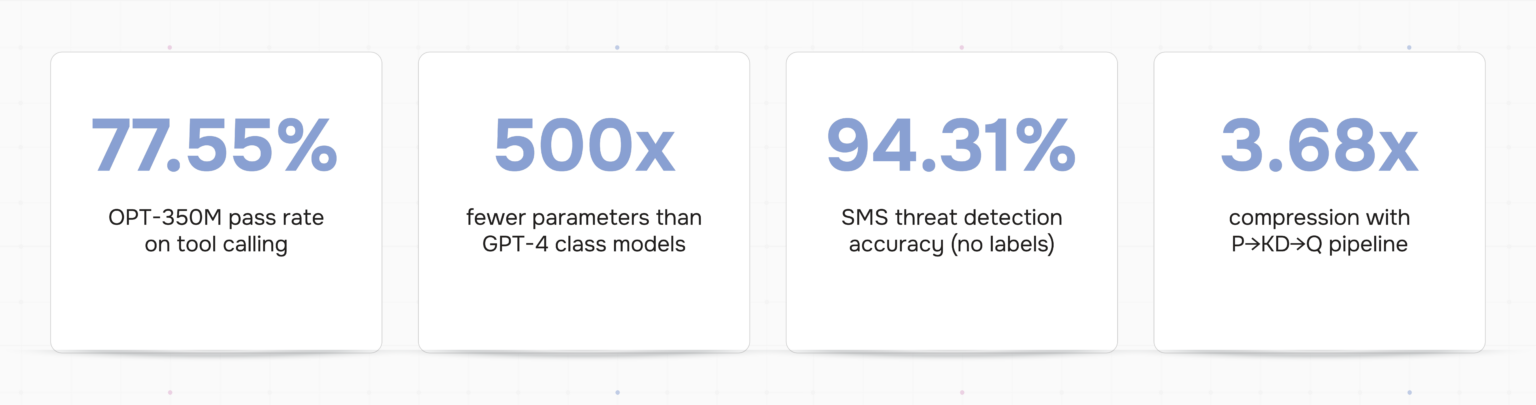
- A fine-tuned 350-million-parameter model reached a 77.55% pass rate on the ToolBench agentic tool-calling benchmark — more than triple ChatGPT’s 26% with chain-of-thought prompting.
- A 500-million-parameter model hit 94.31% accuracy on SMS threat detection with zero labeled training examples, using autonomous distillation.
- The compression order that holds up under testing is Prune → Distill → Quantize (P→KD→Q); reversing it causes irreversible quality loss.
- A 350M-parameter model needs an estimated 500x less inference compute than a 175B+ parameter model for the same task — the difference between one mid-tier GPU and a full GPU cluster at scale.
- SLMs aren’t a universal replacement for large LLMs: they win on narrow, well-defined tasks, not open-ended reasoning or creative work.
A 350-million parameter model just tripled ChatGPT’s score on agentic tool calling. A 500-million parameter model hit 94% accuracy on a security classification task that stumped zero-shot LLMs. A fine-tuned Mistral variant is running in production at Microsoft, beating larger models on both quality and latency.
The era of “bigger is better” in enterprise AI is ending. Not because large language models are getting worse — they aren’t — but because a new class of small, purpose-built models is proving that for the tasks enterprises care about, targeted training beats raw scale. And the gap isn’t closed.
What evidence shows small language models beating large LLMs on enterprise tasks?
The most striking result comes from a study on agentic tool calling — the ability of an AI model to select and invoke the right APIs and functions to complete a task. Researchers fine-tuned Facebook’s OPT-350M, a model with roughly 500 times fewer parameters than GPT-4-class models, using reinforcement learning on the ToolBench benchmark. The result: 77.55% pass rate, compared to ChatGPT with chain-of-thought prompting at 26%, ToolLLaMA-DFS at 30.18%, and ToolLLaMA-CoT at 16.27%.
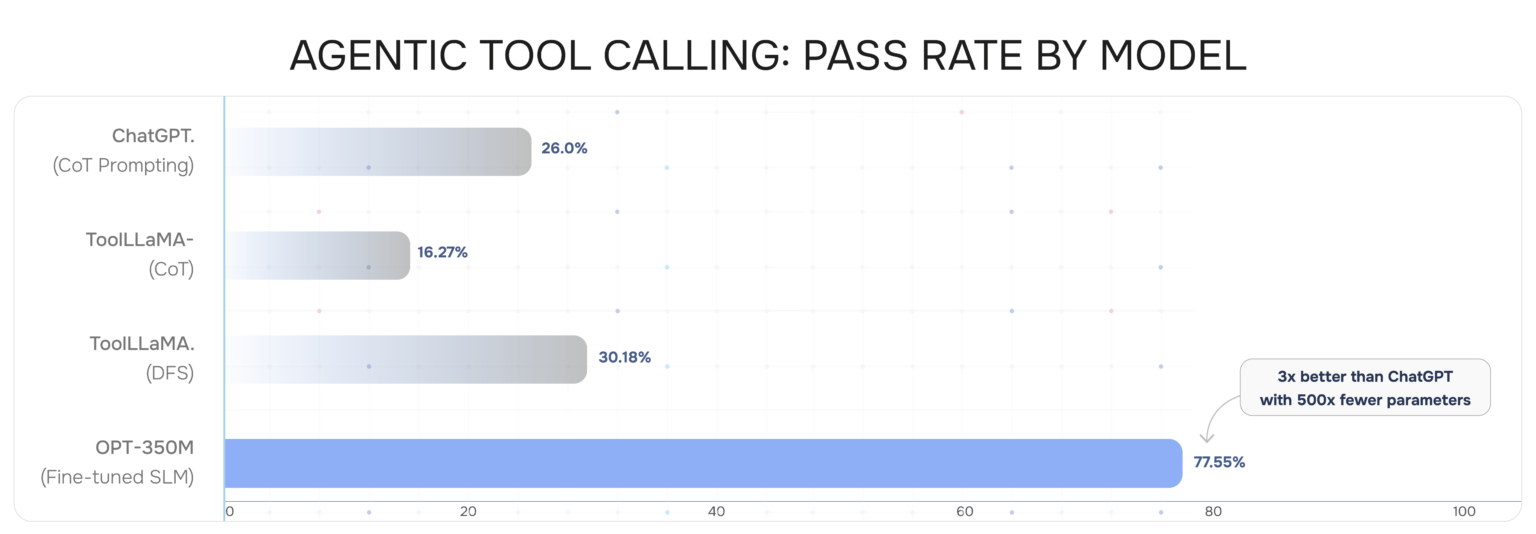
Figure 1 — Agentic tool calling pass rate: fine-tuned OPT-350M vs. larger models
| Read that again. A model that fits on a smartphone beat the largest commercial LLM by a factor of three on a practical agentic task. |
This isn’t an isolated finding. In April 2026, Microsoft published results from their production deployment of small Mistral variants fine-tuned for domain-specific code generation. The SLMs outperformed larger models on both output quality and inference latency — and they’re running in production, not just on benchmarks. The paper also demonstrated per-customer customization: each enterprise customer can have a fine-tuned variant tailored to their specific domain language, something that is economically infeasible with 100B+ parameter models.
Meanwhile, a team studying SMS threat detection built an autonomous distillation pipeline that trained a Qwen2.5-0.5B model to 94.31% accuracy — comparable to human-level classification — without a single labeled training example. The teacher LLM generated all the training data synthetically, the student SLM learned from it via LoRA fine-tuning, and the whole loop ran on consumer hardware.
The pattern holds across bounded, schema-defined enterprise tasks more broadly — from entity extraction to customer-support routing — wherever the job is narrow enough for a fine-tuned model to specialize in it. When the task is well-defined and the training is targeted, small models don’t just match large ones — they win.
Why does targeted training beat raw model scale?
Large language models are generalists: they spread their parameters across every domain, every language, and every task type. A model fine-tuned on one task class concentrates all of its capacity on that single thing instead, which is why narrow training wins on narrow tasks.
When GPT-4-class models make an agentic tool call, they’re drawing on the same parameters used for poetry, medical diagnosis, and unrelated general knowledge — most of that capacity is irrelevant to the task at hand. A 350-million-parameter model trained exclusively on tool-calling patterns doesn’t need to write sonnets, reason about physics, or hold multilingual general knowledge it will never use; every parameter is allocated to the one skill it needs.
This is especially true for enterprise applications, where the task space is well-defined by nature. A telecom network-troubleshooting agent doesn’t need to know about Renaissance art; an insurance claims processor doesn’t need to generate Python code. Enterprise AI is domain-specific almost by definition — and domain-specific is exactly where SLMs have the advantage.
This dovetails with the broader case that small, specialized models — not just fine-tuned SLMs, but also the rerankers and confidence gatekeepers embedded inside a modern context pipeline — win by design rather than raw parameter count.
How are enterprises building these smaller models?
Knowledge distillation is the process of training a smaller “student” model to reproduce the behavior of a larger “teacher” model, so the student inherits much of the teacher’s capability at a fraction of its size. It’s the primary method enterprises use to build task-specific SLMs without training a model from scratch, and two distinct approaches are maturing quickly.
Approach 1: How does chain-of-thought guided reinforcement learning distillation work?
A March 2026 study compressed Qwen 3B down to Qwen 0.5B — a 6x size reduction — while retaining 70–91% of the teacher’s capability in English, up to 95% in Spanish, and 93.5% Rouge-L on code generation. The key innovation: instead of just training the student on the teacher’s outputs, the researchers used the teacher’s chain-of-thought reasoning as a supervision signal during RL training. This taught the student not just what to output, but how to reason.
Multilingual retention is particularly notable for global enterprises. A 500M model that retains 95% of a 3B model’s Spanish capability opens the door to multilingual SLMs that serve diverse markets without the infrastructure cost of large models.
Approach 2: What is autonomous agentic distillation?
The SMS threat detection study introduced a fully autonomous training pipeline. A teacher LLM generates synthetic training data; the student SLM trains on it; performance is evaluated; the teacher adjusts the data based on the student’s weaknesses; and the loop repeats until performance plateaus. No human intervention. No labeled datasets.
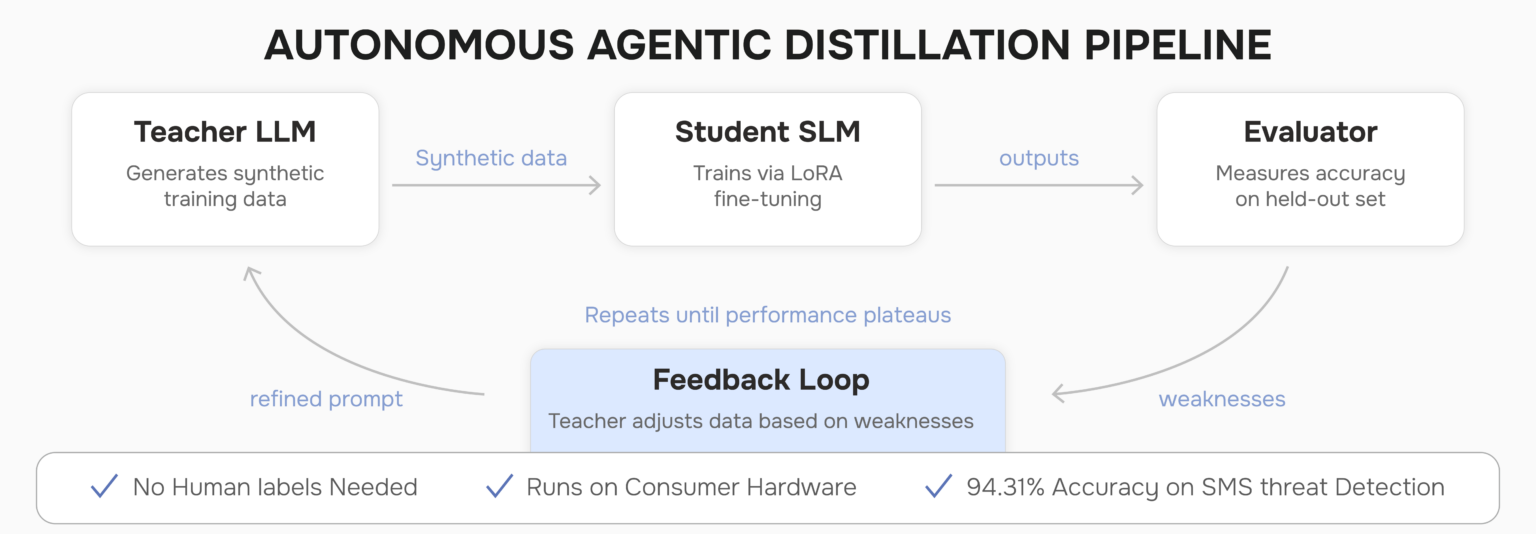
Figure 2 — Autonomous agentic distillation loop: no human labels required
This matters enormously for enterprise domains where labeled data is scarce or expensive. Getting expert-annotated training data for telecom network troubleshooting or insurance claims processing costs real money and real time. An autonomous distillation loop that generates its own training data removes that bottleneck entirely.
| Critical finding: the choice of teacher LLM swings student performance by over 25 percent. Claude and DeepSeek substantially outperformed GPT and Gemini as teachers. Enterprises building SLM training pipelines need to benchmark teacher models carefully. |
Narrow fine-tuning carries its own risk, too: a model trained tightly on one data distribution can learn shortcuts that don’t generalize the way broader training would catch, so validation on held-out, adversarial, and edge-case examples matters as much as the headline accuracy number.
What’s the right order to compress a small language model?
Building a good SLM is one thing. Making it small enough to deploy efficiently is another. UniComp, the first unified evaluation of LLM compression techniques, tested every combination of pruning, knowledge distillation, and quantization across 40 datasets. Their finding is concrete and actionable:
| Optimal ordering: Prune first, then Distill, then Quantize (P → KD → Q), achieving 3.68× compression while preserving strong capabilities. |
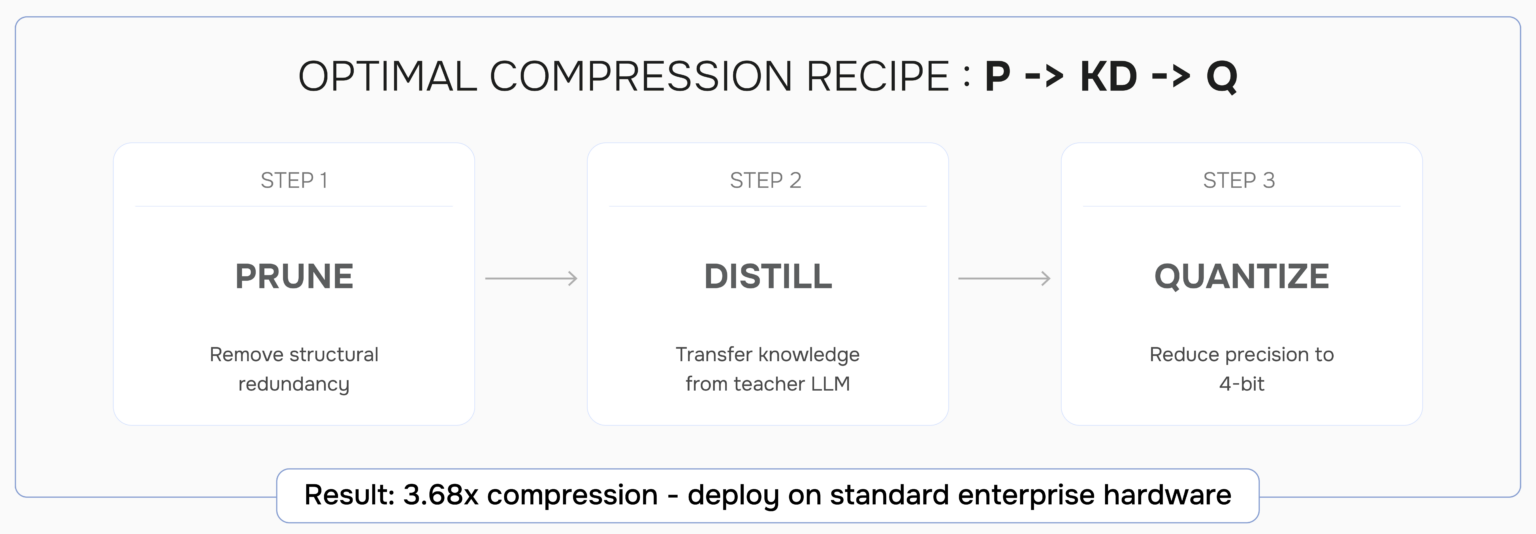
Figure 3 — The P → KD → Q compression pipeline and why ordering is critical
The ordering isn’t a suggestion — it’s critical. The study found that applying quantization early in the pipeline causes “severe, irreversible information loss that impairs subsequent training.” Quantization is a lossy operation, and information destroyed early cannot be recovered by later distillation. But when quantization comes last — after pruning has removed redundant structure and distillation has transferred knowledge efficiently — the remaining model is robust enough to withstand precision reduction.
This gives enterprise teams a concrete recipe:
- Prune the base model to remove structural redundancy
- Distill from a larger teacher using CoT-guided RL or autonomous synthetic data
- Quantize to 4-bit for deployment
The result: models that are 3–4x smaller than the distilled version alone, with acceptable quality loss, deployable on standard enterprise hardware.
UniComp also surfaced a sobering finding: performance on benchmarks doesn’t guarantee reliability. A model can score well on accuracy metrics while behaving inconsistently in production. This is a reminder that compression pipelines need to be evaluated on reliability metrics, not just benchmark scores — especially for enterprise use cases where consistency matters more than peak performance.
What do small language models mean for enterprise AI architecture and cost?
The implications of these findings converge on a single conclusion: the future of enterprise AI is not one giant model serving every use case. It’s a fleet of small, purpose-built models, each trained for a specific domain and task class.
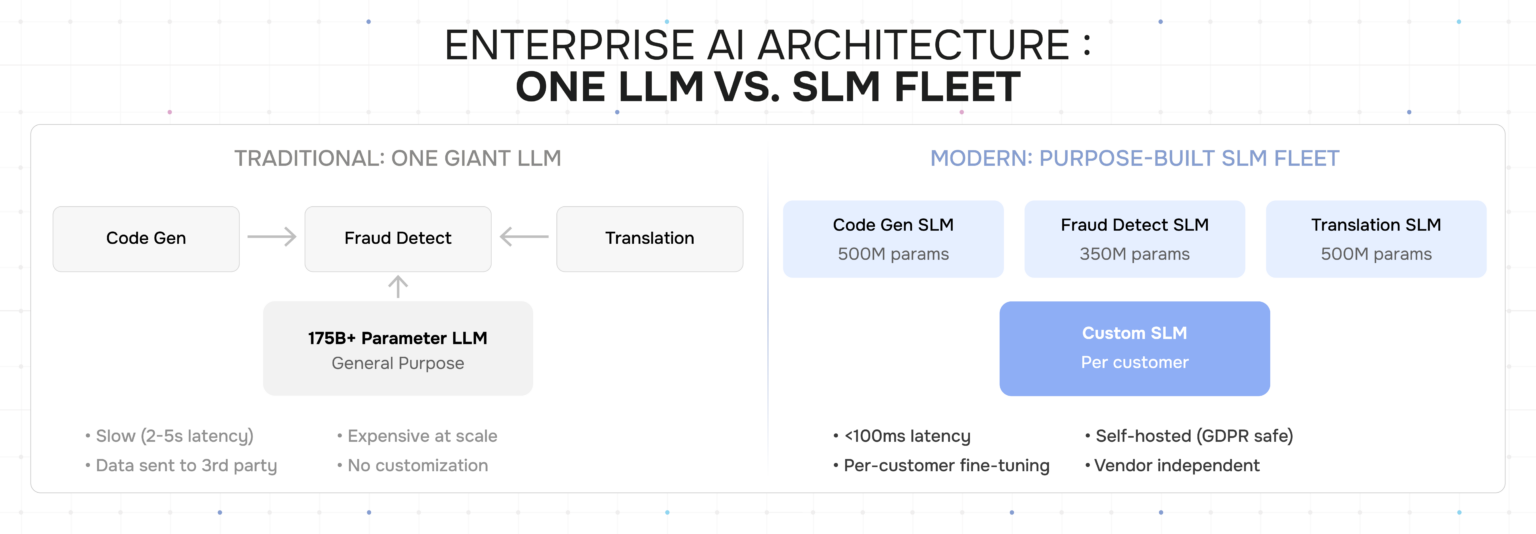
Figure 4 — Traditional single-LLM architecture vs. purpose-built SLM fleet
Consider the economics. A 350M parameter model serving agentic tool calls requires roughly 500x less compute per inference than a 175B+ parameter model. In a self-hosted deployment where the enterprise is paying for GPU hours, that’s the difference between needing a cluster of A100s and running on a single mid-tier GPU. At enterprise scale — millions of agent invocations per day — the cost difference is measured in millions of dollars annually.
| Approach | Best fit | Inference cost per task | Data sovereignty | Vendor lock-in |
| General-purpose LLM (GPT-4-class) | Open-ended reasoning, creative work, broad general knowledge | High — full parameter count active on every call | Data typically leaves the enterprise to reach the provider’s servers unless a private deployment is contracted | Tied to a single foundation-model provider’s pricing, availability, and roadmap |
| Fine-tuned SLM (350M–3B) | Narrow, well-defined tasks — tool calling, classification, domain code generation | Low — an estimated ~500x less compute per inference on tasks tested to date | Can run entirely on-premise, addressing data-residency requirements directly | None — self-hosted and swappable, no dependency on a single provider |
| Synapt AI (Operational Intelligence Layer) | Governing the live context any model — LLM or SLM — reasons over | Not a model; typically reduces LLM token costs by up to 80% by right-sizing model choice within a governed context layer | Model-agnostic, governed context substrate that keeps enterprise data on the enterprise’s own terms regardless of model size | Model-agnostic by design — swapping the underlying model doesn’t require rebuilding the context layer |
None of this removes the need for governed access to live enterprise data, whichever size of model does the reasoning. That’s the layer Synapt AI’s Operational Intelligence Layer is built to provide: a model-agnostic, governed context substrate that connects whatever mix of LLMs and SLMs an enterprise runs to live, current enterprise data, so switching model size or provider doesn’t mean rebuilding the pipeline underneath it.
- Latency: Enterprise applications often have real-time requirements — a customer-facing agent can’t wait three seconds for an LLM API response. Small models running locally can deliver sub-100ms inference, fast enough for real-time decisions in production workflows. The same logic applies at the agent-orchestration level, where routing cheaper, smaller models to handle classification and summarization before escalating only the hardest cases to a frontier model can cut token spend meaningfully.
- Data sovereignty: Large-model APIs send enterprise data to third-party servers; SLMs can run on-premise instead. For industries under GDPR, DORA, Solvency II, or the EU AI Act, that’s not a preference, it’s increasingly a requirement — with enforcement deadlines now weeks away, on-premise deployment is becoming a compliance question rather than only a competitive one. Because SLMs run inside the enterprise’s own environment, every inference call can also be logged and time-stamped locally, which matters wherever automatic logging of AI decisions is itself a legal requirement in some jurisdictions.
- Customization at scale: Microsoft’s production results show that per-customer SLM variants are feasible — each enterprise customer can get a model fine-tuned on their specific domain language. Attempting the same customization with a 175-billion-parameter model would make the fine-tuning cost alone prohibitive.
- Vendor independence: A fleet of self-hosted SLMs means no dependency on any single foundation-model provider. When pricing changes, rate limits tighten, or a provider has a rough patch, production systems keep running. That independence pairs naturally with a model-agnostic context layer underneath — one built so that swapping the model powering an agent doesn’t require rebuilding the infrastructure connecting that agent to enterprise data.
Are small language models going to replace large language models entirely?
No. General-purpose chat, open-ended reasoning, and creative writing still benefit from the breadth that comes with scale, and large models remain the better choice for those tasks. SLMs win specifically on the narrow, well-defined tasks that make up most enterprise AI workloads — which is a large share of enterprise AI spend, but not all of it.
The pieces are falling into place: evidence that SLMs outperform LLMs on targeted tasks, multiple distillation approaches that make SLM training practical and affordable, a concrete compression recipe that makes deployment efficient, and production validation from teams running these models in real enterprise environments
| The enterprise AI stack of the near future doesn’t call an API. It runs a fleet of domain-specific SLMs — self-hosted, governed, and purpose-built. The models are small. The impact is not. |
FAQ's
For narrow, well-defined tasks — tool calling, classification, code generation in a specific domain — yes: fine-tuned SLMs in the 350M-3B parameter range have matched or beaten much larger general-purpose LLMs in multiple published benchmarks and at least one production deployment (Microsoft’s fine-tuned Mistral variants). They are not better at open-ended, general-purpose reasoning or creative tasks, where breadth of training still matters.
Knowledge distillation is the process of training a smaller “student” model to reproduce a larger “teacher” model’s behavior, so the student inherits much of the teacher’s capability at a fraction of the size and inference cost. It’s the primary technique enterprises use to build task-specific SLMs without training a model from scratch.
P→KD→Q is a three-step recipe for shrinking a model for deployment: prune redundant structure first, distill knowledge from a larger teacher second, and quantize to lower numeric precision last. Testing across 40 datasets found this order preserves far more model quality than quantizing earlier in the pipeline, because quantization is lossy and destroys information that later steps can’t recover.
Less than most teams assume — data balance across classes generally matters more than raw volume once a fine-tuning set clears a certain size threshold. For an enterprise team fine-tuning its first task-specific SLM, this changes the planning conversation from “how much data can we collect” to “how well-distributed is the data we already have.”
They remove one major obstacle: because SLMs can run entirely on-premise, enterprise data never has to leave the organization’s own environment to reach a third-party model API. For industries under GDPR, DORA, Solvency II, or the EU AI Act, that’s a meaningful step toward compliance — though it addresses data residency specifically; audit-trail, governance, and access-control requirements still need to be designed in separately.
No. Large, general-purpose LLMs still have a clear advantage for open-ended reasoning, general-purpose chat, and creative work — tasks where breadth of training matters more than depth on one domain. SLMs win specifically on the narrow, well-defined tasks that make up the majority of day-to-day enterprise AI workloads, not on every AI task an enterprise runs.
Roughly two to three orders of magnitude less for a comparable task: a 350-million-parameter model needs an estimated 500x less compute per inference than a 175-billion-plus-parameter model performing the same job. At enterprise scale — millions of inferences a day — that’s commonly the difference between a single mid-tier GPU and a dedicated GPU cluster.

Subscribe to our newsletter
Insights on making enterprise AI actually work - straight to your inbox.
Subscribe to our newsletter
Insights on making enterprise AI actually work - straight to your inbox.