TL;DR
- Bigger models don’t automatically deliver better enterprise AI outcomes.
- Three independent studies found that smaller, fine-tuned models outperformed much larger foundation models on specialized business tasks.
- The advantage wasn’t more parameters—it was task-specific knowledge, structured outputs, and proprietary business context.
- For well-defined enterprise workflows, specialization can improve accuracy, latency, and cost simultaneously.
- Before asking “How big is the model?”, ask “Does it know my job?”
No – bigger AI models don’t reliably beat smaller ones on enterprise tasks. In three independent studies, fine-tuned small models outperformed far larger foundation models on structured extraction, code generation, and classification. When a task has stable structure, private knowledge, and enough training coverage, a specialized small model wins on accuracy, latency, and cost.
Do bigger AI models deliver better enterprise results?
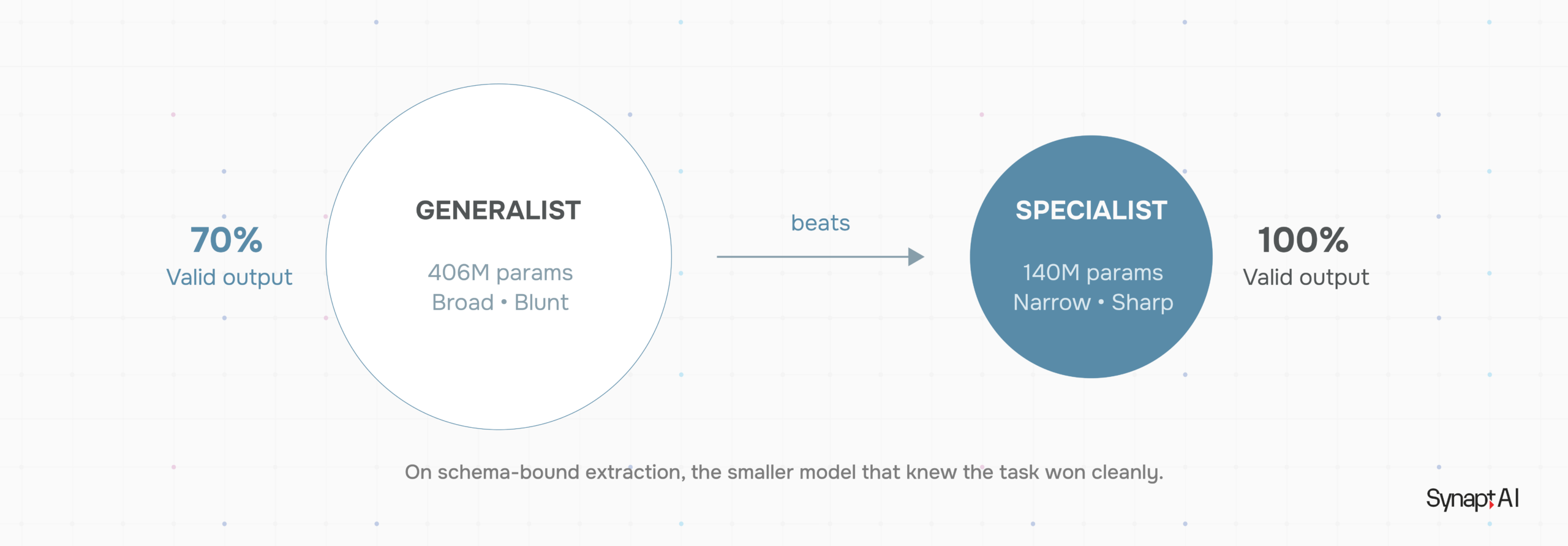
Not when the task is well-defined. Parameters are the internal weights a model learns during training, and parameter count is the standard measure of model size – but size measures general capability, not fitness for a specific job.
BART-base has 140 million parameters. REBEL-large has 406 million. In a direct head-to-head on structured information extraction from text, BART-base produced valid output 100% of the time. REBEL-large managed 70%. A model less than a third the size, winning cleanly on every metric.
The answer isn’t that BART-base is the better model – by most standard measures REBEL-large is more capable. The answer is that BART-base was given something REBEL-large wasn’t: a precise description of what the task looked like. A schema – a set of rules defining which properties to extract and what valid output contained. That schema was worth more than 266 million parameters. The question enterprises should ask about AI deployments isn’t “how many parameters does it have?” It’s “does it know exactly what this job requires?”
How did a 140-million-parameter model beat one three times its size?
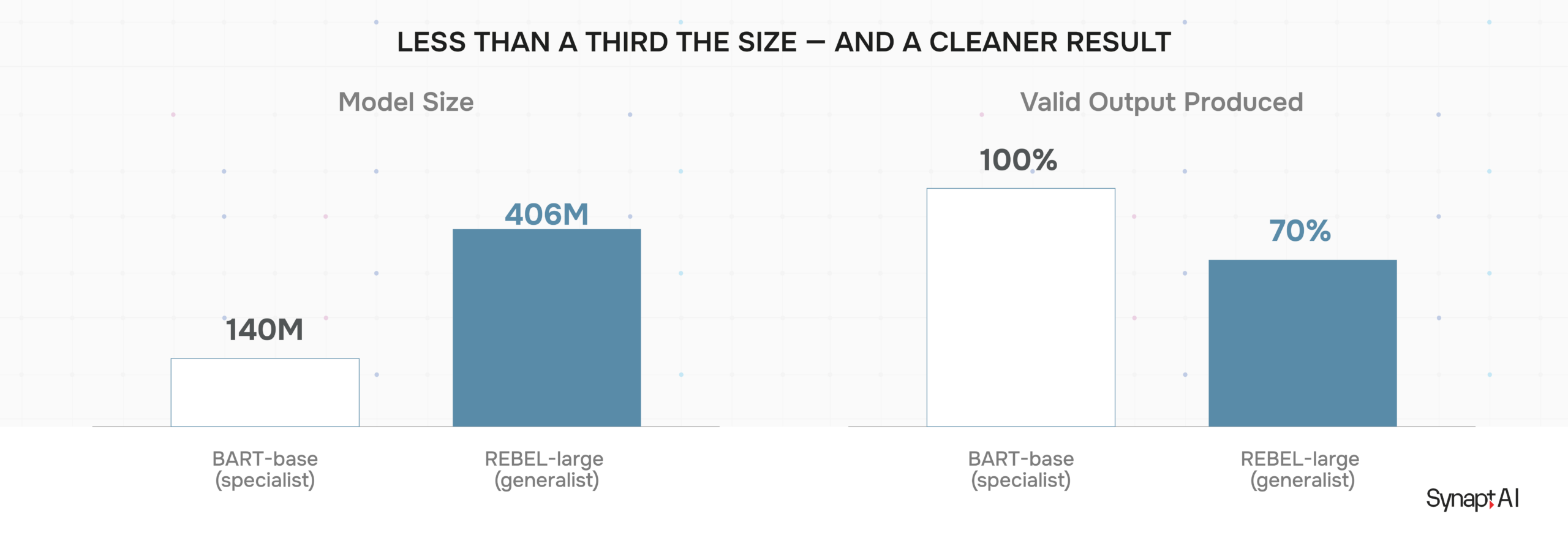
Figure 2 — A smaller model, constrained to the right output space, produced valid results every time.
The smaller model won because it was trained to produce exactly the format the task required, while the larger model was trained for the general case. REBEL-large was built for open-ended relation extraction – given any text, produce the subject-relation-object triples it contains. But when output had to conform to a predefined schema, REBEL produced subjects that didn’t match the expected entity identifiers 30% of the time. For anything downstream that joins on those IDs – a knowledge graph, a database ingestion process – that isn’t a performance issue. It’s a cascade failure.
Large general-purpose models generate text token by token based on probability, while a rigid output schema demands exact, deterministic syntax — a single misplaced bracket or field breaks the format, and REBEL-large’s 30% invalid-output rate is a direct symptom of that conflict.
There’s a second failure hiding in REBEL’s numbers, visible in two metrics. Micro-F1 measures accuracy across all examples pooled together, so frequent categories dominate the score; REBEL’s sits around 65-69. Macro-F1 averages accuracy per output property, weighting rare categories equally; REBEL’s sits around 41-44. The gap reveals a model reliably extracting a few common property types and failing on the rest – good at part of the task and invisible on the remainder.
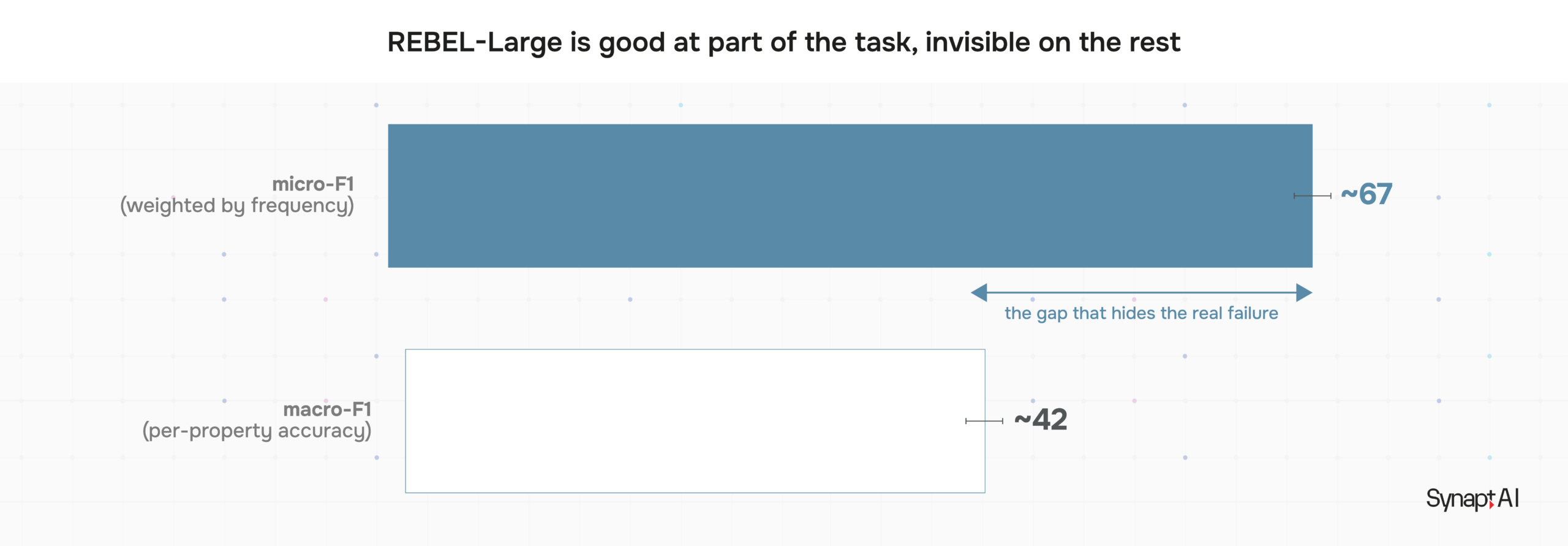
Figure 3 — The micro–macro gap exposes a model that handles common cases and quietly misses the rest.
What do three independent studies show about small vs. large models?
Three research groups, three different tasks, three ways of measuring performance – and the same result each time: the fine-tuned specialist beat the larger generalist. Two of the comparisons involve retrieval-augmented generation (RAG) – a technique that supplies a model with relevant documents or examples fetched at query time, rather than training that knowledge into its weights.
| Task studied | Smaller model | Larger model | Result |
| Structured information extraction against a fixed schema | BART-base (140M), trained on schema-conformant examples | REBEL-large (406M), general-purpose relation extraction | Small model: 100% valid output. Large model: 70%. |
| Natural language to proprietary workflow-automation code (DSL) | Mistral 7B, fine-tuned on 68,000 in-house language-code pairs | GPT-4 with retrieved examples at inference (RAG) | Small model 10x faster (1.3s vs 13.0s median) and matched or beat accuracy. |
| Classifying employee innovation proposals (real ideas vs noise) | SmolLM3 (3B), fine-tuned on 5,000 labeled reviewer decisions | GPT-4o, zero-shot | Small model cleared 90% accuracy; GPT-4o stayed below it. |
In the second study, the task was converting natural language into a proprietary domain-specific language (DSL) – a small programming language built for one narrow purpose, here workflow automation. The latency settled it before accuracy did: 1.3 seconds median for the fine-tuned Mistral 7B against 13.0 seconds for GPT-4 with retrieval – in a user-facing tool, the difference between something people use and something they abandon.
In the third, GPT-4o didn’t fail for lack of intelligence; it failed because it had never seen what this company considered a good idea. That knowledge lived in 5,000 labeled examples of how the company’s reviewers actually decided – and fine-tuning was the only way to transfer it. The pattern is consistent with the broader wave of small language models outperforming larger ones on targeted enterprise tasks.
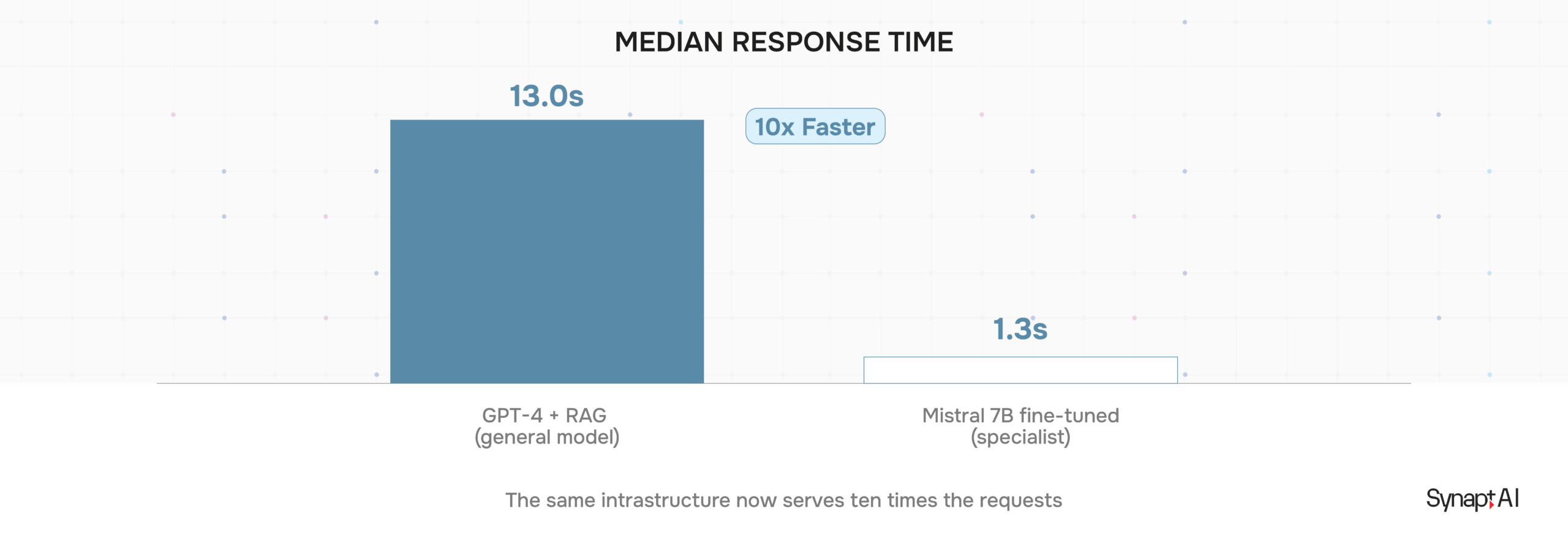
Figure 4 — A 10× latency swing is the line between a tool people use and one they abandon.
The third case is the most direct. A company needed to classify employee innovation proposals — real ideas versus noise. GPT-4o, one of the most capable models available, stayed below 90% accuracy. A fine-tuned SmolLM3, a 3-billion-parameter open model, cleared 90% comfortably.
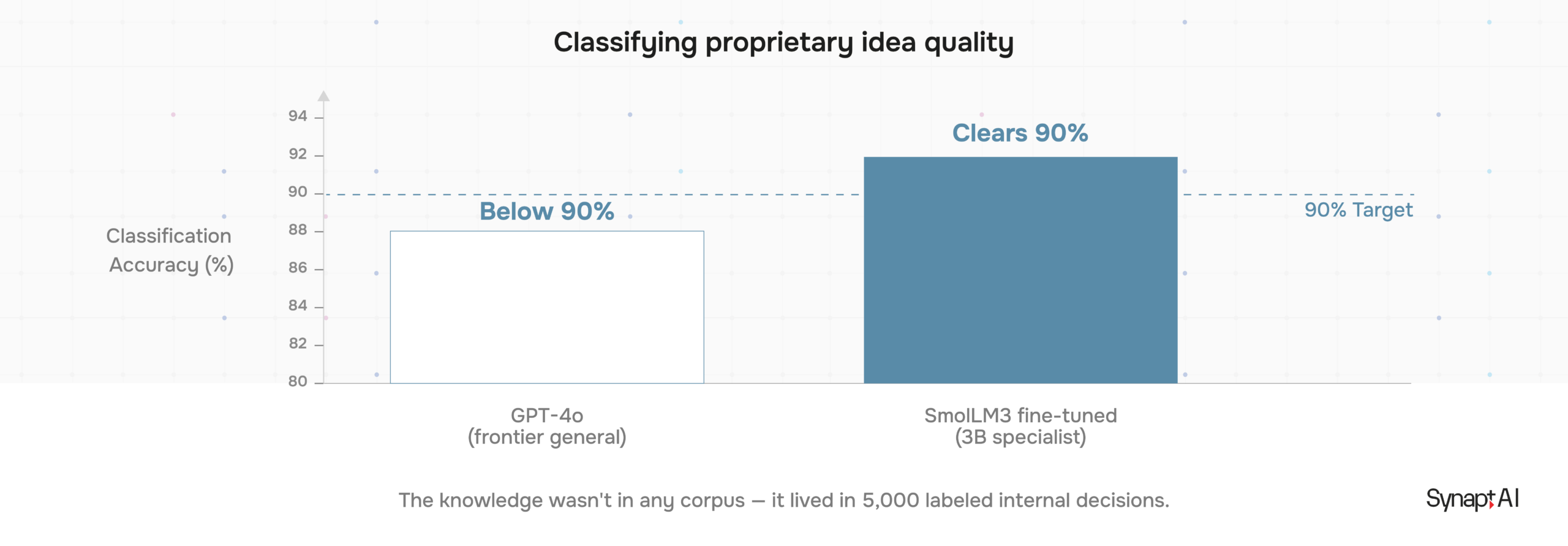
Figure 5 — The frontier model missed the bar; the small specialist cleared it.
Not because SmolLM3 is smarter — it obviously isn’t. Because GPT-4o didn’t know what this company considered a good idea. That knowledge isn’t in any training corpus; it lived in 5,000 labeled examples of how the company’s reviewers actually decided. Fine-tuning was the only way to transfer it.
Three research groups, three different tasks, three ways to measure performance — and the same result each time.
Why does model size stop mattering when the task is bounded?
A bounded task – one with known inputs, a defined output format, and clear success criteria – rewards precision within a narrow space, not breadth across every domain. General models are expensive because they’re trained for generality: every parameter is capacity to hold knowledge and reason across domains. For open-ended problems you can’t anticipate, that capacity is genuinely valuable. But define the task precisely – output is a set of RDF triples, a domain-specific language with a fixed grammar, or a binary classification against a known rubric – and the task no longer demands breadth. A fine-tuned specialist is more accurate because it has less room to go wrong: fewer things it could produce, and all of them correct by construction.
A general practitioner knows a great deal. A hand surgeon knows their domain at a precision no GP can match – not because they’re smarter, but because they traded scope for depth. Most enterprise AI tasks look more like hand surgery than general medicine. The same trade-off is showing up at the architecture level, where context quality beats raw compute in production AI pipelines.
When does a fine-tuned small model beat a frontier model?
A fine-tuned small model wins when the task meets three conditions – stable structure, private knowledge, and enough training coverage. Fine-tuning is the process of continuing a model’s training on task-specific examples so that knowledge is stored directly in its weights.
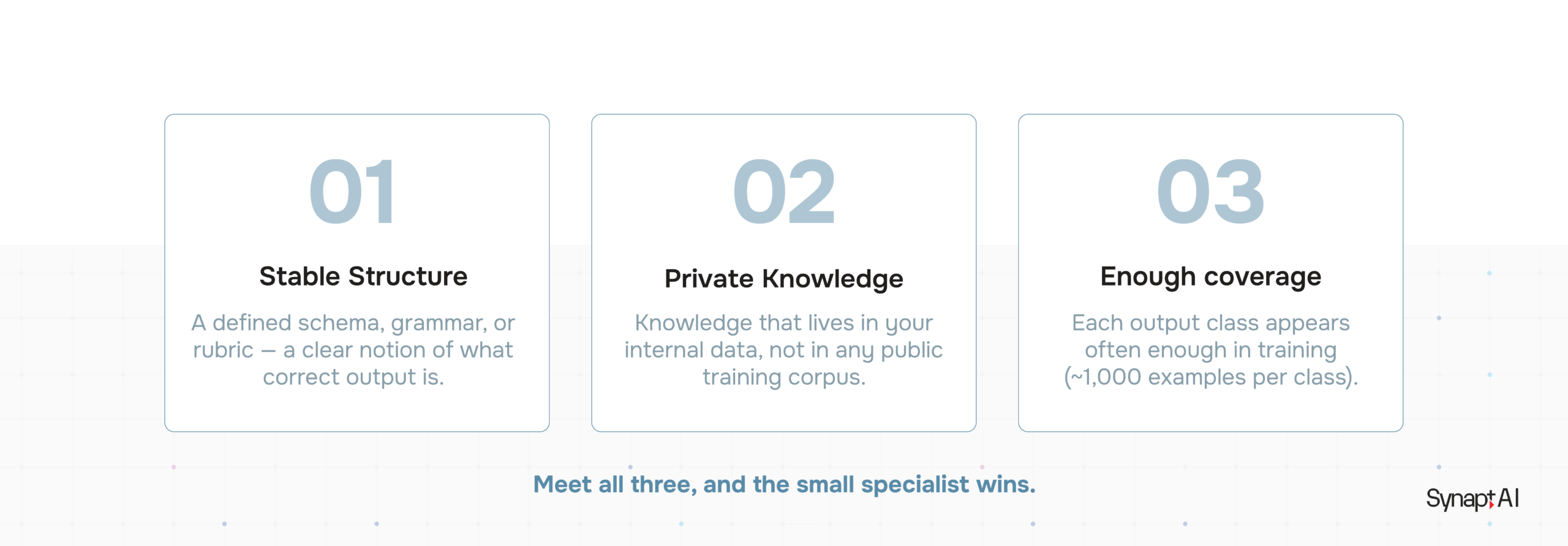
Figure 6— The three conditions a task must meet for a fine-tuned specialist to win.
Stable structure. The task needs a schema, grammar, or rubric — some notion of what correct output is. “Summarize anything” doesn’t qualify; a fixed output format does.
Private knowledge. GPT-4o failed at classifying proposals because it had never seen the company’s internal criteria. That knowledge doesn’t exist in any public corpus, so retrieval can’t substitute for training. Fine-tuning is what moves private knowledge into a model’s weights.
Enough coverage. The knowledge has to appear often enough in training – not just in total, but per output class. A model that knows 90% of the job and has never seen the other 10% is worse in production than its eval scores suggest. It’s a data constraint, and it’s solvable with deliberate attention to how many examples each output class receives during training.
In practice, this means a task with a narrow, well-defined domain, clear inputs and outputs, and privacy or latency requirements a frontier API can’t meet — the same conditions research on small-model deployment groups under three headings:
Most enterprise tasks clear all three. The work is well-defined — that’s why it’s scalable. The knowledge is proprietary — that’s why a generic AI can’t already do it. And the training data, while limited, can be built to cover what the task needs.
Why does cost per query matter more than parameter count?
Cost per query is the total inference cost of answering one request at production volume – and for most production decisions it matters more than any capability benchmark. Parameter count describes what a model could do if you asked it to do anything. Cost per query describes what it costs to ask it to do your specific thing, at your specific volume, for the next three years.
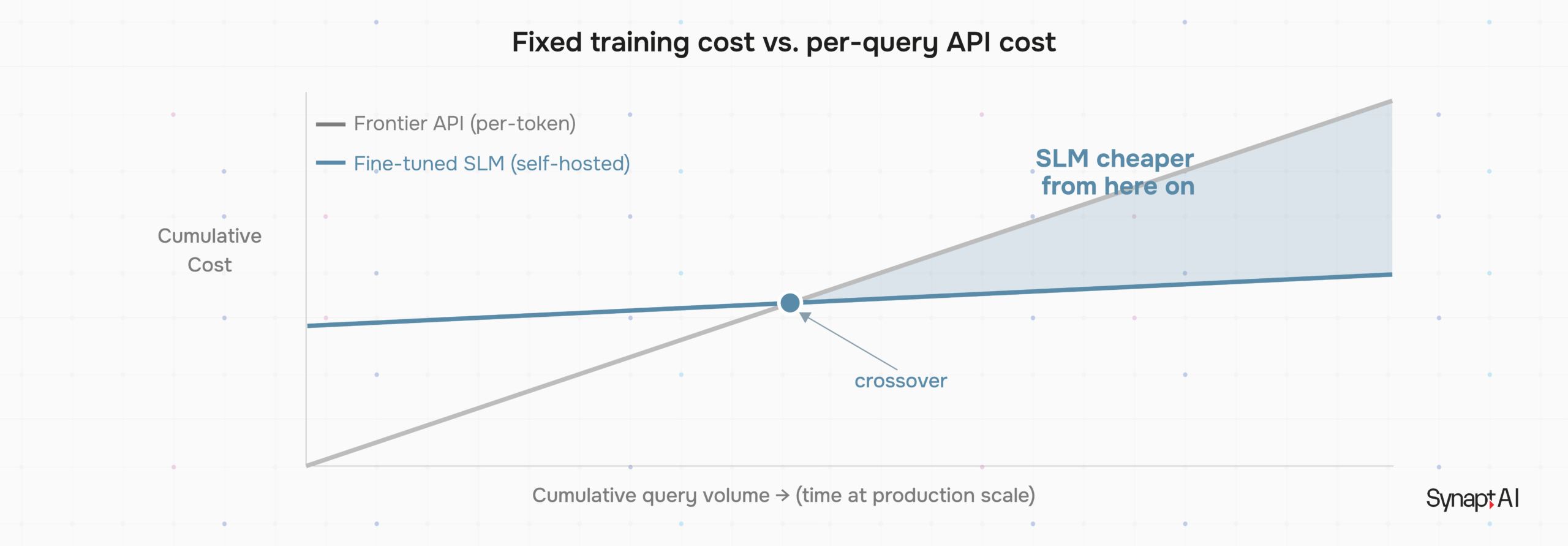 Figure 7 — Upfront training cost is fixed; per-query API cost compounds. At scale, the lines cross fast.
The 10x latency swing from the second study isn’t just user experience – it means the same infrastructure handles ten times the requests. Fine-tuning adds fixed upfront cost: data, training compute, evaluation, deployment. But per-query cost after that is a fraction of a frontier API’s per-token charge. For any task at meaningful scale – and tasks worth automating tend to run at scale – the crossover point isn’t a distant hypothetical. It’s months, sometimes weeks.
At the scale of a continuous deployment, the choice between a self-hosted fine-tuned model and a frontier API call is what decides whether the project survives an annual budget review – the same economics that make token efficiency the defining constraint of enterprise agent deployments.
What should enterprises do differently?
Stop asking “how big is the model?” and start asking “does it know my job?” The industry spent years building the intuition that bigger models are better models. That’s true across diverse benchmarks and open-ended problems. But most enterprise problems are specific, with known inputs, defined outputs, and criteria that live in internal documents rather than public benchmarks. For those, the capable generalist loses to the precise specialist. Three independent groups found it across three different tasks, without trying to make the same point. That’s not a coincidence – it’s the shape of how specialization works.
Knowing the job has two parts, and fine-tuning solves only one of them. It answers static knowledge – the schemas, grammars, and rubrics that change slowly. But much of what an enterprise agent needs is live operational knowledge – the state of systems, customers, and policies right now, which changes far too often to retrain into weights. There are three broad ways to give a model job knowledge, and they solve different problems
For a deeper comparison of the retrieval-side options, see how knowledge graphs, RAG pipelines, and context platforms differ.
| Approach | Where job knowledge lives | Best for | Limits |
| Frontier model + prompting / RAG | Public training corpus + documents retrieved at query time | Open-ended reasoning; tasks you can’t anticipate | Can’t learn org-specific decision rules; doesn’t enforce output structure; per-token cost compounds at scale |
| Fine-tuned small model | Baked into the model’s weights via task-specific training examples | Bounded, repetitive tasks with stable structure and private, slow-changing knowledge | Needs training data coverage per output class; knowledge in weights goes stale as the business changes |
| Operational Intelligence Layer (Synapt AI) | A governed context substrate connecting AI agents to live enterprise data across legacy and operational systems — without migration | Live operational knowledge that changes too often to retrain into weights; works model-agnostically with frontier or fine-tuned models |
|
The most valuable enterprise AI isn’t necessarily the model with the most parameters. It’s the system that knows your job best – a specialized model that knows the task, grounded in a context layer that knows the moment. That combination matters because most enterprise AI failures trace back to context quality, not model capability.
FAQ's
Because each was optimized for a narrowly defined enterprise task with a clear schema, proprietary knowledge, and structured outputs. The larger models brought general capability; the smaller models brought exact knowledge of what the task required – and for bounded tasks, that knowledge matters more than scale.
On well-defined tasks, yes. In one of the studies discussed here, a Mistral 7B model fine-tuned on 68,000 of a company’s own natural-language-to-code pairs matched or beat GPT-4 with retrieval on accuracy – while answering ten times faster (1.3 seconds vs 13.0 seconds median).
No. Frontier models – the largest, most capable general-purpose models available – remain the best choice for open-ended reasoning, broad knowledge, and tasks you can’t anticipate. Fine-tuned small models excel when the task is well-defined, repetitive, and grounded in private knowledge.
Retrieval-augmented generation supplies external documents at query time, but it cannot teach a model organization-specific decision-making or reliably enforce structured output formats. Fine-tuning embeds that knowledge directly into the model’s weights. It’s one reason the industry is moving beyond retrieval alone toward context infrastructure.
When the task has stable requirements, relies on proprietary knowledge that exists nowhere in public data, and runs frequently enough that gains in accuracy, latency, and cost per query justify the upfront training investment.
It depends on the task. In the studies discussed here, 5,000 labeled decisions were enough for a classification task, while a code-generation task used 68,000 examples. What matters most is coverage: every output category the model must handle needs enough examples to learn from.
A small language model is a language model compact enough to run on modest, self-hosted hardware – typically millions to a few billion parameters – and usually specialized for a defined task or domain rather than general-purpose conversation.

Subscribe to our newsletter
Insights on making enterprise AI actually work - straight to your inbox.
Subscribe to our newsletter
Insights on making enterprise AI actually work - straight to your inbox.