TL;DR
- Every telecom operator faces the dual mandate of moving faster and running tighter, but complexity in interconnected systems often becomes the hidden constraint.
- Liberty Communications of Puerto Rico (LCPR) embedded Anthropic Claude across IT delivery and operations, creating role-based AI personas that work alongside architects, developers, QA engineers, and operations teams.
- By adopting the principle “Claude drafts, experts own,” LCPR maintained governance and accountability while accelerating work across design, engineering, testing, deployment, and operations.
- The program delivered a 14% productivity uplift across the delivery lifecycle, with specific gains: 46% faster design cycles, 70% faster test authoring, and deployment recovery time reduced from 30 minutes to under one minute.
- Telco leaders must shift from treating AI as a separate tool. It must be woven into the operating model itself to unlock the speed and quality required in today’s demanding market.
How Complexity Compounds When Operating Models Don’t Evolve?
Every telecom operator is now being asked to do two things at once: move faster and run tighter. Customers expect new digital services and seamless self-service on demand. Margins leave no room for revenue leakage, rework, or slow recovery when systems fail. And behind every one of those expectations sits the same engine: how quickly and safely technology teams can change a complex, interconnected estate.
For Liberty Communications of Puerto Rico (LCPR), part of Liberty Latin America (LLA) and one of the region’s leading connectivity and entertainment providers, accelerating that transformation became a strategic priority. Building on a long-standing partnership that helped establish Liberty Puerto Rico’s greenfield digital ecosystem, Prodapt worked with LCPR to unlock the next phase: transformation through AI.
LCPR’s modernized technology landscape had improved capabilities, but delivery speed remained constrained by the complexity of its digital ecosystem. A single customer-facing change could traverse Salesforce (CRM), billing, charging, rating, payments, logistics, inventory platforms, and numerous third-party systems, along with the integration layers that connected them.
Every feature must work across every one of those layers, and the effects showed up across the business:
| Impact Area | Current State | Business Risk |
| Feature lead times | Stretched into months | Delayed digital self-service and lost revenue |
| Quality assurance | 40–50% of delivery timeline | Manual, multi-tier validation across systems |
| Revenue leakage | Recurring through CRM-to-billing sync failures | Missed instalments, dropped discounts, unmonitored credits |
| Incident resolution | Time-consuming log stitching | Extended downtime during peak periods |
| Engineering capacity | Lost to reverse-engineering and boilerplate | Limited time for high-value work |
The challenge was not headcount, but time needed to understand a deeply interconnected system before anyone could safely change it. Capacity scales cost in a straight line. Complexity grows faster. LCPR needed a way to make expertise go further.
The Vision: AI Inside the Operating Model, Not Beside It
Prodapt and LCPR agreed early on what they would not do: hand out licenses, run a few demonstrations, and hope adoption followed. Instead, they set three business objectives:
- Compress time-to-market across the full lifecycle, not just coding
- Protect revenue by finding billing and provisioning discrepancies before customers or auditors do
- Turn institutional knowledge into a reusable asset available to every team
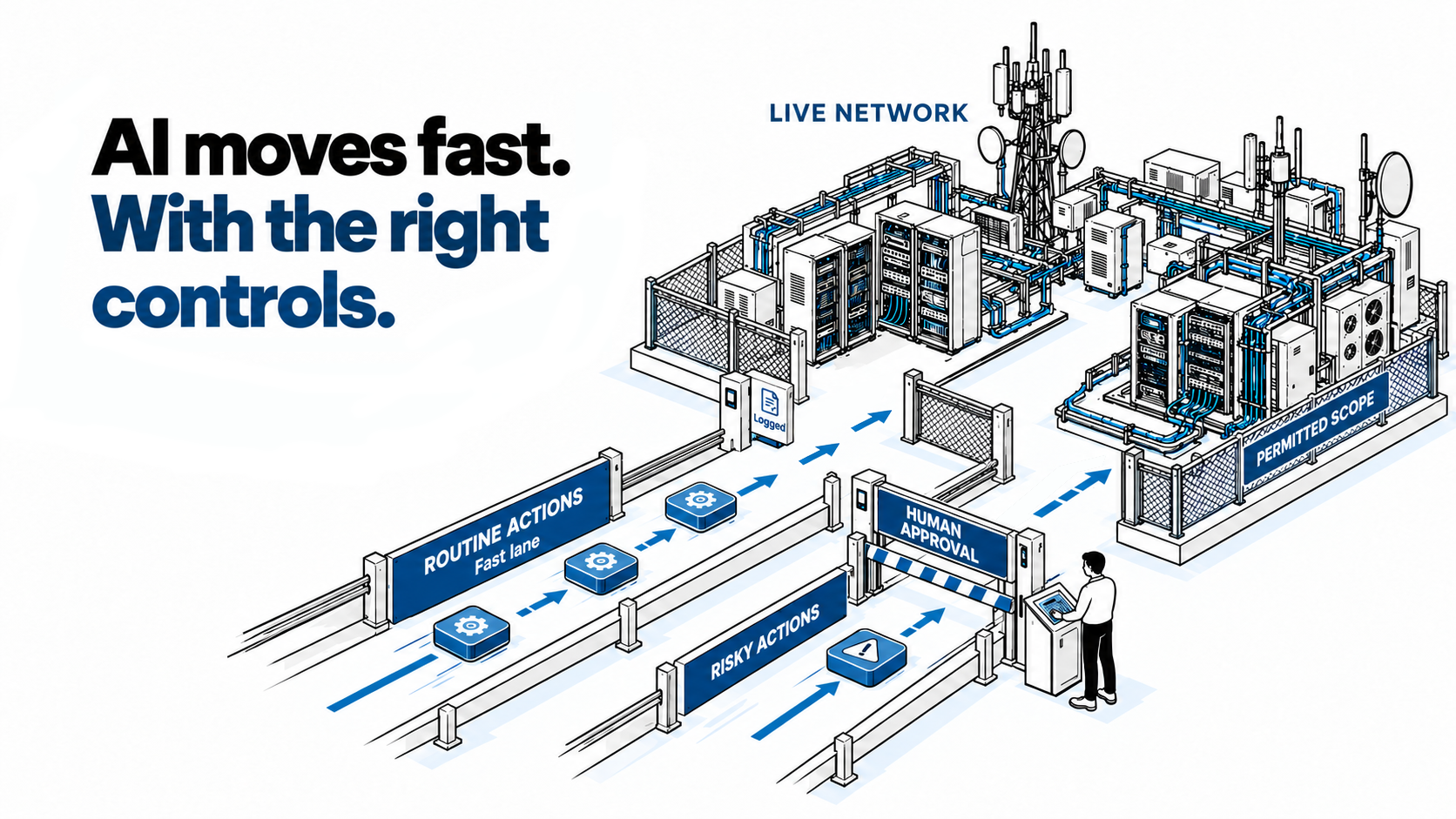
One principle guided every decision: Claude drafts, experts own.
Architects stay accountable for designs, developers for code, and QA leads for sign-off. AI speeds up the work without weakening the controls that keep a telco’s core systems stable.
By embedding Claude across the IT delivery and operations lifecycle, LCPR began reimagining how technology work gets done, from the first requirement to the final production incident, with Anthropic’s Claude serving as the intelligence layer at the center of every stage.
The Human-AI Operating Model powered by Claude
To accelerate execution at scale with quality intact, Prodapt embedded role-based Claude personas across the entire LCPR delivery lifecycle, from requirements and design to engineering, testing, releases and operations. Claude became a digital teammate, working alongside business analysts, architects, developers, testers and support teams.
Design and architecture:
Every change to the LCPR platform required analysis across Salesforce, integrations, and downstream billing and charging systems before development could begin. Prodapt embedded Claude while keeping architects in control of every design decision.
- Early scope validation: An architect opens a PIR/PCCK in VS Code and asks Claude to start. Claude pulls the Jira ticket and linked Confluence pages, restates the requirement and acceptance criteria, and flags gaps before any code is written.
- End-to-end impact analysis: Claude traces every linked flow across Salesforce, OmniStudio, integrations, APIs and downstream platforms, so dependencies are visible before build begins.
- Automated design drafts: Jira automation produces draft low-level designs from approved PIR/PCCK requirements and existing Confluence design references.
- Expert-owned sign-off: Technical Architects review, refine and approve every design, cutting solutioning effort by 46%.
Engineering Execution:
A single LCPR feature rarely lives in Salesforce alone. It spans Apex, Lightning components, OmniStudio flows, CPQ configuration and integrations, and every piece must fit the rest. Claude guided developers through each build phase with context-aware, standards-enforced execution.
- Standards-First Development: Claude Code works alongside developers in VS Code, guided by a version-controlled project playbook that encodes LCPR’s standards, deployment sequence and known org behaviours.
- Baseline first: Before changing a file, Claude compares the local branch with the QA and UAT orgs, so every build starts from what is actually deployed.
- Build from the context pack: Working from the approved design and its Implementation Context Pack, it creates or extends Apex classes, LWCs, OmniScripts, DataRaptors, Integration Procedures and CPQ configurations, without re-reading tickets.
- Zero compromise on Quality: Every Apex change comes with test classes and passes automated code scanning for security and coding standards before it is marked done.
- Human in the loop: Deployment commands are prepared but never run without explicit developer approval.
- Efficient workflow: With repetitive build work handled, developers spend their time reviewing and refining, and deliver faster with greater consistency and quality.
- Regression impact mapping: A Regression Impact Radar maps each new requirement to the B2C regression scenarios it affects, so testing targets real risk.
- Automated UI testing: An automated browser test harness validates Lightning components end to end.
- Data on demand: No test data is no longer a blocker. Claude creates rule-compliant test records, or retrieves them from other environments under governed read-only access, and runs new code against realistic scenarios.
Quality engineering:
Testing was one of the biggest bottlenecks in LCPR’s delivery lifecycle, often consuming 40-50% of the overall timeline. Here’s how Claude addressed it –
- Shift-left testing: Claude generates test scenarios and end-to-end validations across Salesforce, Billing, Rating, and other impacted systems.
- Targeted regression: Coverage is automatically mapped to impacted components and business use cases.
- Simulation where data falls short: When a lower environment doesn’t have proper data, Claude runs flows as a simulation, using data from UAT, so components can be tested without waiting for the proper data setup in lower Org.
- Faster SIT execution: Claude automates test data creation, reducing B2B SIT test data preparation from 40 minutes to 15 minutes.
Release management:
Go-live often exposed issues that were difficult to detect earlier, from scope gaps to deployment failures across interconnected systems. Here’s how deployment reliability was ensured.
- Earlier risk detection: AI-powered validation identifies scope and configuration gaps before release.
- 96% less release effort: Automated OmniScript activation and deactivation eliminate manual intervention and prevent sequencing-related deployment failures.
- Smarter CPQ operations: Automated job execution and monitoring eliminate pricing risks, remove off-hours dependencies, and save 43+ hours annually.
- Faster recovery: Deployment recovery dropped from 30 minutes to under one minute, improving release reliability.
Operations and revenue assurance:
Running LCPR’s operations required balancing speed and revenue protection across complex systems.
- Faster root cause analysis: Claude-assisted investigations trace incidents across CSR, Salesforce, orchestration, and billing systems.
- Proactive revenue assurance: A Disconnect Validation Suite checks orders across all impacted platforms and enables one-click remediation.
- Operational efficiency: Automated validation saves two hours of effort daily while surfacing potential revenue leakage earlier.
The Impact – Enterprise-Wide Transformation
What started as an effort to improve productivity quickly became a catalyst for broader business transformation. Claude was adopted across every development team, delivering measurable gains in speed, quality, and operational performance.
- Faster solutioning: Delivery planning accelerated by 46%, with draft LLDs auto-generated from approved requirements and refined by Technical Architects before sign-off.
- Scaled engineering capacity: AI became part of everyday delivery across Salesforce, OmniStudio, CPQ, and integration development.
- Quality without the bottleneck: Test authoring accelerated by 70%, B2C regression automation reached 100%, and B2B SIT test-data preparation dropped from 40 minutes to 15 minutes.
- More predictable releases: Deployment recovery time fell from 30 minutes to under one minute, while recurring release failures were eliminated.
- Smarter operations: AI-assisted incident investigations helped teams identify issues and revenue-impacting discrepancies faster.
- Measurable business value: The program delivered an overall 14% productivity uplift across the delivery lifecycle.
“Every telco is experimenting with AI. The harder question is whether it changes how the organization actually works. What we’ve built with Prodapt goes beyond a set of AI tools. It’s a new operating rhythm, where Claude handles the heavy lifting and our people apply the judgment.”
— Asad Nabi, Chief Information Officer, Liberty Communications of Puerto Rico
From Operational Transformation to Enterprise AI Leadership
By architecting a modernized delivery lifecycle, Prodapt is now on the right track to scale AI adoption across LCPR, strengthening its AI-first enterprise leadership.
- Increase productivity beyond 14% through deeper AI adoption across delivery teams
- Extend AI code reviews to every feature request, improving quality and consistency
- Scale AI-generated requirements and solution designs across the delivery lifecycle
- Expand test-data automation across B2B and B2C use cases, reducing SIT execution effort by up to 60%
- Advance predictive revenue assurance through earlier anomaly and leakage detection

Subscribe to our newsletter
Insights on making enterprise AI actually work - straight to your inbox.
Subscribe to our newsletter
Insights on making enterprise AI actually work - straight to your inbox.