TL;DR
- Context quality, not model size, is the primary driver of enterprise AI accuracy in production systems.
- A four-stage small-model pipeline — proxy, retrieval/reranking, confidence gating, generation — can replace “just use a bigger model” as the default architecture.
- SlimPLM (Tan et al., ACL 2024) is a verified, citable example: a small proxy model detects what a large model doesn’t know, so retrieval only happens for real gaps.
- Once the context layer does the heavy lifting, the generating model becomes a swappable, replaceable component rather than the whole system.
Straight answer to the title, No! – a bigger AI model does not reliably perform better than a smaller one for enterprise use cases. For most production workloads, the quality of the context supplied to the model determines accuracy more than the model’s parameter count does.
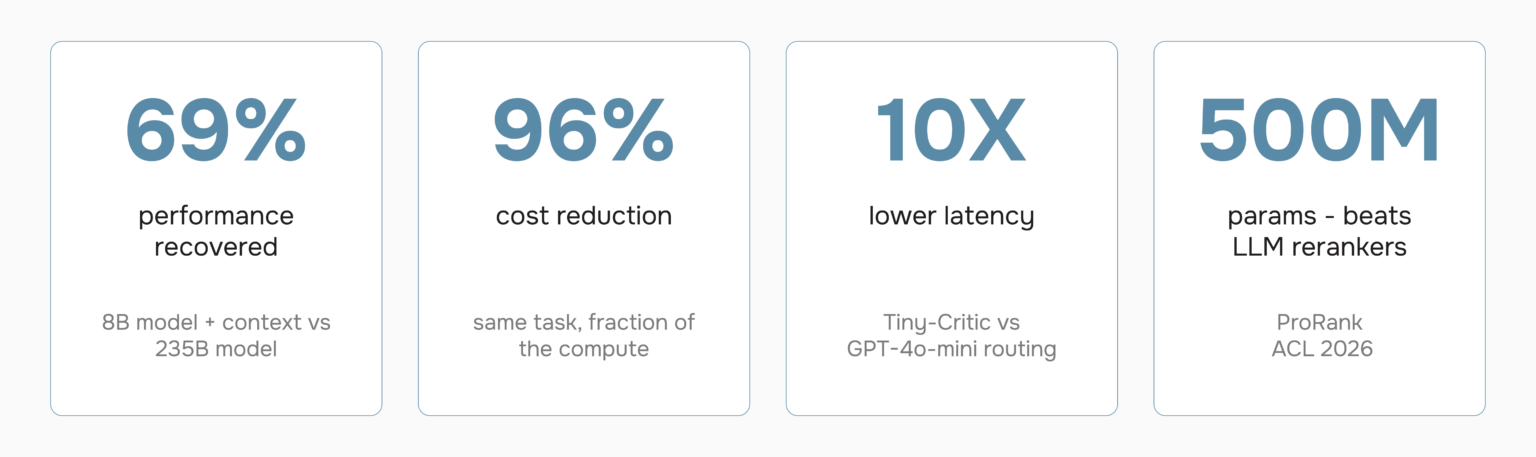
Context quality, not model size – is the primary driver of enterprise AI accuracy. Research shows an 8-billion-parameter model paired with well-curated, confidence-scored context recovers 69% of a 235-billion-parameter model’s performance, at 96% lower cost.
For most enterprise AI workloads, investing in the context layer beats investing in a bigger model.
What Is the “Bigger Model” Assumption, and Why Is It Wrong for Enterprise AI?
The default assumption in enterprise AI goes something like this: better models produce better results. If your agents aren’t performing, upgrade to a larger model. If GPT-4 isn’t cutting it, wait for GPT-5. If your 7B model struggles, switch to the 70 B model.
A context layer is the infrastructure that sits between raw enterprise data and an AI agent, deciding what information to retrieve, scoring its reliability, and delivering only pre-verified facts to the model.
| This assumption is wrong for most enterprise AI workloads. The quality of context fed to a model matters more than the size of the model processing it. |
A growing body of research demonstrates that for production systems, an 8-billion parameter model with well-curated, confidence-scored context recovers 69% of a 235-billion parameter model’s performance — at 96% lower cost. A 500-million parameter reranker outperforms full-scale LLM rerankers. A 1.7-billion-parameter gatekeeper matches GPT-4o-mini at 10 times lower latency.
The implication is architectural: instead of investing in ever-larger models, enterprises should invest in the context layer — the infrastructure that sits between raw data and the agent, deciding what information to retrieve, scoring its reliability, and delivering only pre-verified facts. This mirrors a parallel shift happening on the model side itself — see Why Small Language Models Are Eating Enterprise AI for evidence that purpose-built small models are already outperforming general-purpose LLMs on defined enterprise tasks.
APPROACH 1 — THE PROXY MODEL
How Does a Small Proxy Model Reduce Retrieval Costs? (SlimPLM)
A proxy model in this pipeline is a small language model that answers a query first, so the difference between its answer and the knowledge the task requires reveals what the larger model is missing. It is worth distinguishing from proxy-based chunking structures such as Proxy-Pointer RAG, which use metadata-enriched pointers to represent document sections and reduce cost at the indexing stage rather than the retrieval-decision stage. Both reduce token spend; one decides whether to retrieve, the other decides how documents are represented once retrieved.
Retrieval-Augmented Generation (RAG) is a technique where a model’s answer is grounded by documents fetched from an external knowledge source at query time, rather than relying only on what the model memorized during training.
For a deeper breakdown of how RAG differs from knowledge graphs and full context platforms, see Knowledge Graphs vs. RAG vs. Context Platforms — What’s the Difference?
The most intuitive demonstration of context over compute comes from SlimPLM (ACL 2024). Before asking a large model a question, first ask a small proxy model the same question. The proxy’s answer won’t be perfect — that’s the point. By comparing the proxy’s heuristic answer against expected knowledge, you can identify exactly what the large model is likely to be missing.
This gap detection enables targeted retrieval. Instead of blindly retrieving documents for every query, the proxy identifies the specific knowledge gaps and fetches only what’s needed. The downstream LLM processes less irrelevant context, and answer quality improves because the retrieved information is precisely targeted.
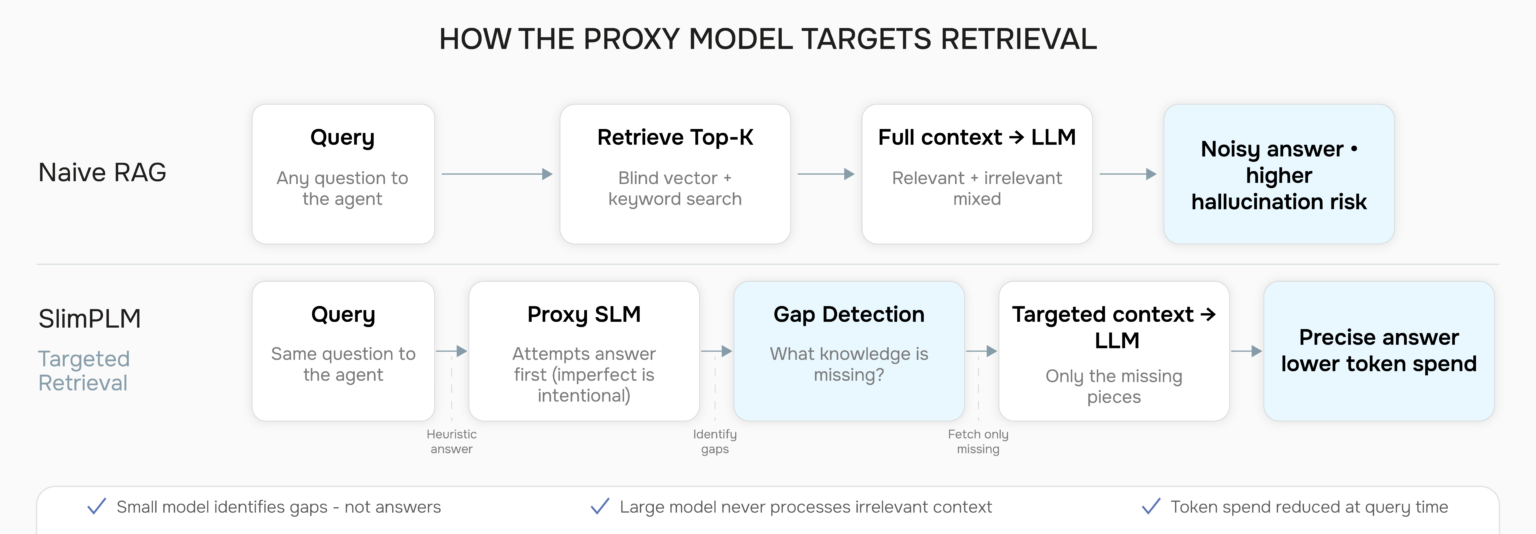
Figure: SlimPLM gap detection: Naive RAG passes noise to the LLM; the proxy model identifies only what’s missing and retrieves that alone
SlimPLM is a retrieval strategy in which a small proxy language model generates a heuristic answer first, and only the knowledge it fails to cover is retrieved – published by Tan et al. at ACL 2024.
| The elegance is in the division of labour: the small model doesn’t need to answer correctly — it needs to reveal what’s absent. The large model doesn’t need to search — it receives exactly what it needs. |
For enterprise deployments, this has immediate economic implications. Every token of context sent to a large model costs money. A proxy model that filters and targets retrieval reduces the context window the large model processes, which directly reduces token spend per query. At enterprise scale — millions of agent queries per day — the savings are measured in the kind of numbers that make FinOps teams pay attention.
How Do You Reduce LLM Costs Without Downgrading to a Worse Model?
You reduce LLM costs without downgrading the model by cutting how many tokens reach it, not by cutting the model’s capability. Four levers do this, and they compound in a specific order – the tactical ones are quick to deploy but plateau, while the architectural one keeps returning savings as query volume grows.
- Prompt caching stores recurring system prefixes and reference documents so repeated context is not re-billed on every call.
- Semantic caching goes further and stores past request-and-response pairs, matched by vector similarity, so near-duplicate questions bypass the model entirely.
- Prompt compression strips low-value filler from context windows before sending, and minifying JSON payloads removes whitespace and redundant structure.
- Batch APIs trade latency for cost on non-urgent background jobs. Output token limits cap runaway generation on tasks where the answer should be short.
Each of these is worth doing. All of them share one ceiling: they make the same volume of context cheaper to send, rather than reducing how much context needs to be sent at all. Once caching is warm and payloads are minified, the remaining spend is structural – it is determined by how much material the retrieval step hands to the model in the first place.
That is what the context layer changes. A proxy model that identifies which knowledge is actually missing means retrieval fires for real gaps instead of every query. A reranker orders candidates so fewer documents need to be passed. A confidence gate stops insufficient context from reaching the model at all, which removes both the token cost and the hallucination risk of a wasted call. The generating model stays exactly as capable as before – it simply receives less, and better, material.
How LLM cost-reduction approaches compare?
| Approach | What it reduces | Deploy effort | Ceiling |
| Prompt caching | Cost of re-sending identical context prefixes | Low – provider feature | Only helps on repeated prefixes |
| Semantic caching | Model calls for near-duplicate queries | Medium – needs a vector store | Requires query repetition to pay off |
| Prompt compression / payload minification | Token count of the context sent | Low | Compression is lossy past a point |
| Batch APIs | Unit price on non-urgent jobs | Low | Unusable for interactive workloads |
| Model routing | Cost of using a frontier model for simple queries | Medium | Routing errors degrade quality |
| Synapt AI – Operational Intelligence Layer | How much context needs to be retrieved and sent at all | Higher – architectural | Scales with query volume rather than plateauing |
Synapt AI is a governed context substrate that connects AI agents to live enterprise data, sitting between legacy enterprise systems and operational data and the agents that reason over them – without migration. Because the layer is model-agnostic, the generating model stays a replaceable component while the context infrastructure remains stable.
How Does Confidence Gating Stop an AI Agent From Hallucinating on Bad Context?
Confidence gating is a binary check — usually run by a small classifier model — that decides whether retrieved context is sufficient before it reaches the model generating the final answer.
Tiny-Critic RAG answers the question of retrieval quality with a 1.7-billion parameter Qwen model fine-tuned via LoRA to make a single binary decision: is the retrieved evidence sufficient to answer the query? Yes or no. Pass or retrieve more.
LoRA (Low-Rank Adaptation) is a fine-tuning method that trains a small set of added parameters instead of the full model, making it cheap to specialize a small model for one narrow task.
The results are striking. This tiny gatekeeper achieves routing accuracy comparable to GPT-4o-mini — while running at ten times lower latency. Constrained decoding (output only YES or NO) and non-thinking inference modes (skip chain-of-thought for binary classification) eliminate unnecessary overhead entirely.
In a production pipeline, this gatekeeper sits after retrieval and before the agent LLM. The agent LLM never sees a query with insufficient context — which means it doesn’t hallucinate from missing information.
Context quality recovers 69% of a 30×-larger model’s performance
A study on persistent AI agents compared an 8-billion parameter model augmented with retrieved context against a 235-billion parameter model — roughly a 30x size difference. The result: the 8B model recovered 69% of the 235B model’s performance at 96% cost reduction. The study also found that 47% of production queries are semantically similar to prior interactions, meaning nearly half of all queries can be served from cached context.
| “Memory, rather than model size, is the primary driver of accuracy.” The real question when evaluating model size is whether your context infrastructure is good enough — not which model is smarter. |
Why Can a 500-Million-Parameter Reranker Outperform a Full LLM Reranker?
A reranker is a model that reorders a list of retrieved documents by relevance before they reach the generating model, so the most useful evidence appears first.
BEIR is a widely used benchmark suite for comparing retrieval and reranking models across a range of search tasks.
ProRank (ACL 2026) demonstrates that a 500-million parameter model trained with RL warmup followed by fine-grained relevance scoring surpasses powerful LLM rerankers on the BEIR benchmark. The RL warmup stage teaches the model to interpret ranking prompts before fine-tuning on graded relevance signals — with the right training approach, the size disadvantage disappears entirely.
At 500 million parameters, this reranker runs in single-digit milliseconds on modest hardware, fits any enterprise latency budget, and can be deployed fully on-premise.
How Much of a Large Model’s Performance Can a Small Model Recover With Good Context?
These four studies converge on a single principle: the smartest system is not the one with the biggest model — it’s the one with the best context infrastructure.
The pattern is a layered pipeline where every stage except final generation uses a small model:
- Proxy / gap detection — identifies missing knowledge, triggers targeted retrieval
- Retrieval + reranking — fetches and semantically orders candidate context
- Confidence gating — binary check that context is sufficient before passing to LLM
- Agent generation — produces the final response from pre-verified, pre-ranked context
How the four approaches compare?
| Approach | Model size | Role in pipeline | Reported result |
| Proxy model (SlimPLM) | Small LM (proxy) | Detects missing knowledge before retrieval | Improved end-to-end QA accuracy across 5 datasets vs. retrieve-every-time baseline (verified: ACL 2024) |
| Confidence gatekeeper (Tiny-Critic RAG) | 1.7B (Qwen + LoRA) | Binary check: is retrieved context sufficient? | Matches GPT-4o-mini routing accuracy at 10x lower latency |
| Reranker (ProRank) | 500M | Reorders retrieved candidates by relevance | Surpasses LLM rerankers on BEIR |
| Small model + good context vs. large model alone | 8B vs. 235B | Full response generation | 8B recovers 69% of 235B performance at 96% lower cost |
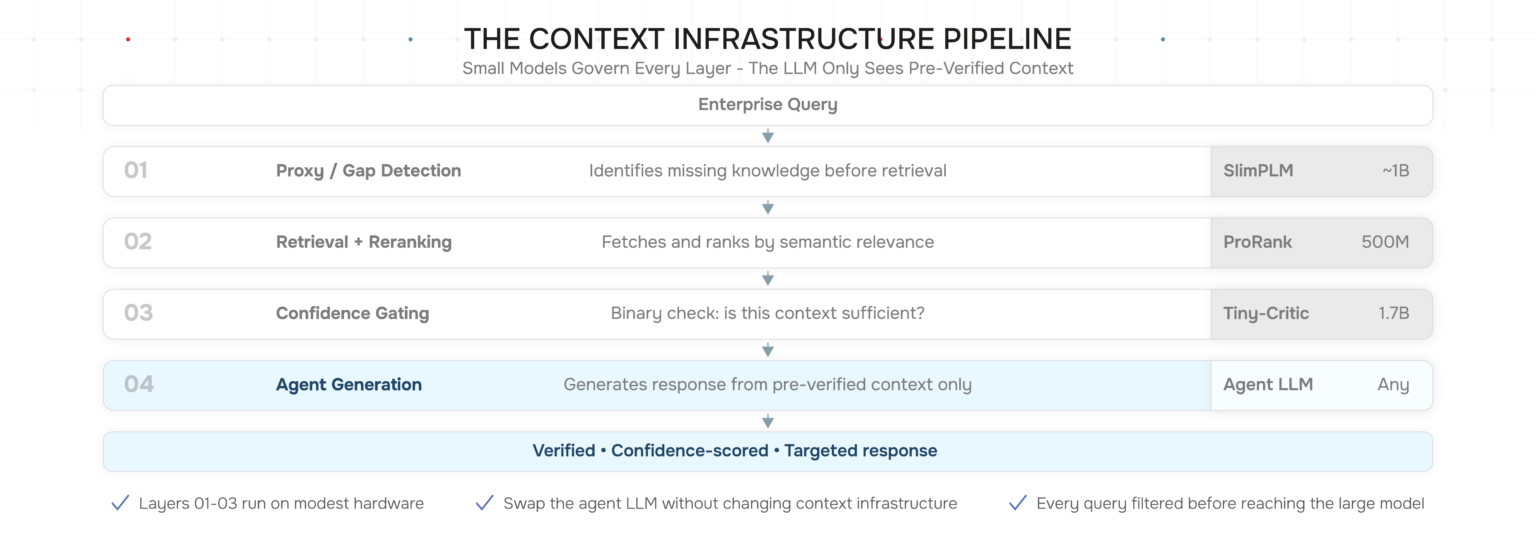
| This produces better results than giving a large model raw, unfiltered context — because large models are not immune to being misled by irrelevant retrieval. Pre-processing with specialised small models improves the large model’s output. |
What Are the Business Benefits of a Context-First Architecture for Enterprises?
Getting this layer wrong isn’t a minor inefficiency — it’s a leading reason enterprise AI projects stall before reaching production; see Why Enterprise AI Fails: The Hidden Context Problem.
The enterprise implications are concrete:
| Token spend drops | Targeted retrieval cuts the volume of tokens sent to the agent LLM. At $10–60 per million tokens for frontier models, this is a direct cost reduction measurable in millions of dollars at enterprise query volumes. |
| Latency improves | Small models running in milliseconds add negligible overhead while reducing the context window the large model processes. Shorter context = faster inference. |
| Data sovereignty becomes achievable | The proxy, reranker, and gatekeeper all run on modest hardware, so the entire context layer can be self-hosted on-premise. Regulated enterprises can keep retrieval, scoring and ranking inside their own boundary and send only the final generation step to a cloud API – or keep that in-house too. Where residency rules prohibit sending operational data to an external provider, a small-model context layer is often the only architecture that complies. |
| Model choice is flexible | Because the context layer is model-agnostic, enterprises can swap the agent LLM without rebuilding infrastructure. The context layer is the stable foundation; the generative model is a replaceable component. |
| The era of “throw a bigger model at it” is ending. Context, not compute, is the bottleneck. And small models are the ones building the pipes. |
When Does a Bigger Model Actually Make Sense for Enterprise AI?
A bigger model is the right choice when the task itself is open-ended rather than bounded. Context engineering cannot substitute for raw reasoning capacity, so three categories still favour scale:
- Open-ended reasoning across unfamiliar domains. When a task requires synthesising concepts the organisation has no documented knowledge of, there is no context to retrieve – the model has to reason from its own training. Multi-step planning over novel problems sits here.
- Broad multilingual and code-generation work. Wide-spectrum programming language coverage and high-fidelity translation across many language pairs benefit directly from parameter count, because breadth of training exposure is the capability.
- Exploratory and open-domain conversation. General-purpose assistants that field unpredictable questions cannot rely on a curated context set, because the query space is not bounded in advance.
The distinction is bounded versus unbounded work. Enterprise workloads – claims adjudication, invoice extraction, compliance review, incident triage, service assurance – are bounded: the correct answer exists somewhere in the organisation’s own systems. For bounded work, retrieving the right context beats reasoning harder without it. For unbounded work, the reverse holds.
FAQ's
No. For most production workloads, the quality of the context fed to the model matters more than its parameter count. A well-curated context layer can let a much smaller model recover a large share of a much larger model’s performance at a fraction of the cost — though the specific percentages cited in published research should be confirmed against the original source before being quoted.
A proxy model is a small language model asked a question before the main model, so its imperfect answer reveals exactly what knowledge the larger model is missing. SlimPLM (Tan et al., ACL 2024) uses this to target retrieval only at real gaps rather than retrieving documents for every query.
Confidence gating is a binary check, usually performed by a small classifier model, that decides whether retrieved context is sufficient before it reaches the model generating the final answer. If context is judged insufficient, the pipeline retrieves more instead of letting the large model guess, which is one way production systems reduce hallucination caused by missing information.
Reranking — ordering retrieved documents by relevance — is a narrow, well-defined task that doesn’t require general-purpose reasoning. A small model trained specifically for relevance scoring can be competitive with a general-purpose LLM on this one task while running at a fraction of the latency and cost.
Yes, in principle. Proxy, reranking, and gating models in the 500M–8B parameter range can run on modest on-premise hardware, so the context layer can be fully self-hosted while the enterprise calls a cloud API only for final response generation.
Yes. Because a context layer is built to work with any downstream model, enterprises can swap the generating model as better or cheaper options emerge without rebuilding the retrieval, reranking, and gating infrastructure around it.

Subscribe to our newsletter
Insights on making enterprise AI actually work - straight to your inbox.
Subscribe to our newsletter
Insights on making enterprise AI actually work - straight to your inbox.