TL;DR
- Prevent inconsistency by separating business facts from the language model. Product details, pricing, policies, and eligibility rules should come from governed enterprise sources, not model memory.
- Prevent hallucinations by validating every customer-facing claim against approved business systems before it is delivered.
- Prevent bias by basing recommendations on customer requirements and stated needs, not inferred personal characteristics.
- Define hard boundaries around what the AI is never allowed to do, and enforce those boundaries through systems rather than prompts.
- Maintain a governed context layer so business knowledge remains independent of the model and can be reused across AI agents and future model upgrades.
Customer-facing AI does not need to crash to create business risk. An AI assistant can provide different answers to the same question, present incorrect information with confidence, or make recommendations based on assumptions rather than verified customer data. When this happens, the issue is not just an AI error, it becomes a broken customer promise.
In many cases, the root cause is not the large language model itself. The real problem is allowing the model to access, interpret, and communicate information without clear governance and verification controls.
Three common risks affect customer-facing AI systems:
- Inconsistency: The AI provides different factual answers to identical or similar customer questions.
- Hallucination: The AI generates information that sounds credible but is inaccurate or completely fabricated.
- Bias: The AI treats customers differently based on inferred characteristics or assumptions instead of actual needs and verified data.
While prompt engineering can reduce these risks, prompts alone cannot eliminate them. Large language models generate responses probabilistically, which means instructions cannot reliably enforce every business rule, compliance requirement, or operational constraint.
A more effective approach is to clearly define what the AI can influence and what must remain governed by trusted systems, business rules, and validation mechanisms. Critical information such as pricing, eligibility, availability, and service commitments should always be verified before being presented to customers.
The telecommunications industry provides a practical example. When ordering home internet services, customers do not want to navigate complex product catalogs or compare technical specifications. They simply want a plan that fits their needs, accurate pricing, and a confirmed installation date.
To improve the experience, we replaced a traditional ten-screen ordering journey with a single conversational interface. However, simplifying the interaction is only valuable if the responses remain accurate, consistent, and fair. The following three controls demonstrate how organizations can reduce hallucination, inconsistency, and bias while delivering a more reliable customer-facing AI experience.
Control #1: Ensure Consistent Answers with Governed Facts
How do you ensure customer-facing AI provides consistent answers?
The key is separating factual information from the language model’s response generation.
Large language models generate responses by predicting the most likely next words. While this enables natural conversations, it also means the wording of an answer may vary between interactions. That variation is acceptable. What should never change are the underlying business facts.
For example, a customer asking about a home internet plan should receive the same plan name, speed, pricing, and availability regardless of how the question is phrased or when it is asked. Consistency in customer-facing AI is measured by factual accuracy, not by identical wording.
Some organizations try to reduce variability by lowering the model’s temperature. While this can make responses more predictable, it does not guarantee correctness. A language model can consistently generate the same wrong answer if it is not grounded in trusted business data.
Separate Communication from Truth
A more reliable approach is to assign different responsibilities to different layers of the AI system:
- The AI model determines how to communicate. It interprets customer intent and generates natural, conversational responses.
- A governed knowledge source determines what is true. It provides approved product information, pricing, eligibility rules, and business facts.
- A validation layer verifies accuracy and consistency. It ensures responses use approved data before information is presented to customers.
This architecture prevents business-critical information from depending on what the model happens to remember. Instead, facts are retrieved from authoritative enterprise sources at the time of interaction.
Why an Enterprise Context Layer Matters
Enterprise AI systems require more than retrieval alone. They need a governed mechanism that connects AI agents to trusted, traceable business knowledge.
Synapt Context Substrate addresses this challenge through a governed context layer that sits between enterprise systems and AI agents. Its Knowledge Store grounds responses in source-linked enterprise data, while freshness indicators and traceability controls help ensure agents work with current and verifiable information.
Consider a pricing update. When the cost of an internet plan changes, the AI should retrieve the latest approved price from the governed source rather than rely on information embedded in the model’s training data. This approach reduces the risk of outdated responses and improves business consistency.
Consistency Must Be Measured, Not Assumed
Grounding AI on trusted data is essential, but it is only part of the solution. Organizations should continuously test consistency by asking the same question across different phrasing patterns, channels, sessions, and time periods.
A useful validation question is:
Does the AI always return the same approved business facts, even when customers ask the question differently?
If the answer is no, the issue is not prompt quality. It is usually a problem with context governance, retrieval logic, or validation controls.
For customer-facing AI, consistency is achieved when the facts remain stable, the sources remain trustworthy, and the experience remains reliable regardless of how the conversation begins.
Control #2: Prevent Hallucinations Through Response Validation
How do you prevent customer-facing AI from making things up?
The most effective approach is to validate every factual claim before it reaches the customer.
AI hallucinations occur when a model generates information that sounds credible but is not supported by verified data. In customer-facing scenarios, this can quickly undermine trust and create business risk.
Consider a home internet ordering experience. An AI assistant might confidently describe a plan speed that does not exist, quote outdated pricing, or recommend a package that is no longer available. To the customer, these responses appear legitimate even though they are incorrect.
Prompting the model to “be accurate” is not enough. Reliability requires a validation process that checks factual claims against trusted business sources before any response is delivered.
Validate Facts Before They Reach the Customer
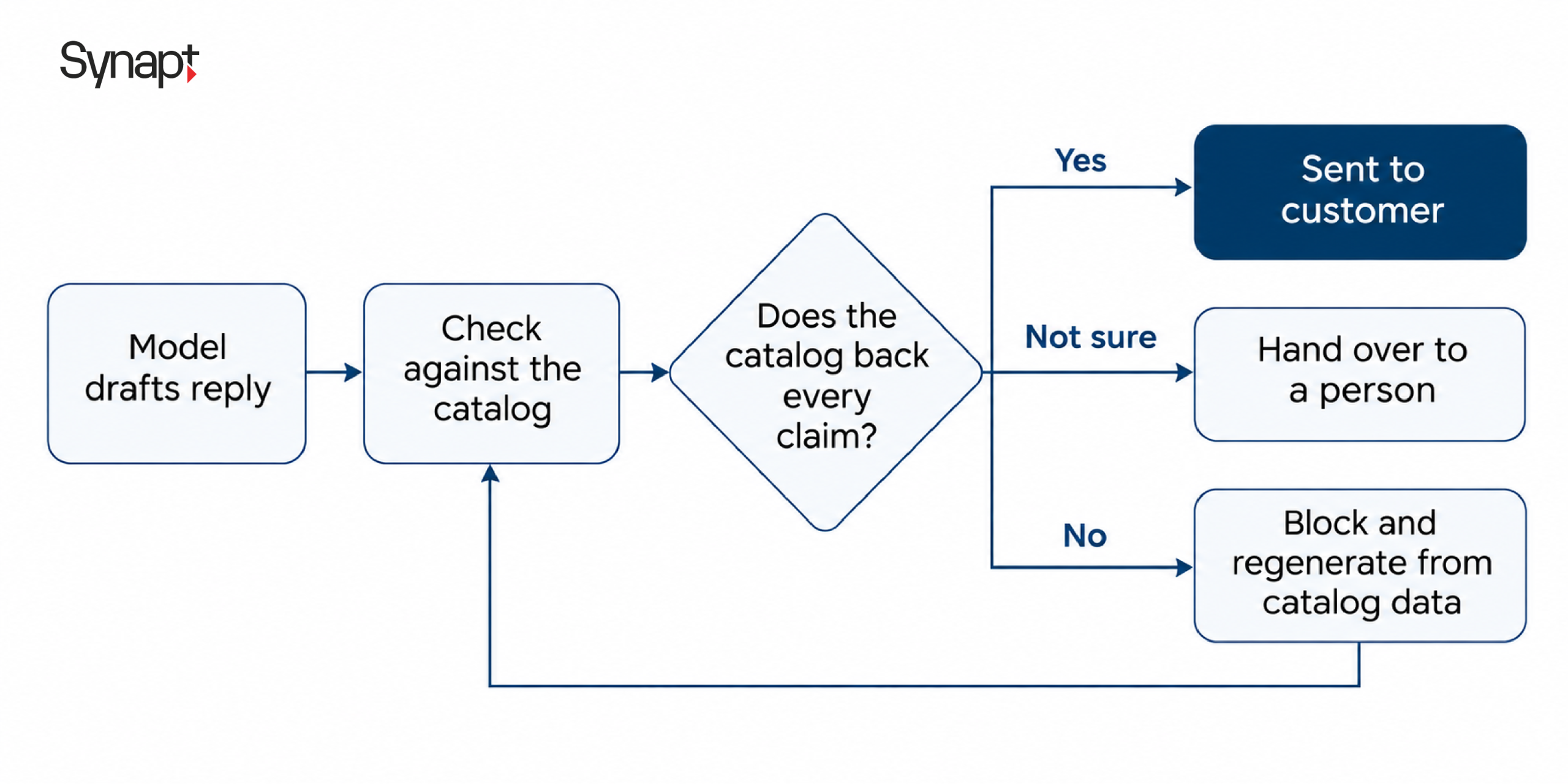
In a governed AI architecture, the model generates a draft response, but the system validates every business-critical claim before it is presented.
For a home internet ordering assistant, the process typically works as follows:
- The AI generates a response based on the customer’s request.
- The system validates plan names, internet speeds, pricing, and availability against the approved product catalogue.
- If all claims are verified, the response is delivered.
- If any claim cannot be validated, the response is rejected and regenerated using approved catalogue data.
- If certainty cannot be established, the conversation is escalated to a human agent.
The customer therefore receives information that has been verified against business systems rather than an unchecked model-generated response.
Block Unsupported Claims by Design
One of the simplest ways to reduce hallucination risk is to prevent the AI from making claims that cannot be independently verified.
For example, an assistant should not describe a plan as:
- The “best” option
- The “fastest” service
- The “cheapest” plan
- The “most reliable” choice
These are comparative judgments that may not be supported by authoritative business data.
Instead, the assistant should communicate only verifiable information:
- Internet speeds and pricing are presented exactly as listed in the product catalogue.
- Unsupported statements are blocked before they reach the customer.
- Uncertain information is escalated for human review.
- Installation appointments and technician availability are retrieved directly from scheduling systems.
This approach shifts the AI’s role from inventing answers to communicating validated information.
Confidence Is Not Accuracy
One of the biggest challenges with generative AI is that confidence and correctness are not the same thing. A hallucinated answer often sounds indistinguishable from a verified one.
For that reason, customer-facing AI systems should be designed around a simple principle:
If a claim cannot be verified, it should not be communicated.
When the system encounters uncertainty, the safest response is often the most trustworthy one.
A statement such as “Let me connect you with someone who can confirm that information” may introduce a short delay. However, providing inaccurate pricing, availability, or product details can result in lost orders, customer complaints, compliance issues, and long-term trust erosion.
Reliable AI systems do not eliminate uncertainty. They manage it by ensuring that only validated information reaches the customer.
Control #3: Reduce Bias by Grounding Recommendations in Customer Needs
How do you prevent bias in customer-facing AI recommendations?
The answer is to base recommendations on stated customer requirements rather than inferred personal characteristics.
Bias occurs when an AI system makes decisions using assumptions about a customer instead of information that is directly relevant to the problem being solved.
For example, a model may infer a customer’s income level, location, background, or purchasing power from conversational cues and allow those assumptions to influence product recommendations. Even when unintentional, this can lead to inconsistent treatment and reduced customer trust.
The solution is not simply instructing the model to be unbiased. Effective bias mitigation requires controlling which information can influence recommendations in the first place.
Constrain Recommendations to Relevant Inputs
Customer recommendations should be based only on information that is directly relevant to the customer’s needs.
In a home internet ordering experience, the assistant should focus on practical usage requirements such as:
- Number of people using the connection
- Types of online activities performed
- Areas of the home requiring coverage
- Required levels of bandwidth, latency, and reliability
These factors influence service suitability. Personal assumptions do not.
By restricting recommendations to relevant inputs, organizations create a more transparent and consistent decision process.
Recommend Based on Usage, Not Assumptions
Consider a household with four users:
- One child attends online classes from a basement study.
- Another participates in piano lessons via video conferencing.
- Two adults regularly join video meetings from upstairs offices.
The assistant evaluates these requirements by estimating the bandwidth, coverage, and reliability needed to support simultaneous activities. It then recommends an appropriate catalogue plan based on those operational requirements.
The recommendation is derived from the household’s stated usage patterns, not assumptions about income, neighborhood characteristics, demographics, or personal background.
Make Recommendations Explainable
Transparency is an essential control for reducing bias.
Customer-facing AI should explain why a recommendation was made so that both customers and businesses can understand the decision process.
For example:
“This plan was recommended because your household supports four concurrent video streams, two remote workers, and multiple devices operating across three floors.”
Providing reasoning creates an audit trail that allows recommendations to be reviewed, validated, and challenged when necessary.
If two customers with equivalent usage requirements receive different recommendations, businesses can compare the supporting rationale and identify where the decision process diverged.
Test for Fairness, Don’t Assume It
Bias mitigation is not a one-time configuration exercise. Recommendations should be continuously evaluated across equivalent customer scenarios.
A practical test is simple:
Do customers with the same stated requirements receive the same recommendation and reasoning?
If they do not, organizations should investigate whether unintended variables are influencing the outcome.
Trustworthy customer-facing AI does not rely on assumptions about people. It relies on validated requirements, explainable reasoning, and consistent decision criteria.
Define What Customer-Facing AI Is Never Allowed to Do
Reducing hallucination, inconsistency, and bias requires more than validating responses. Organizations must also establish clear boundaries that define what the AI can and cannot do.
This is a critical distinction in enterprise AI. Even a highly capable model should not have unrestricted authority to make commitments, interpret policies, or act beyond its intended scope.
For a home internet ordering assistant, these boundaries might include:
- It cannot describe a plan as the fastest, best, cheapest, or most reliable unless those claims can be objectively verified.
- It can communicate speeds, pricing, and product specifications only as approved in the product catalog.
- It cannot promise installation dates or technician availability beyond what scheduling systems confirm.
- It must identify itself as an AI assistant when requested.
- It must transfer billing disputes, complaints, and exception cases to a human agent.
- It must remain focused on internet plan selection and ordering, redirecting unrelated requests back to the supported workflow.
The most effective controls are enforced through system design rather than relying exclusively on prompts.
A prompt tells a model what it should do. A system rule defines what it is allowed to do.
That distinction becomes increasingly important as AI systems scale. Models can reinterpret instructions, overlook constraints, or generate unexpected outputs. Business-critical policies, compliance requirements, and customer commitments should therefore be enforced through governance controls that operate independently of the model.
Separate the Model from the Governed Business Context
Enterprise AI models will continue to evolve. Organizations will adopt newer foundation models, fine-tune existing ones, or switch providers entirely as capabilities improve.
If business knowledge exists only inside prompts or model behavior, every model change creates a new validation challenge. Product information, pricing rules, operational procedures, and compliance requirements must then be retested for every deployment.
A more sustainable approach is to separate business context from the model itself.
When enterprise knowledge is maintained outside the model, organizations can update AI capabilities without rebuilding or revalidating the underlying business facts.
In a governed architecture:
- The AI model interprets customer intent and generates natural-language responses.
- The enterprise context layer provides verified business facts, policies, and procedures.
- Governance and validation controls determine which responses, recommendations, and actions are permitted.
This is the principle behind Synapt Context Substrate. Rather than embedding business knowledge directly within prompts or model behavior, it introduces a governed context layer between enterprise systems and AI agents.
Its architecture combines three complementary stores:
| Component | Description | Key Features | Outcome |
| Knowledge Store | Maintains enterprise facts with source grounding, confidence scoring, freshness timestamps, and traceable provenance. | Source grounding, confidence scoring, freshness timestamps, traceable provenance | Provides trusted, up-to-date, and verifiable business knowledge that AI agents can use confidently in responses and decisions. |
| Procedure Store | Maintains governed workflows and standard operating procedures. | Version-controlled procedures, human approval checkpoints, governance gates, operational guardrails | Ensures AI agents follow approved business processes, remain compliant, and execute tasks consistently. |
| Context Graph | Connects enterprise entities and their relationships including customers, accounts, products, contracts, assets, and policies. | Relationship mapping, connected business context, entity linking, dependency awareness | Enables AI agents to understand the full business context, deliver more accurate recommendations, personalize interactions, explain decisions, and take context-aware actions. |
By understanding how these entities relate to one another, agents can make decisions using business context rather than isolated data points.
Together, these capabilities allow AI agents to operate using structured, governed enterprise knowledge instead of relying solely on model memory or prompt instructions.
The model may change over time. The governed business context should remain independent, traceable, reusable, and continuously maintained.
The Real Cost of Customer-Facing AI Failures
An incorrect response rarely ends when the conversation ends.
Customer-facing AI errors create downstream business costs that are often invisible when organizations focus only on model accuracy metrics.
A single unsupported claim can result in:
- Lost orders because customers received inaccurate information.
- Additional contact center volume to correct misunderstandings.
- Refunds, credits, or compensation costs.
- Escalations to customer support and compliance teams.
- Reduced customer confidence in future AI-assisted interactions.
These impacts affect customer acquisition, operational efficiency, and retention, even if the AI appears accurate according to technical benchmarks.
From a business perspective, the trade-off is usually clear.
Blocking an unsupported claim may require an additional validation step or a brief escalation. Allowing that claim to reach a customer can lead to lost revenue, service disputes, or damaged brand trust.
For that reason, customer-facing AI should be measured on more than language generation quality. Organizations should also evaluate whether the system:
- Communicates approved business information.
- Respects operational and compliance boundaries.
- Produces consistent customer outcomes.
- Maintains trust across interactions.
- Reduces business risk without increasing customer effort.
Replacing Ten Ordering Screens with a Single Conversation
The value of governed customer-facing AI extends beyond risk reduction. It can also improve the customer experience.
In the home internet ordering example, a traditional ten-screen onboarding process was replaced with a single conversational workflow.
The result was a measurable reduction in customer effort:
- Average onboarding time decreased from approximately 20 minutes to 12 minutes.
- This represents roughly a 40% improvement in ordering efficiency.
- Customers could explain their requirements conversationally rather than navigating multiple forms and screens.
Because the assistant operates using validated business information, the streamlined experience does not come at the expense of governance or control.
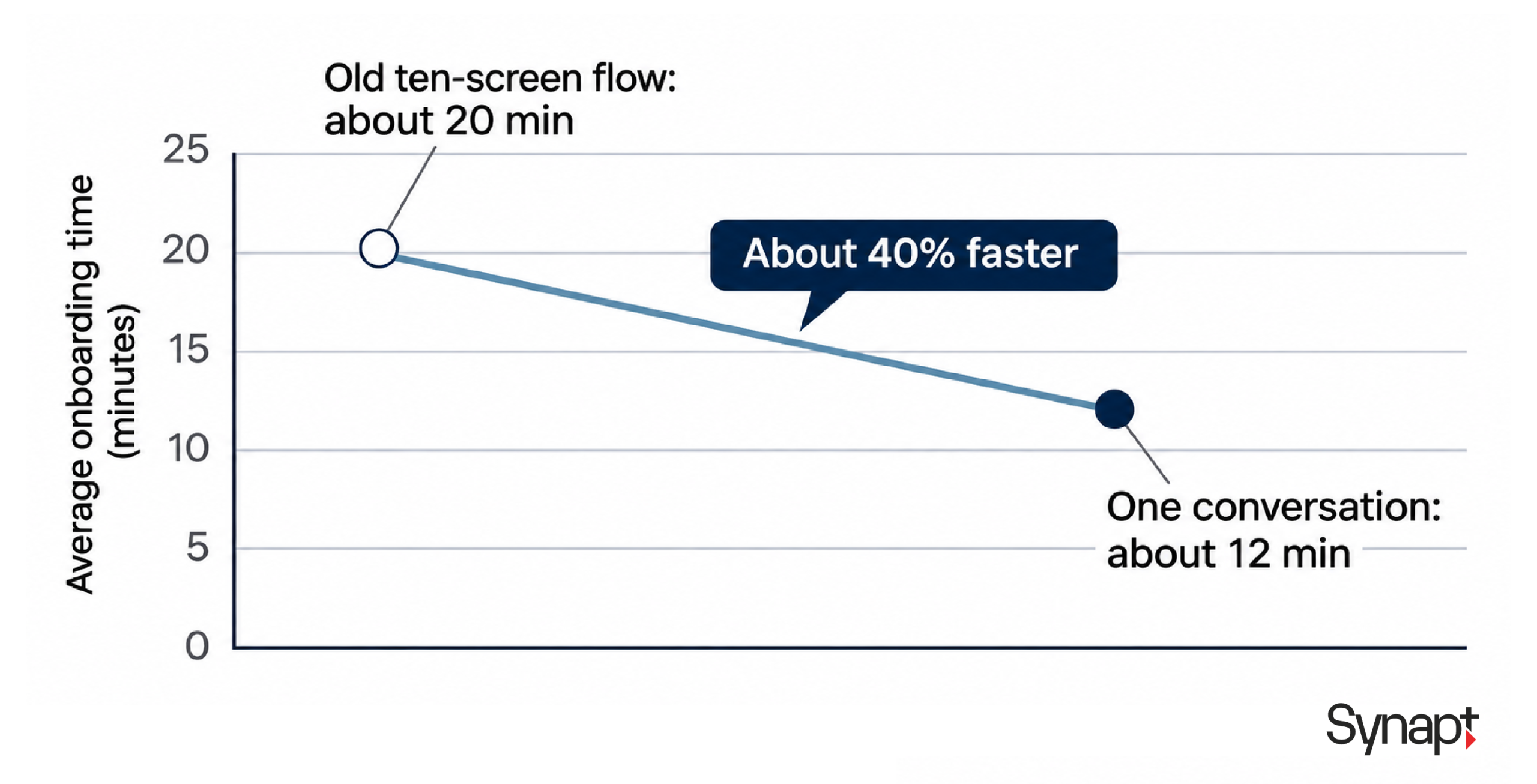
The business outcome is straightforward: customers complete orders more quickly while the organization retains control over pricing, availability, recommendations, and service commitments.
Bottom Line: Trust Depends on What Surrounds the Model
Customer-facing AI becomes trustworthy not because of the model alone, but because of the systems that govern how the model operates.
Reliable AI experiences require:
- Verified business facts.
- Response validation controls.
- Transparent recommendation logic.
- Clearly enforced operational boundaries.
The three controls discussed throughout this article address the most common sources of customer-facing AI failure:
| Risk | Control |
| Inconsistency | Ground business facts in governed enterprise sources rather than model memory. |
| Hallucination | Validate customer-facing claims before they are delivered. |
| Bias | Base recommendations on stated customer requirements rather than inferred assumptions. |
Together, these controls help organizations build AI systems that are more predictable, accountable, and trustworthy.
Ultimately, customer trust is not created by a model. It is created by the governance framework, validation processes, and enterprise context that surround it.
Before evaluating which model to deploy, organizations should answer a more important question:
Which parts of the customer experience should an AI system never be allowed to control?
The answer often determines whether customer-facing AI becomes a competitive advantage or a source of operational risk.
Looking to build more reliable customer-facing AI with governed business context, verified information and clear operational controls? Work with Synapt
FAQ's
Customer-facing AI hallucinations can be reduced by validating every factual claim against approved business systems before the response is delivered. Product information, pricing, availability, and policy details should always be verified rather than generated from model memory.
AI models generate responses probabilistically, which can lead to different answers across interactions. Consistency improves when business facts are retrieved from governed enterprise sources and validated before being presented to customers.
Organizations can reduce AI bias by restricting recommendations to relevant customer requirements, such as usage patterns, service needs, and operational criteria, while excluding inferred personal characteristics and assumptions.
Trustworthy customer-facing AI requires four key controls: governed business knowledge, response validation, recommendation governance, and clearly enforced operational boundaries that limit what the AI can say or do.
A governed context layer separates business knowledge from the AI model, providing trusted facts, procedures, and relationships that remain consistent across model upgrades, multiple AI agents, and evolving enterprise systems.

Subscribe to our newsletter
Insights on making enterprise AI actually work - straight to your inbox.
Subscribe to our newsletter
Insights on making enterprise AI actually work - straight to your inbox.