TL;DR
- An SLM can handle predictable, recurring tasks without invoking a larger model for every request.
- Complex requests and tasks that fail reliability checks are escalated to an LLM.
- The reusable SLM–LLM loop adds a continuous, team-led improvement process to conventional model routing.
- Teams decide which LLM-generated responses become training examples. This is not automatic self-training.
- Track LLM escalation rate, SLM resolution rate, answer quality, and total operating cost.
Yes, enterprises can potentially reduce large language model (LLM) costs over time by adopting an SLM-first architecture with LLM fallback and a team-led fine-tuning process. A small language model (SLM) handles routine requests first, while a larger model processes requests that exceed the SLM’s demonstrated capabilities.
Suitable responses generated by the LLM are reviewed, evaluated, and used as training examples to improve the SLM. As the smaller model becomes more capable of handling recurring tasks, fewer requests may need to be escalated to the LLM.
However, cost reductions are not guaranteed. Enterprises must maintain answer quality and account for training, evaluation, hosting, and infrastructure costs when measuring the overall economics of this approach.
Why Does Using LLMs at Scale Get Expensive?
Using large language models across enterprise applications can become expensive as request volumes increase. LLMs provide advanced language understanding and reasoning capabilities, but not every business request requires the same level of computational capability.
A large language model (LLM) is an AI model trained on extensive datasets to understand and generate language, perform complex reasoning, and support a wide range of tasks. A small language model (SLM) is a smaller model that can be adapted for specific tasks or domains, often with lower inference and deployment requirements.
Enterprise workloads generally contain two types of requests:
- Routine requests: Predictable tasks such as answering frequently asked operational questions, retrieving known procedures, and handling recurring incident queries.
- Complex requests: Tasks involving unfamiliar situations, multi-step reasoning, specialized domain knowledge, or decisions that require additional validation.
Sending every request to a large model can increase inference costs unnecessarily. On the other hand, relying entirely on a small model can affect response quality when requests exceed its capabilities.
This creates an important architectural question:
Can enterprises reduce their dependence on LLMs over time without compromising response quality?
One approach is to let an SLM handle requests first, escalate uncertain or unreliable responses to an LLM, and use suitable LLM outputs to improve the SLM through controlled fine-tuning.
The objective is not to eliminate large models. It is to reserve their capabilities for requests that genuinely need them.
For a broader comparison of model capabilities, trade-offs, and enterprise use cases, see Small Models vs. Large Models: Choosing the Right AI Strategy for the Enterprise.
The goal is not to replace large language models with smaller ones. It is to use large models when their capabilities are needed while enabling smaller models to handle more recurring tasks over time.
How Is the SLM–LLM Loop Different from Model Routing?
Model routing determines which AI model should handle a particular request. The reusable SLM–LLM loop extends this approach by adding a structured process for improving the smaller model using selected outputs from the larger model.
In conventional model routing, a system evaluates a request and directs it to an appropriate model based on factors such as complexity, expected response quality, and cost.
For example, Microsoft’s research paper, Hybrid LLM: Cost-Efficient and Quality-Aware Query Routing, explores a hybrid inference approach that routes queries between smaller and larger models based on predicted query difficulty and desired quality.
The reusable SLM–LLM loop builds on this principle. Instead of treating the LLM only as a fallback, it also treats suitable LLM-generated responses as candidate training examples for future SLM improvement.
| Aspect | Conventional model routing | Reusable SLM–LLM loop |
| Primary objective | Select the right model for the current request | Handle the current request and improve future SLM performance |
| Decision basis | Complexity, cost, and expected quality | Model routing plus a structured improvement process |
| Role of the SLM | Handles requests within its capabilities | Handles requests and improves through fine-tuning |
| Role of the LLM | Handles requests assigned to it | Handles escalated requests and supplies candidate training examples |
| Improvement process | Routing decisions may be updated independently | Evaluated examples can support successive SLM fine-tuning cycles |
The key difference is that model routing optimizes the current request, while the reusable SLM–LLM loop also creates a process for improving how future requests are handled.
What Components Make Up the SLM–LLM Architecture?
An enterprise SLM–LLM architecture consists of five main components: an orchestrator, a domain-specific SLM, an LLM fallback, a domain knowledge layer, and a training and evaluation pipeline.
Each component has a distinct responsibility in managing requests, maintaining answer quality, and improving the smaller model.
Orchestrator
The orchestrator manages the request flow and determines which model should process each request. It directs requests to the SLM first and manages escalation when reliability criteria are not met.
Domain-Specific SLM
The domain-specific SLM handles recurring requests that fall within its demonstrated capabilities. It is adapted to the requirements of a particular business domain or task.
LLM Fallback
The LLM handles requests that the SLM cannot reliably resolve. It provides the additional reasoning and language capabilities required for more complex or unfamiliar scenarios.
Domain Knowledge Layer
The domain knowledge layer supplies relevant enterprise information, business rules, and standard operating procedures (SOPs) to the LLM.
This layer helps the model work with organizational knowledge rather than relying only on its general training data.
For example, Synapt’s Context Substrate can serve as the domain knowledge layer, connecting AI agents to governed enterprise knowledge, procedures, and relationships. Through an MCP integration, the LLM can retrieve relevant organizational context when handling an escalated request.
This separation between the model and organizational knowledge is important. As enterprises adopt different models, the knowledge layer can remain independent of any specific LLM. Read more in Where Should Organizational Knowledge Live? Building AI Systems Beyond LLM Memory.
Training and Evaluation Pipeline
The training and evaluation pipeline prepares suitable LLM-generated responses as candidate training examples, supports SLM fine-tuning, and evaluates updated model versions before deployment.
Together, these components establish a system that balances model capability, enterprise context, response quality, and operating cost.
Governing the Agent Lifecycle
As enterprises expand from individual AI agents to multiple use cases, managing their lifecycle becomes increasingly important. Deployment alone is not enough. Organizations also need visibility into agent workflows, governance, observability, and operational spend.
Synapt Agent Hub addresses this lifecycle challenge by managing agents from definition and deployment through maintenance, with governance built into the process.
In an SLM–LLM implementation, this provides a complementary governance layer around the agents orchestrating model selection, escalation, and execution.
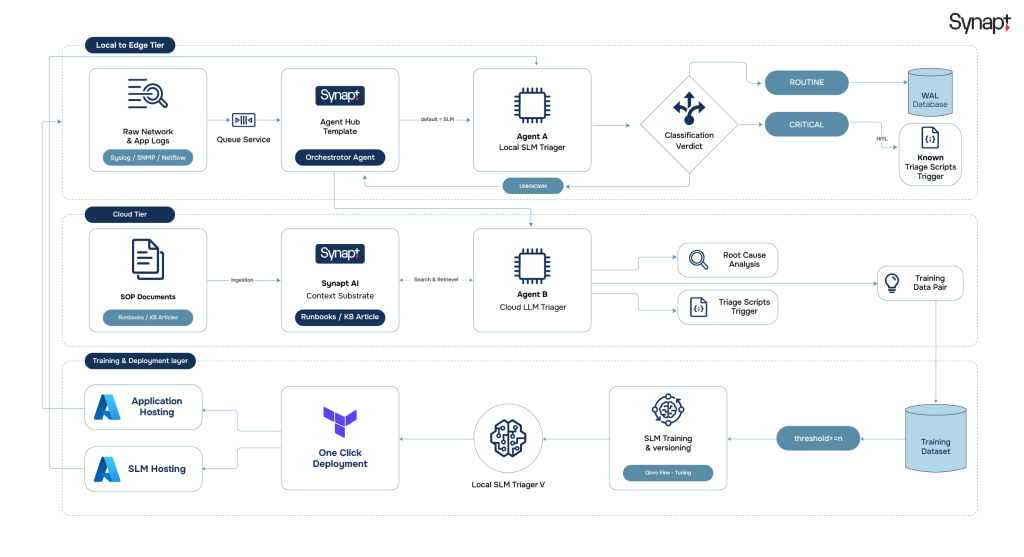
Proposed Architecture
The architecture can be understood in three layers:
Local-to-Edge Tier: Incoming logs reach a small local model (Agent A), which classifies requests as routine, critical, or unknown.
Cloud Tier: Unknown cases are escalated to a larger model (Agent B), which retrieves relevant company runbooks and procedures through the Context Substrate.
Training and Deployment Layer: Suitable LLM responses become candidate training pairs. After evaluation and human approval, the SLM is fine-tuned, tested, and redeployed.
HITL (human in the loop) indicates that a person must review or approve the relevant step before it proceeds.
How Does a Request Flow Through the System?
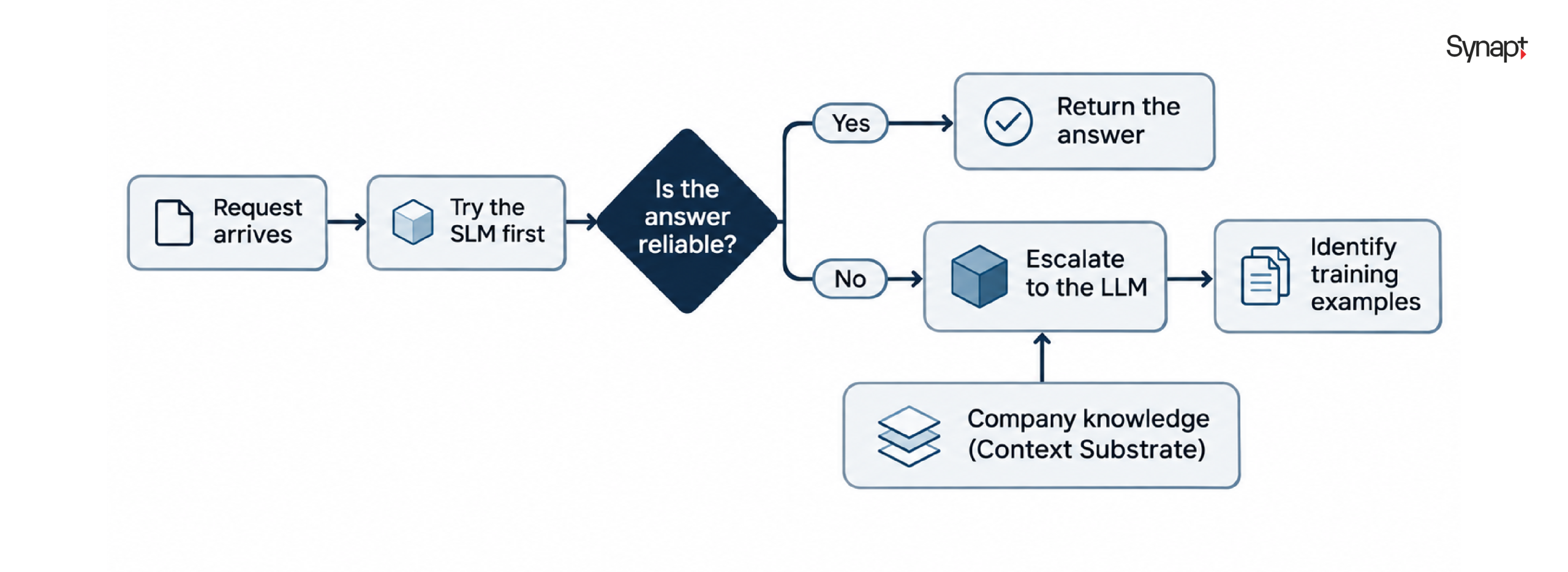
Every request is initially processed by the SLM. The system escalates a request to the LLM when the SLM cannot produce a sufficiently reliable response or fails a required validation check.
Consider an enterprise operations assistant that receives requests about recurring incidents, troubleshooting procedures, or known operational conditions.
The request follows five steps:
- Try the SLM first: The orchestrator sends the incoming request to the domain-specific SLM, which generates an initial response.
- Check the response: The system evaluates the response against predefined reliability criteria and validation checks.
- Escalate when needed: If the response is unreliable, the model returns an unknown response, or a validation check fails, the request is passed to the LLM.
- Use domain knowledge: The LLM accesses relevant enterprise knowledge, runbooks, and SOPs through the Context Substrate and MCP integration to generate a context-aware response.
- Identify training examples: Suitable LLM-generated responses are identified as candidates for future SLM training.
An important implementation consideration is that escalation should not depend only on whether the SLM explicitly says it does not know an answer. A model can produce a convincing but incorrect response. Therefore, the architecture needs appropriate validation mechanisms and clearly defined escalation criteria.
This connects immediate request handling with the longer-term model improvement process.
How Does the Reusable SLM–LLM Agent Loop Improve the SLM?
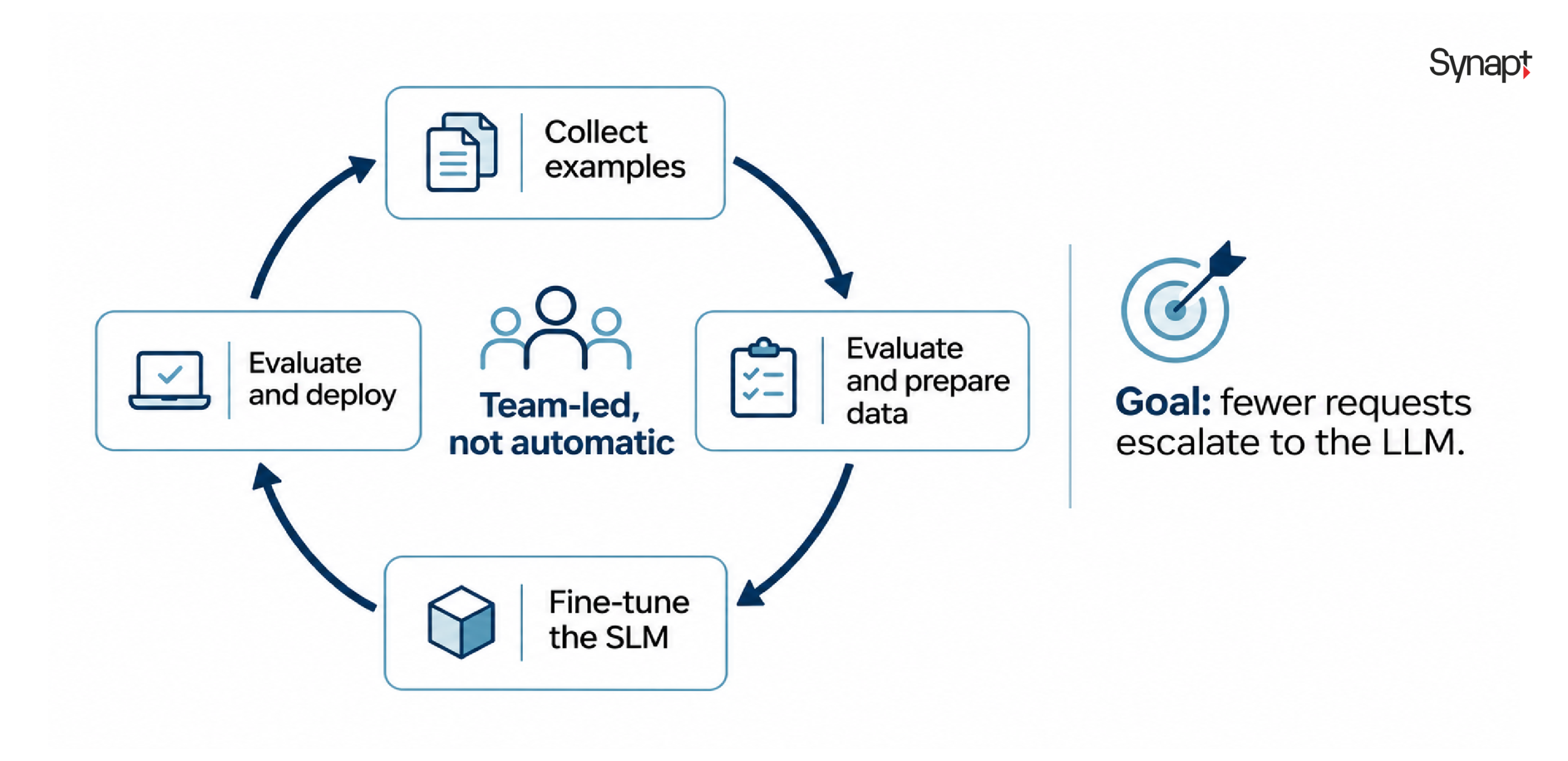
The reusable SLM–LLM agent loop improves a smaller model through a controlled process of collecting suitable LLM outputs, evaluating training examples, fine-tuning the SLM, and testing the updated model before deployment.
The larger model acts as a source of candidate training examples, while the enterprise team decides which examples are suitable for improving the smaller model.
The process has four main steps:
Step 1: Collect Examples
Capture relevant requests and their corresponding LLM-generated responses. These examples should represent recurring tasks that the SLM may be able to handle in future iterations.
Step 2: Evaluate and Prepare Data
Review the collected examples for correctness, completeness, consistency, and compliance with domain requirements.
Incorrect, incomplete, or unsuitable responses should not become training examples.
Research on active synthetic data generation for fine-tuning language models explores how iterative selection and generation of training examples can support improvements in smaller models.
Step 3: Fine-Tune the SLM
Use the prepared dataset to fine-tune the domain-specific SLM. Fine-tuning adapts a pretrained model using additional task-specific examples so it can perform better on selected tasks.
Microsoft’s fine-tuning guidance explains how high-quality, task-specific training data can help improve model accuracy, relevance, and task performance.
Step 4: Evaluate and Deploy
Test the updated SLM against predefined quality criteria before deploying it.
Compare its performance with the previous version to determine whether it has improved without introducing unacceptable regressions.
This creates a repeatable improvement cycle. With each iteration, the team can assess whether the SLM is resolving more recurring requests reliably and whether fewer requests need to be escalated to the LLM.
The important distinction is that this is a team-led improvement loop, not automatic self-training. Human review, data preparation, fine-tuning, and model evaluation remain essential.
Can the SLM–LLM Loop Be Reused Across Different Domains?
Yes. The SLM–LLM loop can be reused as an architectural template across different enterprise domains, provided the models, knowledge sources, escalation rules, and evaluation criteria are adapted to each domain.
The overall workflow remains similar, but the implementation must reflect the requirements of the business function.
For each new domain, the team needs to:
- Select an appropriate SLM for the domain and its recurring tasks.
- Connect relevant enterprise knowledge sources and operational procedures.
- Define when requests should be escalated to the LLM.
- Configure the training-data preparation and evaluation pipeline.
- Establish quality criteria for evaluating updated SLM versions.
For example, an operations team may use an SLM for recurring incident queries, while another business function may adapt the same architectural approach for routine document classification or domain-specific knowledge requests.
However, a model or dataset that performs well in one domain should not automatically be assumed to perform equally well in another. Each implementation needs its own validation and evaluation process.
What Can Go Wrong with an SLM–LLM Architecture, and How Can Enterprises Manage the Risks?
An SLM–LLM architecture introduces four important implementation risks: incorrect responses, poor training-data quality, model regressions, and unexpected operating costs.
These risks can be managed through validation, human review, controlled fine-tuning, and continuous evaluation.
| Risk | What can happen | How to manage it |
| Incorrect answers | The SLM produces a plausible but incorrect response instead of returning an unknown result. | Use predefined reliability criteria, validation checks, and escalation mechanisms. |
| Training-data quality | Incorrect LLM responses introduce errors into the SLM during fine-tuning. | Review candidate examples and enforce defined quality criteria before training. |
| Model regressions | A fine-tuned version performs worse on certain tasks than the previous version. | Evaluate every updated model against held-out test cases before deployment. |
| Overall operating cost | Training, evaluation, hosting, and infrastructure costs offset the savings from reduced LLM inference. | Measure total operating cost rather than monitoring LLM usage alone. |
The goal is not simply to reduce the number of LLM calls. It is to maintain the required response quality while improving the economics of the overall system.
How Do You Measure Whether LLM Costs Decrease Over Time?
Enterprises can determine whether an SLM-first architecture reduces LLM costs by comparing it against an existing implementation using equivalent workloads and the same response-quality requirements.
Four metrics are particularly important:
| Metric | What it measures |
| LLM escalation rate | The percentage of requests that require LLM fallback. |
| SLM resolution rate | The percentage of requests reliably handled by the SLM. |
| Answer quality | Whether responses maintain the required accuracy, completeness, and reliability. |
| Total operating cost | The combined cost of inference, training, evaluation, hosting, and relevant infrastructure. |
The central hypothesis is that, across successive training cycles, the SLM may resolve a greater proportion of recurring requests without compromising answer quality.
However, a lower LLM escalation rate alone does not demonstrate cost savings.
For example, an SLM may handle more requests, but the additional costs of fine-tuning, evaluation, infrastructure, and hosting could outweigh the reduction in LLM inference costs.
Therefore, enterprises should compare the total operating cost of both approaches using equivalent workloads.
The results will establish whether the reusable SLM–LLM loop delivers measurable cost improvements in the selected business domain.
Conclusion: From Model Routing to Continuous Model Improvement
Reducing enterprise AI costs is not simply about replacing large language models with smaller alternatives. It requires an architecture that balances model capability, response quality, enterprise knowledge, governance, and operating cost.
A reusable SLM–LLM agent loop offers a practical approach: use a smaller model for recurring, well-defined requests; escalate complex or unreliable cases to a larger model; and use suitable, reviewed LLM responses as candidate training examples to improve the SLM over time. The aim is to increase the range of tasks smaller models can handle reliably while reducing unnecessary reliance on larger models.
This approach becomes more compelling when smaller models are purpose-built for specific domains. For example, Synapt’s 4B telecom-specific model ranked seventh on the GSMA Open Telco Leaderboard, competing alongside much larger general-purpose models. Its performance illustrates how a smaller model, trained and evaluated for a focused domain, can perform strongly on specialised tasks without requiring the scale of a general-purpose model.
However, model efficiency is only one part of enterprise AI transformation. Organizations also need trusted enterprise context, governed agent lifecycles, reliable data foundations, and domain-specific operational capabilities.
The objective is not simply to use fewer LLM tokens. It is to build enterprise AI systems that make better use of models and organizational knowledge, route work to the right level of intelligence, and maintain the reliability and governance required at scale.
Looking to maximize AI ROI while keeping LLM costs under control? Work with Synapt.
FAQ's
An SLM–LLM agent loop is an architecture in which a small language model handles requests first, a large language model processes requests the SLM cannot resolve reliably, and a team uses suitable LLM-generated responses to fine-tune and improve the SLM over time.
No. An SLM does not replace the LLM. The smaller model handles requests within its demonstrated capabilities, while the larger model remains available for complex requests, unreliable responses, and tasks requiring additional reasoning.
No. An SLM-first approach does not automatically guarantee lower operating costs. Enterprises must account for inference, training, evaluation, hosting, and infrastructure expenses. Savings should be measured against an existing implementation using equivalent workloads and response-quality requirements.
No. The improvement loop is team-led, not automatic self-training. The team reviews LLM-generated responses, prepares suitable training examples, fine-tunes the SLM, and evaluates the updated model before deployment.
A request should be escalated when the SLM cannot produce a sufficiently reliable answer, returns an unknown response, or fails a required validation check. Escalation should not rely only on the model’s ability to recognize its own uncertainty because an SLM can generate plausible but incorrect answers.
Synapt’s Context Substrate can serve as the domain knowledge layer in this architecture. Through an MCP integration, it provides the LLM with relevant enterprise information, runbooks, and standard operating procedures when handling escalated requests.
Yes. The architecture can be reused as a template across business domains. Each implementation requires an appropriate SLM, relevant knowledge sources, domain-specific escalation rules, a training and evaluation pipeline, and clearly defined quality criteria.
Enterprises should track four primary metrics: LLM escalation rate, SLM resolution rate, answer quality, and total operating cost. These metrics help determine whether the smaller model is handling more requests reliably and whether the architecture is delivering actual cost improvements.

Subscribe to our newsletter
Insights on making enterprise AI actually work - straight to your inbox.
Subscribe to our newsletter
Insights on making enterprise AI actually work - straight to your inbox.