TL;DR
- Enterprises will use multiple AI models over time for different tasks. Knowledge should exist in a shared layer that remains independent of any specific LLM, ensuring it survives model changes, upgrades, and vendor shifts.
- Knowing that information changed is not enough. Organizations also need to preserve why it changed, who changed it, what assumptions existed at the time, and how the change affected subsequent decisions and actions.
- Different teams, systems, AI agents, and data sources may describe the same event differently. Rather than forcing a single version of reality too early, organizations should preserve multiple observations and their context to enable better reasoning and decision-making.
- Facts without provenance, definitions, timestamps, evidence, and ownership can easily be misinterpreted. Effective knowledge systems preserve both information and the context required to understand and trust it.
- As AI models continue to evolve, the lasting asset is not model memory but organizational knowledge. Enterprises should focus on building knowledge systems that are shared, evolving, plural, and traceable, regardless of which AI technologies they use.
As enterprises adopt generative AI, a critical architectural question emerges,
Where should organizational knowledge live?
The answer matters more than choosing between individual large language models (LLMs).
Most organizations will not rely on a single model. A software engineering team might use one LLM for code generation, another for document analysis, a third for enterprise search, and private models for handling sensitive or regulated data. As AI capabilities, costs, and governance requirements evolve, these model choices will inevitably change.
For that reason,
organizational knowledge should not reside inside any specific LLM. While models can access, interpret, and reason over knowledge, they should not become the permanent system of record for that knowledge. The knowledge layer must remain independent so that organizations can adopt new models, replace existing ones, or operate multiple AI systems without losing context, history, or institutional memory.
Why Enterprises Need an External Knowledge Layer?
Many AI architectures are still presented as though a single model sits at the center of the system. In reality, enterprises increasingly operate multi-model environments where different LLMs serve different business functions based on performance, cost, privacy, compliance, or domain expertise.
When knowledge becomes tightly coupled to a specific model, prompt structure, or vendor-specific memory mechanism, changing models turns into a knowledge migration challenge. Organizations may need to rebuild context, re-engineer prompts, or recreate historical reasoning paths.
A more sustainable approach is to maintain organizational knowledge in a shared, external knowledge layer that can be accessed by AI agents, applications, workflows, employees, and multiple LLMs. In this architecture, models can evolve independently while enterprise knowledge remains consistent, portable, and governed.
Why Is Enterprise Knowledge More Than Just Current Facts?
Separating knowledge from the model raises an important follow-up question:
What should be preserved?
The answer extends beyond storing the latest information.
Enterprise knowledge evolves over time. Business decisions are made using information available at a particular moment. Multiple teams may interpret the same event differently, and those interpretations often influence subsequent actions, outcomes, and decisions.
Because of this, effective knowledge systems must capture not only current facts but also historical context, changes over time, decision rationale, and the sequence of events that led to specific outcomes. A persistent enterprise knowledge layer should preserve both the state of knowledge and its history, enabling AI systems to understand not just what is true today, but how that knowledge evolved.
How Does Enterprise Knowledge Change Over Time?
Enterprise knowledge is not a fixed asset. It evolves as systems, processes, relationships, and business conditions change. Because of this, an effective knowledge system must capture not only the current state of information but also how that information has changed over time.
Consider a simple example: System A depends on System B. Six months later, the statement becomes: System A depends on System C.
| View | What Changed? | What It Captures | What It Misses |
| Text Diff | “System B” changed to “System C” | Character-level or document-level modifications | Business impact, rationale, risk implications |
| Semantic Diff | Dependency shifted from B to C | Meaning, operational impact, architectural changes, decision context | N/A |
| Enterprise Knowledge Perspective | Why the dependency changed | Ownership, security implications, cost impact, decision rationale, timeline | N/A |
A traditional version-control system can identify that “B” was replaced with “C.” However, the real significance is not the text change itself. The underlying meaning changed. One dependency ended, another began, and that shift may have implications for system architecture, operational risk, cybersecurity, ownership, compliance, costs, and business continuity.
This is why enterprise knowledge management requires more than a textual change history. It requires a semantic history. Organizations need to preserve what changed, when it changed, who made the change, and why the change occurred. The explanation behind the change often becomes as valuable as the information itself.
This capability becomes critical when teams ask questions such as:
• Why was this decision made six months ago?
• What assumptions existed at the time?
• What information was available when the decision was approved?
• What changed between then and now?
The latest version of knowledge rarely provides these answers on its own. To understand past decisions accurately, organizations must be able to reconstruct the historical context in which those decisions were made. In other words, enterprise knowledge needs version control for meaning, not just version control for documents.
Can Multiple Primary Data Sources Describe the Same Reality Differently?
A common assumption in analytics and AI is that moving closer to primary data eliminates uncertainty. In practice, reality is often more complex.
Many people believe that if information comes directly from a primary source, it represents a single, definitive version of the truth. However, multiple primary sources can legitimately report different values for what appears to be the same event, observation, or business condition.
This became particularly visible during the COVID-19 pandemic, when organizations frequently encountered conflicting figures across authoritative data sources. The differences were often not caused by errors. Instead, they emerged from variations in definitions, reporting schedules, geographic boundaries, aggregation methods, inclusion criteria, and data collection processes.
As a result, two primary sources can both be accurate while describing the same situation differently.
This changes an important analytical question. Instead of asking:
Which value is correct?
Organizations often need to ask:
Why do these values differ?
The explanation behind the discrepancy may reveal important information about methodology, assumptions, reporting standards, or operational context. If one version is selected too early and alternative interpretations are discarded, valuable knowledge about how the data was generated may be lost.
Why Context Matters as Much as Facts
For AI systems, knowledge graphs, enterprise search platforms, and autonomous agents, storing facts alone is insufficient. Facts require context to be interpreted correctly.
A persistent enterprise knowledge layer should preserve:
- The source of each fact
- When the fact was recorded
- How the data was defined
- Who produced or validated it
- What methodology was used
- What evidence supports it
- How the fact changed over time
By preserving both facts and their context, organizations create a knowledge foundation that supports explainability, governance, auditability, and trustworthy AI decision-making. This enables AI systems to understand not only what is known, but also how that knowledge was created, interpreted, and evolved over time.
| Fact Alone | Missing Context |
| COVID cases = 10,000 | Which reporting authority provided the number? |
| System A depends on System C | When did the dependency change? |
| Revenue grew 15% | Compared with which period? |
| Customer churn = 5% | What definition of churn was used? |
| Risk level = High | Who assigned the rating and using what framework? |
Key takeaway: Facts answer what happened. Context explains why it happened and how it should be interpreted.
What a Persistent Knowledge Layer Should Preserve?
| Knowledge Element | Why It Matters |
| Facts | Current state of information |
| Historical Versions | Understanding change over time |
| Source Information | Trust and traceability |
| Definitions | Consistent interpretation |
| Decision Rationale | Explains why actions were taken |
| Ownership | Accountability and governance |
| Evidence | Supports verification |
| Relationships | Connects systems, people, and processes |
| Timeline | Reconstructs past states of knowledge |
How Can Multiple Facts Describe the Same Event?
Imagine a production incident. An infrastructure engineer reports that database connections reached their configured limit. An application engineer reports that requests failed because the application could not obtain a connection. Operations records twelve minutes of service unavailability. A customer reports that an order could not be submitted.
These statements describe the same event, but they are not the same fact. They do not necessarily contradict one another. Each reflects a different perspective, role, and level of observation.
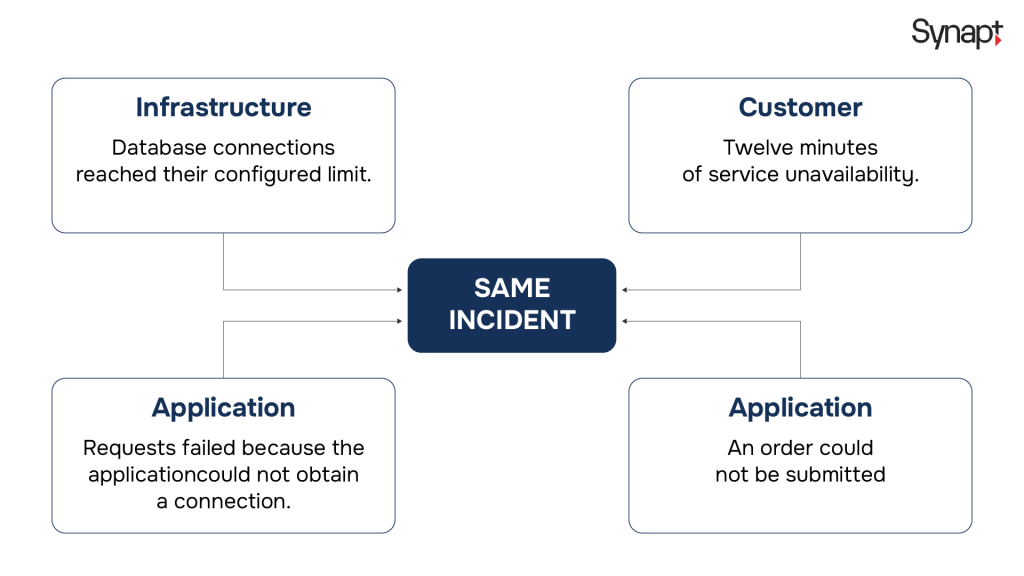
Enterprise systems often attempt to create a single authoritative version of events as early as possible. While standardization is sometimes necessary, early normalization can remove valuable context. A more effective approach is to preserve multiple observations about the same event together with the context that explains them.
How Can the Same Event Produce Different Facts?
Different teams observe the same incident through different lenses:
| Observer | Observation |
| Infrastructure Team | Database connections reached capacity |
| Application Team | Application could not obtain connections |
| Operations Team | Service was unavailable for 12 minutes |
| Customer | Unable to submit an order |
All four observations may be accurate. Together, they provide a more complete understanding of the event than any single statement alone.
Not every observation ultimately carries the same weight. Some facts may later prove inaccurate, while others are supported by stronger evidence, better provenance, or higher confidence. The goal is not to treat all facts equally. The goal is to preserve them until their relationships and differences are understood.
Can Knowledge Be Plural Without Being Inconsistent?
Yes. Multiple facts can coexist without creating inconsistency when they represent different perspectives on the same reality.
This becomes increasingly important as knowledge is generated simultaneously by employees, enterprise applications, documents, sensors, AI agents, and large language models. If an AI system receives only a single normalized answer, it may never know that alternative observations existed. When multiple observations are preserved, AI systems can reason about differences, uncertainty, confidence levels, and context rather than inheriting assumptions made earlier in the information pipeline.
Why Should Enterprise Knowledge Capture Decision Flow, Not Just Facts?
Knowledge is often represented as entities and relationships. A service depends on a database. An employee belongs to a department. A policy applies to a business process.
However, enterprise knowledge is more than static relationships. It also contains a flow of events and decisions.
An observation leads to an assessment. The assessment influences a decision. The decision triggers an action. The action produces an outcome.
If only the final outcome is preserved, much of the context required to understand that outcome is lost.
What Information Explains Why a Decision Was Made?
Consider a configuration change made six months ago.
The current configuration value tells us what changed, but it does not explain:
• Why was the change made?
• Was it related to an outage?
• Was it driven by a security requirement?
• Was it intended to improve performance?
• Was it a temporary workaround?
• Who approved the change?
• What information was available at the time?
• What happened after implementation?
Without this context, organizations can understand the outcome but not the reasoning behind it.
What Should a Knowledge System Preserve Beyond Facts?
A persistent knowledge system should preserve the complete decision flow, not just the final result.
| Knowledge Element | Example |
| Observation | Database connection saturation detected |
| Assessment | Application outage risk identified |
| Decision | Increase connection pool capacity |
| Action | Configuration updated |
| Outcome | Service restored and stabilized |
| Evidence | Monitoring logs and incident reports |
| Ownership | Engineer and approver responsible |
| Timestamp | When each step occurred |
This chain creates traceability between what was observed, what was decided, what action was taken, and what outcome followed.
Why Does Decision Flow Matter for AI Agents?
This becomes even more important as AI agents move beyond information retrieval and begin taking actions.
If an AI agent changes a configuration, approves a workflow, updates a policy, or executes an operational task, that action should become part of the organization’s knowledge history.
Organizations should be able to trace backward to the information, evidence, and reasoning that informed the decision and trace forward to the resulting outcomes.
This level of traceability supports AI governance, explainability, auditability, and trust. It helps organizations answer not only
“What happened?” but also “Why did it happen?”, “Who made the decision?”, and “What evidence supported the action?”
How Can Organizations Create “Git for Knowledge” Instead of Just Documents?
Git transformed software development because it preserves history. Teams can see what changed, who made the change, when it happened, and how one version differs from another.
Enterprise knowledge requires similar capabilities, but with an important distinction: knowledge systems must preserve changes in meaning, not just changes in text.
Traditional version control can show that a sentence was modified. However, it cannot automatically explain how that change affected business operations, risk exposure, compliance requirements, ownership responsibilities, or architectural decisions.
What Is Semantic History in a Knowledge System?
Semantic history captures more than document revisions. It preserves the meaning and context behind changes.
A knowledge system should be able to answer questions such as:
- What changed?
- Why did it change?
- Who made the change?
- What evidence supported it?
- What business impact resulted from the change?
- Which decisions were influenced by it?
In many cases, organizations also need to preserve multiple valid observations about the same event rather than forcing everything into a single normalized representation.
How Is a Knowledge System Different from Traditional Version Control?
| Traditional Version Control | Knowledge Version Control |
| Tracks text changes | Tracks meaning changes |
| Preserves file history | Preserves knowledge history |
| Shows what changed | Explains why it changed |
| Focuses on documents | Focuses on facts, context, and decisions |
| Restores previous versions | Reconstructs historical understanding |
| Tracks authorship | Tracks provenance, evidence, and impact |
Viewed this way, enterprise knowledge becomes more than a collection of documents. It becomes a system of record for organizational understanding.
The analogy to Git is not exact, but it highlights an important principle: knowledge should not be treated as a single snapshot in time. Its history is often as valuable as its current state.
What Are the SEPT Principles for Enterprise Knowledge Systems?
To organize these ideas, I use a framework called SEPT: Shared, Evolving, Plural, and Traceable.
The SEPT principles describe the characteristics required for knowledge to remain useful across changing AI models, applications, and business environments.
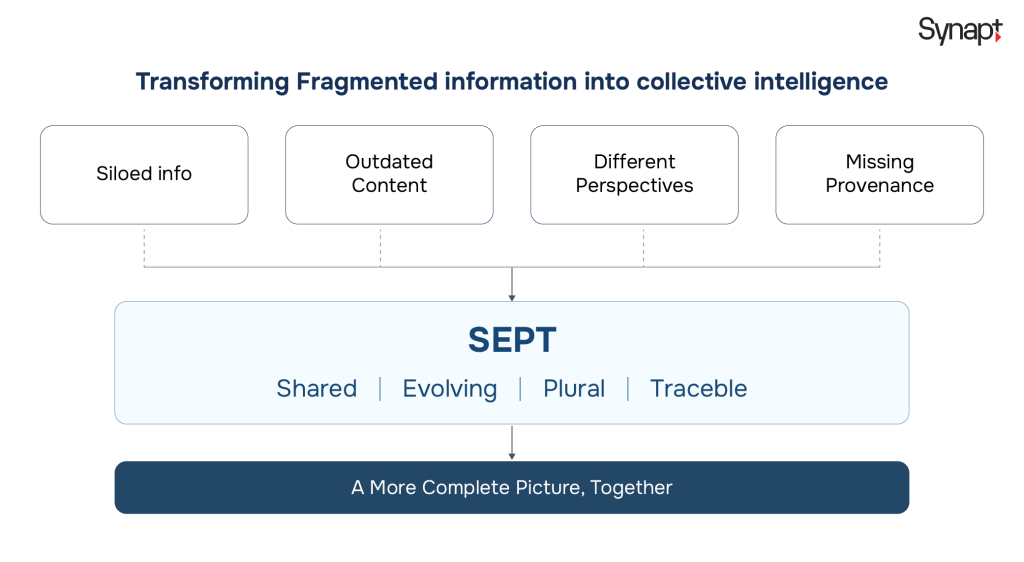
What does SEPT stands for?
| Principle | Meaning | Why It Matters |
| Shared | Knowledge exists independently of the models that use it. | Organizations can adopt, replace, or combine LLMs without losing institutional knowledge. |
| Evolving | Knowledge preserves history and semantic changes over time. | Decisions can be understood within their original context. |
| Plural | Multiple contextual facts about the same event can coexist. | Different perspectives remain available for analysis and reasoning. |
| Traceable | Knowledge includes provenance, ownership, evidence, and usage history. | Supports governance, explainability, and accountability. |
Why Should Enterprise Knowledge Be Shared?
Organizations increasingly use multiple AI systems for different purposes. A single LLM may excel at coding, another at document analysis, and another at enterprise search.
If knowledge becomes tied to one model’s memory, prompts, or proprietary architecture, every model migration becomes a knowledge migration project.
A shared knowledge layer allows models to change while organizational knowledge remains stable.
Why Must Knowledge Be Evolving, Plural, and Traceable?
Knowledge is rarely static. Facts change. Interpretations differ. Decisions depend on circumstances that may no longer exist.
Organizations therefore need the ability to:
• Preserve historical context
• Retain multiple perspectives
• Understand provenance
• Reconstruct decision-making processes
• Audit actions taken by humans and AI systems
Without these capabilities, valuable institutional knowledge can disappear even when the underlying data remains available.
Does SEPT Require a Specific Database or Technology Stack?
No.
SEPT is not tied to a particular technology choice. Organizations may implement these principles using:
- Relational databases
- Graph databases
- Document stores
- Event-driven architectures
- Knowledge graphs
- Hybrid data platforms
The critical question is not which database is used. The more important question is:
Can the system preserve knowledge, context, history, provenance, and decision flow over time?
Technology choices should support those outcomes rather than define them.
What Should Organizations Preserve as LLMs Continue to Evolve?
Large language models will continue to improve, specialize, and change. Most enterprises will use multiple models simultaneously and replace them over time as business requirements evolve.
Because of this, the durable asset should not be the memory of any individual model.
Instead, organizations should focus on preserving a persistent knowledge layer that survives changes in AI technology.
Rather than asking:
- What does the LLM know?
Organizations should increasingly ask:
- What does the knowledge system know?
- How has that knowledge changed over time?
- Why is that knowledge trusted?
- How has it influenced decisions and actions?
These questions focus on the long-term asset that outlasts any individual AI model.
What Is the Ultimate Goal of an Enterprise Knowledge System?
The goal is not to make an LLM remember everything.
The goal is to ensure that organizational knowledge remains shared, evolving, plural, and traceable, regardless of which models, agents, applications, or technologies access it in the future.
The goal is not to make an LLM remember everything.
The goal is to make knowledge survive the LLM.
FAQ's
Organizational knowledge should live in a shared, persistent knowledge layer rather than inside a specific LLM. This allows multiple AI models, agents, applications, and employees to access the same trusted knowledge while avoiding dependence on any single AI provider or model.
When knowledge becomes tied to a specific model, prompt structure, or vendor-specific memory mechanism, changing AI models can become a knowledge migration challenge. Keeping knowledge external ensures continuity, portability, governance, and long-term accessibility.
Semantic history captures the meaning behind changes, not just the text that changed. It records what changed, why it changed, who made the change, and the impact of that change, helping organizations reconstruct past decisions and understand historical context.
Yes. Different teams, systems, or data sources often observe the same event from different perspectives. These observations may not contradict one another and can collectively provide a more complete understanding of what actually happened.
SEPT stands for: Together, these principles help organizations build knowledge systems that remain trustworthy, explainable, and resilient as AI technologies continue to evolve.

Subscribe to our newsletter
Insights on making enterprise AI actually work - straight to your inbox.
Subscribe to our newsletter
Insights on making enterprise AI actually work - straight to your inbox.