Cisco’s 2026 State of AI Security report found that 83% of enterprises are actively planning or building agentic AI systems. But a March 2026 industry survey found that only 11 to 14% of those pilots are running at production scale (DigitalApplied, March 2026).
That is a 54-point gap between ambition and delivery. And it is not closing. It is widening.
Every major foundation model provider, such as Anthropic, OpenAI, Google, and Meta, is shipping increasingly capable agents. Enterprises are building on Claude, GPT-4, Gemini, and open-source alternatives at a rapid pace. The tooling has never been better. The deployment rate has never been lower.
This is not a model problem. It is an infrastructure problem. And until enterprises fix the layer beneath their AI, the gap between building and shipping will remain exactly where it is.
McKinsey’s 2026 State of AI in Enterprise identified five failure modes accounting for 89% of enterprise AI scaling failures (McKinsey, 2026). None relate to model quality. All relate to what sits beneath the model.
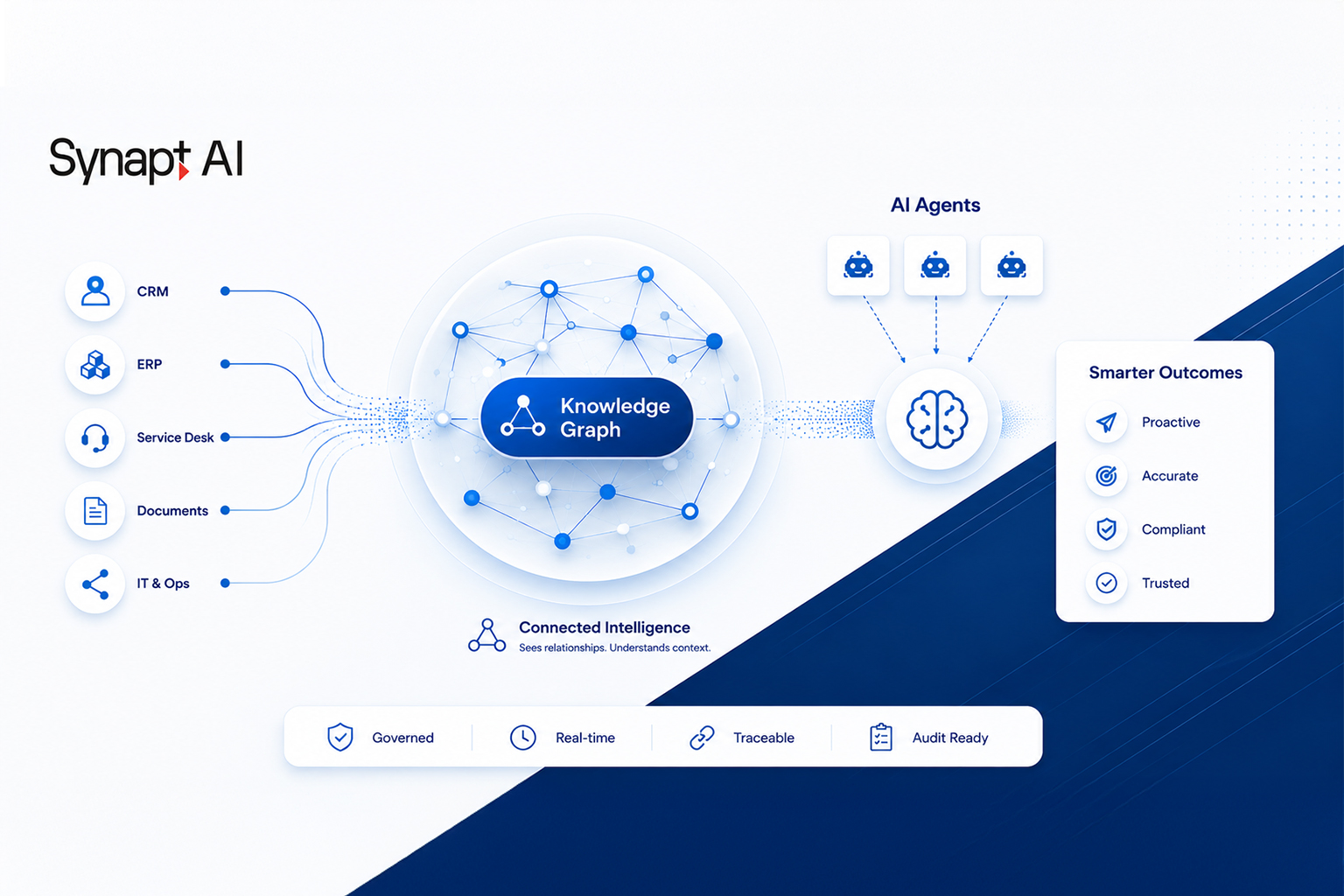
1. Integration with legacy systems: Enterprise AI agents need to act within systems enterprises have run for decades — ERPs, CRMs, OSS/BSS platforms, claims systems, billing engines. API integrations work in pilots. They break at production scale, where stale data, conflicting schemas, and missing business context cause agents to act on incomplete or incorrect information. The fix is not more integrations. It is a unified operational intelligence layer that normalises enterprise knowledge before the agent ever sees it.
2. Output quality at volume: In a pilot, humans review every output. In production, they cannot. The moment agents operate at scale without human review, quality becomes a statistical problem — and the outliers are the ones that make headlines. Agents built on Claude or ChatGPT are excellent reasoners. They are not, by default, excellent enterprise operators. Without a layer that carries domain-specific knowledge — policies, procedures, business rules, and customer-specific constraints, agents will be accurate on average but dangerously wrong at the edges.
3. Monitoring and observability: Most enterprise AI monitoring today measures model performance: latency, token usage, and error rates. Necessary — but insufficient for agentic systems. Agents take actions with downstream consequences. Monitoring whether the model responded quickly is not the same as monitoring whether the agent acted correctly — within policy, within authorisation boundaries, with current information. Production-ready agentic AI requires observability into the decision layer, not just the model layer.
4. Ownership and accountability: In most enterprises, no one clearly owns the AI agent in production. The AI team built the pilot. IT manages the infrastructure. The business unit owns the outcomes. Compliance owns the risk. This ambiguity is not just organisational — it is architectural. When an agent operates without a governed intelligence layer, accountability becomes untraceable. Fixing this requires infrastructure, not org charts.
5. Domain knowledge currency: The largest gap between a capable AI agent and a production AI agent is access to current, validated domain knowledge. A foundation model does not know how your hospital’s discharge protocol works today. It does not know which products are eligible for a loyalty bundle in which regions this quarter. It does not distinguish between a standard and a priority compliance escalation in your organisation. Fine-tuning is slow, expensive, and goes stale the moment your procedures change. What enterprises need is not a model trained on their domain six months ago — it is an agent with access to governed, current operational intelligence at inference time.
Foundation models like Claude, GPT-4, Gemini, and Llama are remarkable. They reason, plan, write, and execute multi-step tasks with increasing reliability. Anthropic, OpenAI, and Google are investing billions to make them more capable and safer. But capability is not the bottleneck for enterprise AI at production scale.
The bottleneck is the operational intelligence infrastructure.
When enterprises build agents on the Claude or ChatGPT APIs, they gain access to world-class reasoning capabilities. What they do not access is a layer that knows their enterprise — its products, policies, workflows, compliance obligations, and live operational state. That layer does not come with the model. It must be built or bought.
The enterprises winning at production AI are not the ones with the best models. They are the ones who invested in the intelligence infrastructure that makes those models enterprise-ready.
McKinsey’s 2026 report contains one number that reframes the conversation: 67% of production LLM deployments now use retrieval augmentation — up from 31% in 2024 (McKinsey, 2026).
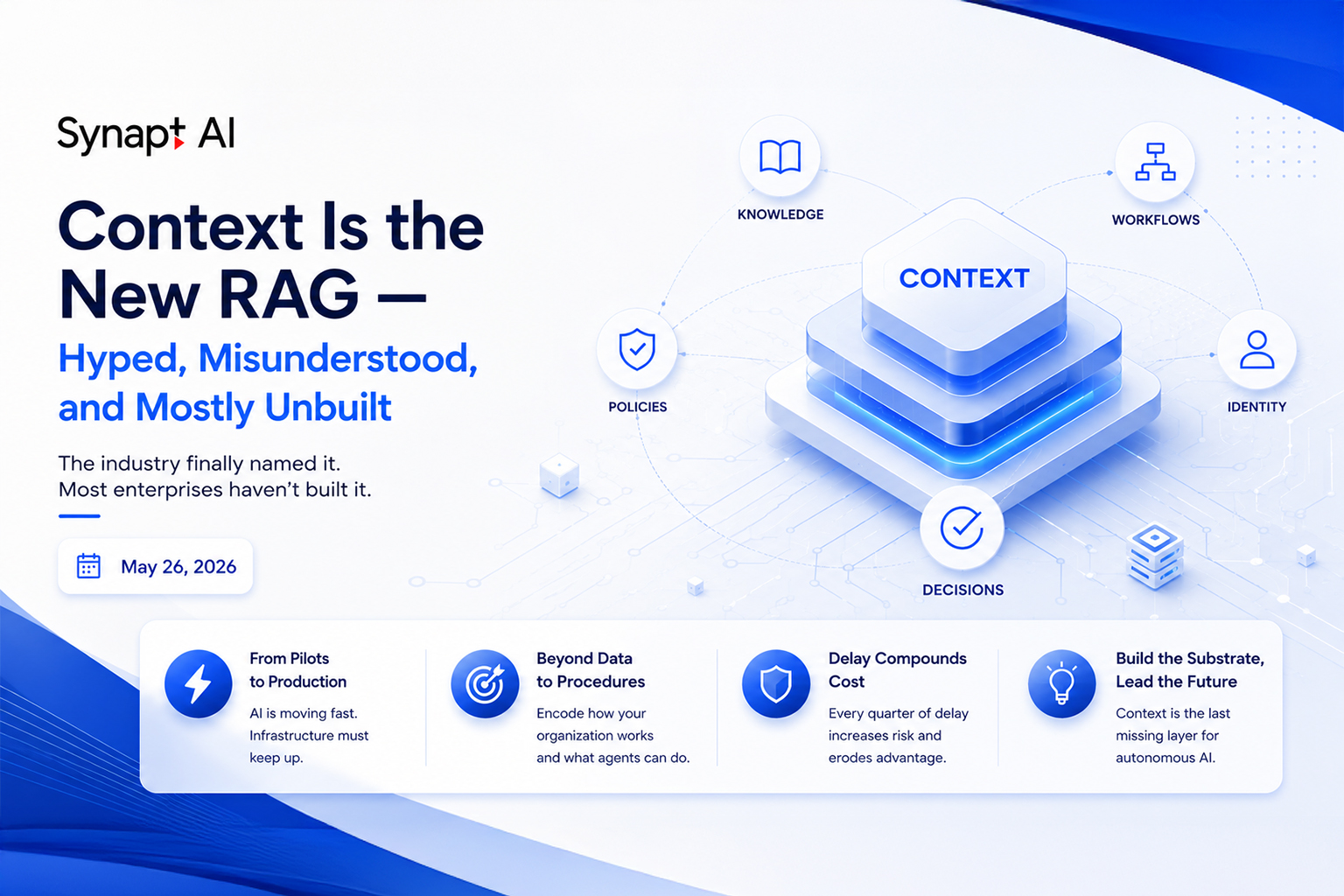
RAG has moved from feature to infrastructure. The buyer question is no longer “should we use RAG?” — it is “what sits above RAG?”
The answer is domain intelligence infrastructure. A layer that does not just retrieve documents but understands which are policy-current, which facts have been superseded, which procedures apply to this specific agent action, and which outputs need human review. A layer that maintains a governed, temporally consistent operational knowledge graph of the enterprise.
McKinsey’s own data tells the story: 67% of deployments use RAG. Only 11% reach production scale. The gap between retrieval and production-readiness is the domain intelligence layer — and most enterprises have not built it.
Production-ready does not mean perfect. It means AI that:
This architecture is achievable. Enterprises deploying agents at production scale are not waiting for the next model release. They are investing in the operational intelligence infrastructure that makes the models they already have production ready.
The 54-point readiness gap is not a technology gap. It is an infrastructure gap.
The enterprises in the 11% shipping agentic AI-at-scale group share one characteristic: they treated operational intelligence infrastructure as a first-class investment from day one — not an afterthought bolted on after pilots failed. They built governance into the layer beneath their AI before compliance asked for it. They made auditability a property of the intelligence layer, not a reporting exercise.
For the 83% still building — and watching pilots stall before production — the path forward is not a better model. It is a better foundation.
We are building that foundation.