Every technology cycle comes with its own vocabulary. Partly to help insiders communicate. Mostly to make everyone else feel like they missed a memo.
Enterprise AI in 2026 is no different. Except this time, the words matter more than usual. Because the gap between understanding these terms and not understanding them isn’t just intellectual but deeply operational. The organizations that grasp what’s actually being described, and act on it, will run autonomous AI operations by 2027.
Here are the concepts reshaping enterprise AI right now. Use them not to learn the words, but to diagnose the gaps.
What it sounds like: Creative AI pilots. Impressive demos. Bold internal announcements.
What it actually means: AI that performs transformation without delivering it.
Innovation theatre has become the defining enterprise AI failure mode in recent years. The pattern is almost predictable now. A team builds something genuinely impressive in a sandbox, whether it is a customer service agent, a procurement assistant, or a network monitoring copilot. It works beautifully in controlled conditions. Leadership gets excited.
Then it meets the enterprise. The legacy ERP it needs to query doesn’t have a clean API. The SOP it’s supposed to follow exists as a 200-page PDF from 2019. The permissions architecture was designed for human workers, not for autonomous agents acting at machine speed. And the pilot, which costs real money and real credibility, quietly stops going anywhere.
78% of enterprises have AI pilots running today. Only 14% have scaled to AI production. That 64-point gap isn’t a technology failure. It’s an AI architecture one. The AI was ready. The substrate underneath it wasn’t.
The most dangerous innovation theatre isn’t the pilot that fails loudly. It’s the one that succeeds quietly — and still never runs the business.
What it sounds like: Lots of AI agents. Sounds productive.
What it actually means: AI multiplication without AI coordination. Faster chaos.
There is a version of enterprise AI adoption that looks like success from the outside and feels like a slow-motion problem from the inside. Every department has an agent. Procurement, finance, operations. None of them know about the others.
Agent sprawl is what happens when AI gets deployed horizontally across an enterprise before a shared context layer exists beneath it. Each agent operates on its own interpretation of data, permissions, and logic. They don’t conflict visibly. They just quietly erode the organization’s ability to explain or govern anything they do.
Traditional AI technical debt accumulates slowly. You take shortcuts, and the interest compounds over years. Agent sprawl compounds differently. Because agents act, they don’t just store code. Every decision made on inconsistent context, every action taken without traceable permission, every output that can’t be explained by reference to policy — those aren’t future problems. They’re present liabilities, adding up in real time.
The organizations falling behind in 2026 are not the ones that deployed too little AI. They’re the ones that deployed too much, too fast, on foundations that were never built to hold it.
What it sounds like: A financial metaphor for AI problems.
What it actually means: The accumulated cost of every AI action you can’t explain, every decision that can’t be audited, every agent that operated outside its actual authority.
The concept of AI technical debt is forty years old. Agentic debt is its 2026 successor, and it accumulates at a speed that makes the original look manageable.
When a human employee makes a bad decision, you have a conversation, retrain, and move on. When an AI agent makes a class of bad decisions, systematically, at scale, without the contextual grounding to know they were bad — you have a regulatory event, a reputational exposure, or both. The liability isn’t in the decision. It’s in the absence of the AI governance framework that should have constrained it.
Only 1 in 5 companies has mature AI agent governance today. The other 4 in 5 are accumulating agentic debt, whether they know the term or not.
The dangerous version is the debt you don’t know you’re carrying. An agent working correctly for months. An exception case. A decision made on inference rather than policy. No one noticed until the auditor asked.
What it sounds like: A fancier term for prompt engineering.
What it actually means: The discipline of structuring what an AI knows, in the form it needs to know it, so it can reason — not just retrieve.
Prompt engineering was always a workaround, a way to nudge a model toward the right answer by carefully shaping the question. Context engineering is something structurally different. It is the practice of building the knowledge architecture that AI agents operate within. Not what you ask the model, but what the model actually understands about your organization. Its structure, its procedures, its authority rules. The difference between asking someone who has read a manual and employing someone who actually knows how the place works.
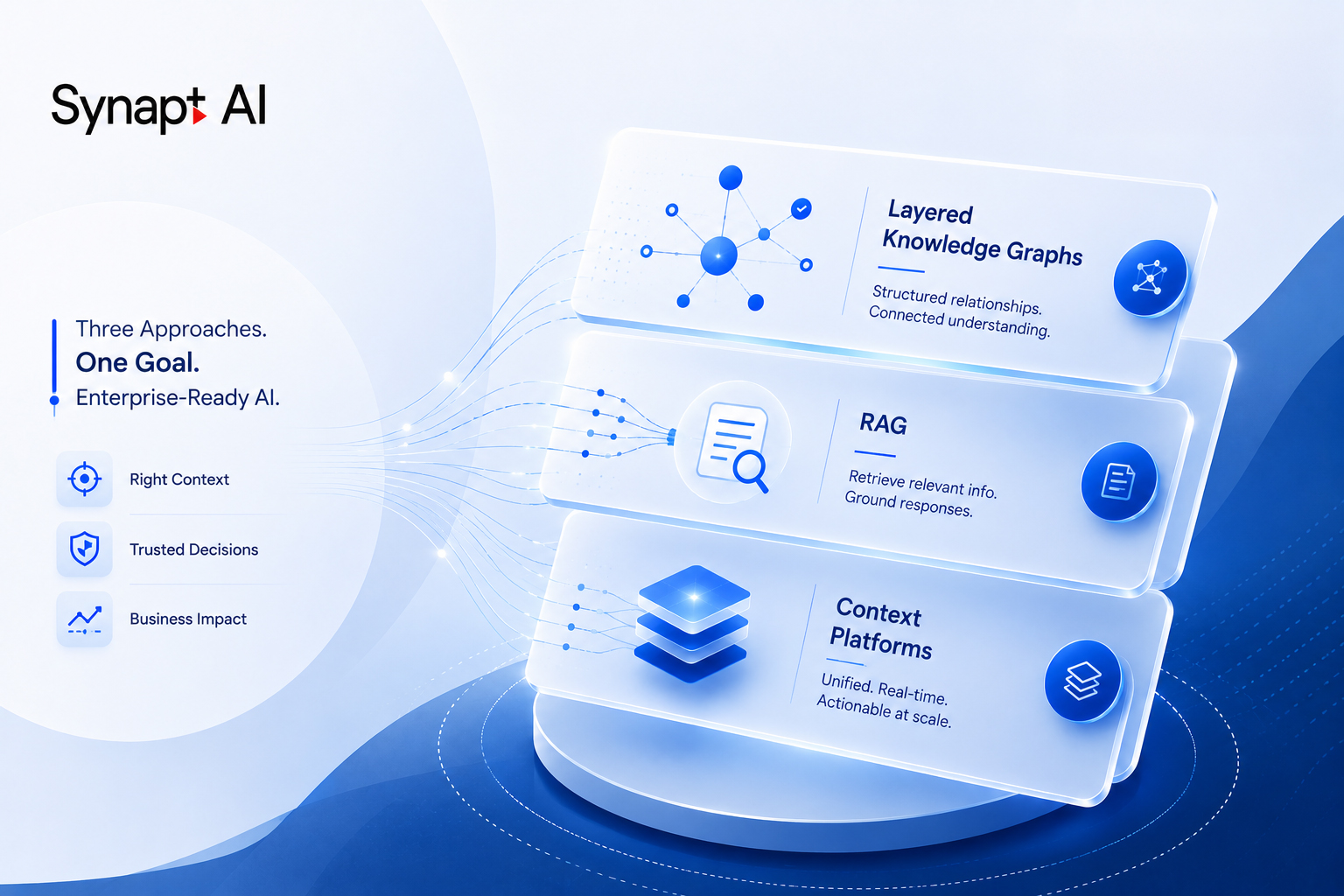
Gartner predicts that more than 50% of AI agent systems will leverage context graphs by 2028 — specifically because retrieval-based architectures cannot encode the decision logic, institutional memory, and procedural constraints that production AI demands. You cannot RAG your way to autonomous operations.
Context without procedure is just a better search engine. The enterprises that understand this distinction are building something the others aren’t — and the gap is widening.
What it sounds like: Infrastructure. Plumbing. Necessary but overlooked.
What it actually means: The most strategically important thing being built in enterprise technology right now.
SAP calls it the foundational layer. Sam Altman calls it the unified operating layer. Gartner calls it context graphs. Palantir has been calling it the Ontology for years. The terminology has never been consistent. The architecture they’re all describing has.
The substrate is the layer that sits between your existing enterprise systems and the AI agents operating across them. It is not a model. It is not a data warehouse. It is not a workflow automation tool. It is the structural encoding of how your organization operates: what it knows, how it makes decisions, what its agents are permitted to do, and why every action taken is traceable back to a rule, a policy, or an authority.
The AI substrate is no longer a concept being debated in architecture reviews. It is a competitive asset being built right now. The enterprises that have it will deploy new AI capabilities in days, not quarters. The ones without it will keep rebuilding the foundation from scratch with every new agent and accumulating the agentic debt that comes with it.
When an industry starts naming its failure modes — innovation theatre, agent sprawl, agentic debt — it means something important has shifted. The conversation is no longer about whether AI can do this. It is about whether the enterprise is built to hold it.
The organizations that will run autonomous AI operations in 2026 and 2027 are not necessarily the ones with the best models. They are the ones that asked the harder question first:
“Before we build another agent — what is the AI foundation it’s supposed to operate on?”
That question has a name now. Several, actually. And the enterprises that are asking it, and answering it architecturally, are the ones quietly separating from the rest.