TL;DR
- A world model predicts the next state of a situation given an action, so an AI can compare actions in imagination before acting.
- A language model predicts the next word. A world model predicts the next state. That difference is what makes planning possible.
- Four kinds of effort share the name: abstract-space prediction (AMI Labs, JEPA), live generated worlds (Google DeepMind’s Genie), exportable 3D worlds (World Labs’ Marble) and narrow simulators for testing (Wayve’s GAIA models, NVIDIA’s Cosmos).
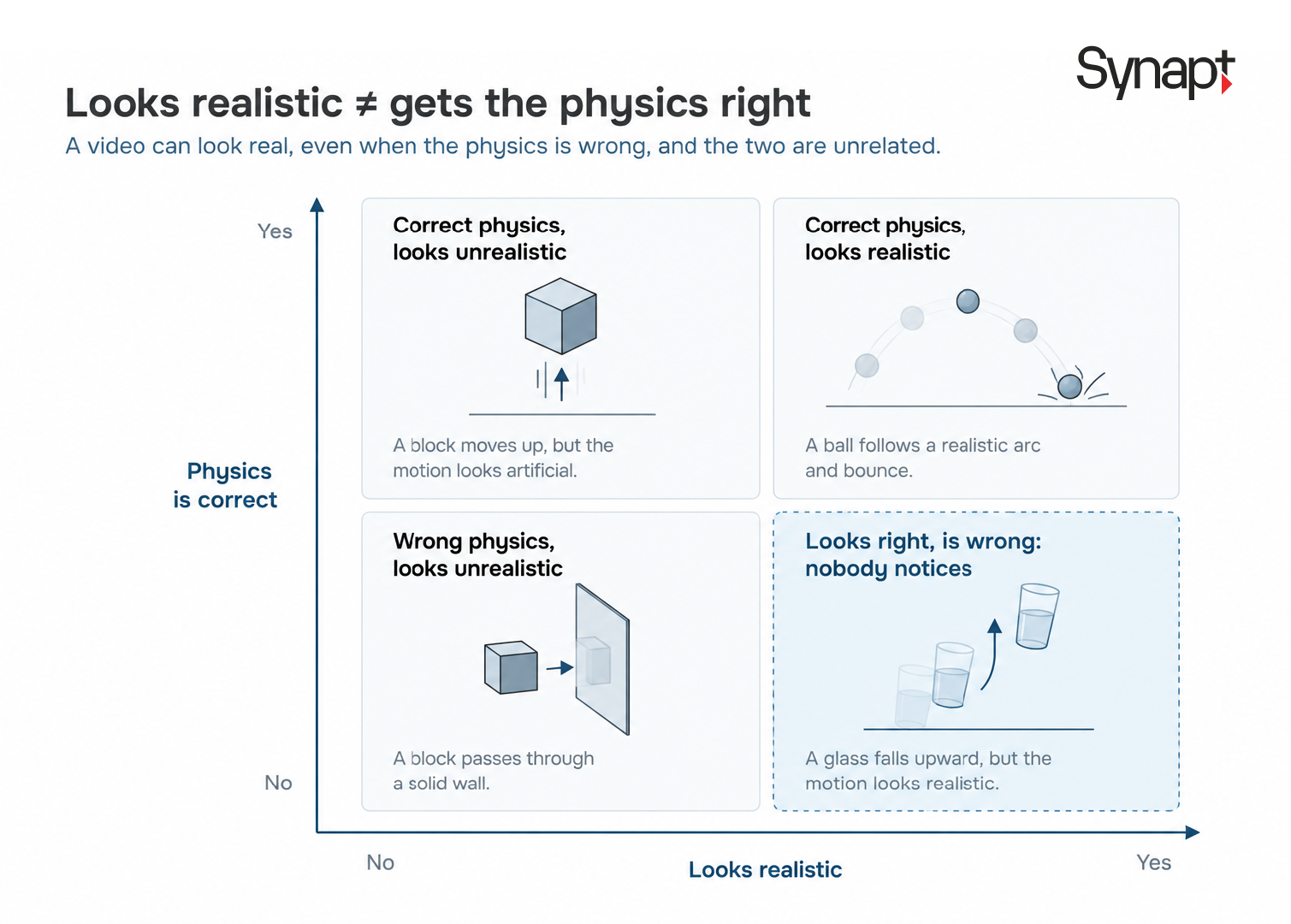
- Realistic output and correct physics are separate properties. The Physics-IQ benchmark found no relationship between them in the video models it tested.
- Our read: narrow simulators have the most real use behind them today. The abstract-space bet is promising and unproven, and generated worlds are impressive and unchecked.
A world model is an AI system’s internal, predictive simulation of how a situation changes, including how it changes when the system takes a particular action. That lets the system test actions in imagination and act in the real world only once it likes the predicted result. In 2026, several well-funded teams are building them, using different methods.
How Does a World Model Work in AI?
A world model is an AI system that predicts how the state of an environment will change in response to an action. It takes the current state of a situation, considers a possible action, and predicts what happens next. For example, if you push a glass toward the edge of a table, you can anticipate that it may fall without actually pushing it off. This ability to predict outcomes comes from an internal understanding of how objects and their environments behave.
Traditional AI models and world models make different types of predictions. A language model predicts the next word or token based on the preceding text. A world model, on the other hand, predicts the next state of an environment based on its current state and a possible action. In the glass example, it predicts how the glass moves toward the edge and what happens if it falls.
The ability to predict the consequences of actions is what makes world models useful for planning and decision-making. Instead of immediately executing an action, an AI system can simulate several possible actions, compare their predicted outcomes, and select the most suitable one. This process is known as planning: the system evaluates potential outcomes in a simulated environment before acting in the real world.
World models are particularly valuable in environments where trial-and-error learning can be expensive or dangerous. A robot cannot learn to carry a tray by repeatedly dropping it, and an autonomous driving system cannot rely on real-world crashes to learn how to respond to every situation. By learning to simulate possible scenarios, world models allow AI systems to practise, evaluate decisions, and improve their behaviour without having to experience every outcome in the physical world.
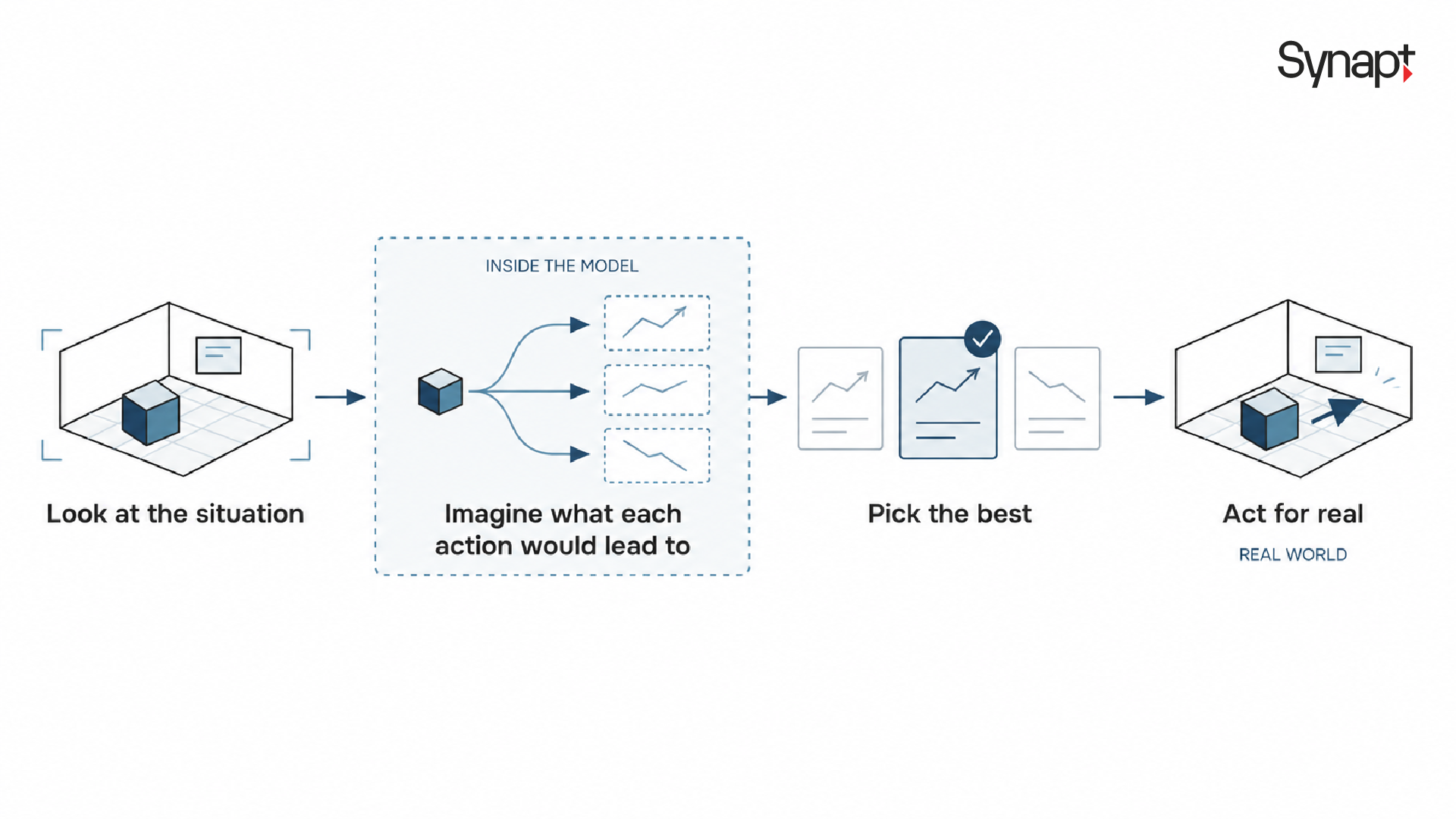
How a world model reaches a decision?
- Look at the situation.
- Imagine what each action would lead to. This step happens inside the model.
- Pick the best outcome.
- Act for real. Only this step touches the real world.
How Is a World Model Different From a Large Language Model?
A language model predicts text; a world model predicts how a situation changes after an action. Text describes the world rather than being the world. A model that has read ten thousand descriptions of knocking over glasses can write a convincing account of it, which is different from holding a working picture of how glasses move.
A language model is trained to minimize prediction error on text, and what it learns from that is what the loss function measures, not what its designers intend. Nothing in a plain next-word predictor forces it to check consequences.
Yann LeCun has made this argument directly. In a January 2026 MIT Technology Review interview, he said
language models “can’t truly reason or plan, because they lack a model of the world,” and that an agentic system “cannot work reliably unless it has a world model to predict the consequences of its actions.” We read that as a bet about where the ceiling is, not a settled fact. Language models do plan and reason to a useful degree. The question underneath the argument still applies to any system that acts: what checks an action before it happens? – Yann LeCun
Where Did the World Model Idea Come From?
The idea took clear shape in 2018, when David Ha and Jürgen Schmidhuber trained an agent entirely inside what they called its own “hallucinated dream”: a compact model of an environment, learned from data (World Models, arXiv 1803.10122). Once the agent worked in the dream, they transferred its policy back to the real environment. The 2026 efforts below are larger, more ambitious descendants of that trick.
How Is a World Model Built?
Most world models do three jobs: compress what the system sees, learn how that compressed state changes, and use the predictions to plan.
- Compress what the system sees. Camera frames and sensor readings are squeezed into a compact internal state, the way you keep “glass near the edge” rather than every pixel of the glass. That compact format is called a latent space, or an abstract representation.
- Learn how the state changes. Given a state and an action, predict the next state. Training relies mostly on recordings of video or robot movements, so it needs few human labels.
- Use the predictions. Roll the model forward step by step in imagination, score the outcomes, and choose the actions that lead somewhere good.
Two details separate the efforts covered below:
- Where the prediction happens. Either in a compact abstract space or directly in pixels.
- How long the model stays right. Every imagined step starts from the previous imagined step, so small errors pile up. That is why long, consistent imagined worlds are hard, and why every approach has a limit on how far ahead it can be trusted.
What Is JEPA and How Does It Work?
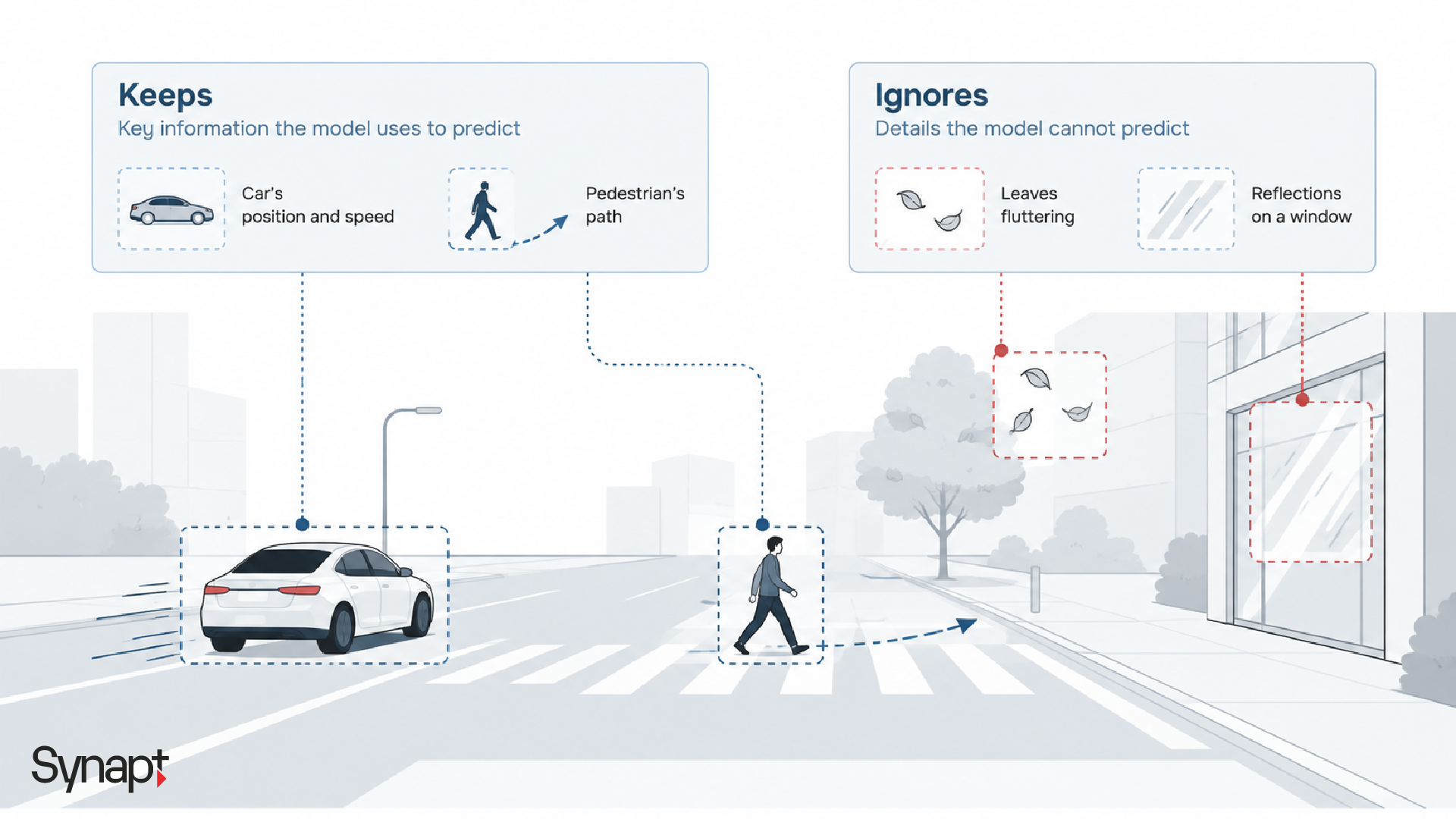
JEPA (Joint Embedding Predictive Architecture) is an AI architecture that predicts changes in abstract representations of a scene rather than generating every pixel or detail. Instead of reconstructing exactly what the future will look like, JEPA learns a compact representation of the current situation and predicts how that representation will change.
This approach is central to Yann LeCun’s vision for the future of AI through AMI Labs, a Paris-based AI company where LeCun serves as executive chairman and Alex LeBrun as CEO.
LeCun argues that predicting every detail of the future is fundamentally difficult because the real world contains too many unpredictable variables. Rather than building generative models that attempt to reproduce every possible detail, JEPA focuses on learning abstract representations of the world and predicting changes within those representations. This allows AI systems to focus on meaningful information while ignoring details that cannot be reliably predicted.
Funding. In March 2026 AMI announced a $1.03 billion round (AMI’s launch update). Tech.eu reported it at a $3.5 billion valuation and as Europe’s largest-ever seed round.
Product status. AMI’s updates page lists only its March 2026 launch announcement, and as of 5 November 2026 we found no AMI model, product or API that the public can test.
Research so far. AMI’s people have started to publish. A preprint co-authored by LeCun and Michael Rabbat (H-JEPA, arXiv 2610.06805, submitted 5 October 2026) stacks three levels of JEPA models so planning happens at several timescales. On a simulated maze task (Visual AntMaze) it reports success rising from 18% to 73% against a flat JEPA baseline, using less planner compute. The paper also reports offline planning on real-robot video, which is not the same as running a robot. It is a preprint, so it shows the approach is being tested rather than proven in the real world.
Earlier evidence. It comes from LeCun’s years at Meta. V-JEPA 2 learned from more than 1 million hours of internet video. Meta then post-trained an action-conditioned version (V-JEPA 2-AC) on less than 62 hours of robot video and deployed it zero-shot on robot arms in two different labs, with no data collected from those robots or environments (Meta’s V-JEPA 2 page summarizes the result).
We read this as a well-funded, specific thesis whose proof is still mostly ahead of it. Judge it on results that appear in the open.
What Is a Generative World Model? Genie 3, Genie 4 and Marble Compared
A generative world model creates an interactive environment by generating frames based on previous frames and the user’s actions. This approach is called autoregressive generation, where each new frame is generated using the information produced so far and the latest action.
| World Model | Developer | How It Works | Key Capabilities | Current Limitations / Status |
| Genie 3 | Google DeepMind | Generates interactive environments from text prompts, allowing users to explore and interact with them in real time. | 24 FPS, 720p resolution, real-time interaction and environment generation. | Continuous interaction is limited to a few minutes. Complex multi-agent interactions remain a research challenge. |
| Genie 4 | Google DeepMind | Generates interactive simulations with native audio and supports changes through natural-language instructions. | Native audio generation and natural-language simulation editing. | Visual details and object permanence can drift during longer simulations or complex edits. Research preview announced on 27 October 2026 for trusted testers. |
| Marble | World Labs | Creates editable 3D environments from text, images, videos, or coarse 3D layouts. | 3D world generation, editing, expansion and export as Gaussian splats, meshes or video. | Focuses on creating editable 3D environments rather than generating an environment dynamically as users move. |
How Are Genie and Marble Different?
| Comparison | Genie 3 / Genie 4 | Marble |
| Primary approach | Real-time interactive world generation | Persistent 3D world creation |
| Input | Text prompts and user actions | Text, images, video and 3D layouts |
| Environment generation | Generates environments as users interact | Creates environments that users can edit and expand |
| Main purpose | Interactive simulation | 3D world creation and spatial intelligence |
| Output | Dynamic, evolving environment | Editable and exportable 3D environment |
World Labs describes Marble as a step toward its broader goal of spatial intelligence. The company announced a definitive agreement to join AMD on 28 September 2026, with the transaction expected to close by the end of 2026.
Do AI Video Models Actually Understand Physics?
No. Generating realistic videos does not necessarily mean an AI model understands the physical laws governing the real world. Visual realism and physical accuracy are two different capabilities. A video can look convincing while incorrectly representing how objects move, collide, interact, or respond to physical forces.
The Physics-IQ benchmark (arXiv research paper; project page) evaluates whether video generation models can accurately represent physical phenomena.
What Does the Physics-IQ Benchmark Reveal?
| Benchmark Attribute | Details |
| Benchmark name | Physics-IQ |
| Dataset | 396 videos |
| Video duration | 8 seconds each |
| Physical scenarios | 66 |
| Physics domains | Fluid dynamics, optics, solid mechanics, magnetism and thermodynamics |
| Models evaluated | Sora, Runway, Pika, Lumiere, Stable Video Diffusion and VideoPoet |
| Main finding | Physical understanding was severely limited and did not correlate with visual realism |
| Research publication | WACV 2026, according to the project page |
Why Does Physical Accuracy Matter in World Models?
The Physics-IQ benchmark evaluated earlier video generation models, not Genie 3 or Genie 4. Therefore, its findings cannot establish how accurately those world models simulate physics.
However, it highlights an important challenge for AI systems that use generated environments for planning and training.
| Challenge | Why It Matters |
| Incorrect physical behaviour | Objects may move or interact differently from their real-world behaviour. |
| Misleading simulations | AI agents may learn patterns that do not hold in physical environments. |
| Errors during planning | An agent may select an action based on an inaccurate prediction of its consequences. |
| Hidden inaccuracies | Subtle physical errors can go unnoticed while influencing the agent’s learned behaviour. |
The key concern is that a physically inaccurate simulation can teach an AI agent the wrong behaviour. If an agent trains or plans inside a world where physical interactions are subtly incorrect, it may make decisions that work in simulation but fail in the real world.
A related gap shows up in safety testing, where a model that infers it is being evaluated can behave differently under evaluation than it does once deployed.
How Are World Models Used in the Real World?
World models are already being applied in autonomous driving, robotics, and physical AI, particularly for simulation, testing, and training. These systems help AI models predict how physical environments respond to specific actions, allowing developers to evaluate potential outcomes before deploying systems in the real world.
Two notable examples are Wayve’s GAIA models for autonomous driving and NVIDIA’s Cosmos models for physical AI.
How Is Wayve Using World Models for Autonomous Driving?
Wayve uses its GAIA (Generative AI for Autonomy) models to generate realistic driving scenarios and simulate how autonomous driving systems respond to different road conditions. These simulations help developers evaluate driving systems against scenarios that may be rare, dangerous, or difficult to reproduce on real roads.
| Model | Release / Announcement | Key Capabilities and Developments |
| GAIA-1 | 2023 | Contains over 9 billion parameters and was trained on 4,700 hours of driving data collected in London. |
| GAIA-3 | 2 December 2025 | Contains 15 billion parameters and was pretrained on ten times more data than GAIA-2, covering multiple continents. Designed to generate safety-critical driving scenarios for simulation and evaluation. |
| GAIA-4 | 3 August 2026 | Integrates Wayve’s AI Driver into the simulation loop, allowing the generated environment to change in response to driving decisions. It also generates radar alongside camera video. |
According to Wayve, early studies indicate that GAIA-3 simulated testing closely mirrors real-world driving results and has reduced synthetic-test rejection rates fivefold.
Wayve has also announced DriveSafeSim, a UK government-funded project with Warwick Manufacturing Group at the University of Warwick, focused on validating generative world models for safety evaluation.
How Is NVIDIA Using World Models for Robotics and Physical AI?
NVIDIA is developing its Cosmos family of models to support physical AI applications, including robotics and autonomous systems.
On 31 May 2026, NVIDIA announced Cosmos 3, which it describes as an open world foundation model for physical AI. The model can be used to simulate physical environments and predict future world states, supporting AI training and evaluation.
According to NVIDIA, Cosmos 3 also ranks first among open models on the Physics-IQ benchmark for world-generation accuracy. This is a company-reported performance claim.
| Attribute | NVIDIA Cosmos 3 |
| Developer | NVIDIA |
| Announcement date | 31 May 2026 |
| Category | World foundation model for physical AI |
| Primary application | Robotics, physical AI simulation, training and evaluation |
| Key capability | Simulating physical environments and predicting future world states |
| Benchmark claim | NVIDIA reports first place among open models on Physics-IQ for world-generation accuracy |
These examples demonstrate how world models are moving beyond research into practical applications. Autonomous driving companies use them to evaluate safety-critical scenarios, while physical AI developers use them to simulate environments and train systems before real-world deployment.
Which World Model Approach Has the Most Evidence Today?
Narrow simulators for testing have the most real use behind them as of November 2026. The abstract-space bet has papers and simulations, and generated worlds have demos with stated limits.
Comparing the Four Main Approaches to World Models
| Comparison | Abstract-Space Prediction (JEPA) | Live Generated Worlds | Exportable 3D Worlds | Narrow Simulators for Testing |
| Approach | Predicts changes in abstract representations | Generates interactive environments frame by frame | Creates editable and exportable 3D environments | Simulates specific physical scenarios and actions |
| Examples | AMI Labs; Meta’s V-JEPA 2 | Google DeepMind Genie 3; Genie 4 (preview) | World Labs Marble | Wayve GAIA-3 and GAIA-4; NVIDIA Cosmos 3 |
| What it predicts or builds | A compact representation of how a scene changes | An explorable world that evolves in real time | A 3D environment that can be edited and exported as Gaussian splats, meshes or video | The consequences of specific actions, such as driving scenarios or robot behaviour |
| Evidence today | Research papers, simulations and V-JEPA 2 robot-arm tests in two labs | Interactive demonstrations with stated limitations | Publicly available product since November 2025 | Company-reported results and an announced UK government-funded validation project |
| Main open question | Does it work on real robots outside the laboratories where it was developed? | Is the simulated physics accurate, and how long does the environment remain consistent? | How accurately can generated 3D worlds support planning? | What does independent validation reveal about simulation accuracy? |
World models are being developed through different technical approaches. JEPA focuses on predicting changes in abstract representations, Genie generates interactive environments, Marble creates editable 3D worlds, and systems such as GAIA and Cosmos target simulation for specific physical AI applications.
These approaches share a common goal: helping AI systems predict, represent, or simulate how the world behaves. However, their capabilities, applications, and levels of real-world validation differ.
How Can You Tell If a World Model Actually Works?
Not all world models do the same thing, so their claims should not be judged by the same criteria. A useful evaluation starts with three questions:
- What type of world model is it? Is it predicting changes in an abstract representation, generating an interactive world frame by frame, creating an editable 3D environment, or simulating a specific action for testing? Each approach has different capabilities and requires different evidence.
- What was actually tested? Visual realism and physical accuracy are not the same. A model can generate convincing images or video without correctly predicting how objects, forces or environments behave.
- What evidence supports the claim? Look at whether the result comes from a published research paper, a controlled simulation, a public demonstration, a shipped product or independent real-world testing. These provide different levels of evidence. For example, JEPA-related research has demonstrated progress through papers and simulations; Genie has been shown in interactive demos with stated limitations; and the use of world models for autonomous-driving validation includes company-reported results and the ongoing evaluation work of the government-funded DriveSafeSim project.
The most important question is: Has anyone tested whether the model’s predictions are correct, or have they only shown that its outputs look convincing?
Several developments could provide stronger evidence:
- AMI Labs: A model release that independent researchers and developers can test.
- Real-world robotics: A JEPA-style planner succeeding on physical robots beyond the laboratory where it was developed.
- Independent physics evaluations: Tests that include newer world generators such as Genie 3 and Genie 4.
- DriveSafeSim: Published validation findings showing how well generative world models perform in safety evaluation.
These developments will help distinguish promising demonstrations from systems that can reliably predict and simulate real-world behaviour.
What Does This Mean for Enterprises Deploying AI Agents?
Enterprise agents that change a configuration, approve a workflow or update a policy face the question a world model is built to answer: what checks an action before it happens? Most enterprise agents have no learned simulator to rehearse in. What they have is the state they are handed and the rules around it.
A prediction, however good the method, starts from that state. If the state is stale, ungoverned or missing the authority behind a decision, the prediction inherits the error, the same way a generated world inherits a subtle physics mistake.
For agents that act today, the first checks therefore sit on the data and policy side: which authority an action runs under, which version of a policy applied, and a record that can be audited afterward. The governance gaps MCP leaves open, such as access without per-user authorization and audit trails that record actions but not authority, are examples of what has to close before simulation can help.
Synapt AI’s covers that side of the question. It is a governed context substrate that connects AI agents to live enterprise data without migration, so the state any prediction starts from is current and traceable, whichever model method sits on top.
FAQ's
A world model is an AI system’s internal, predictive simulation of how a situation changes in response to an action. It takes the current state and a proposed action, predicts the next state, and lets the system compare likely outcomes in imagination before acting in the real world.
A language model predicts the next word from the words so far. A world model predicts the next state of a situation given an action, so it can compare actions in imagination before choosing one. Language models can plan and reason to a useful degree, but nothing in a plain next-word predictor checks consequences.
JEPA, championed by Yann LeCun, predicts how a compact, abstract summary of a scene changes and ignores detail it cannot predict; LeCun has said “JEPA is not generative AI.” Genie 3 generates each frame of an explorable world in real time, one frame after another, steered by the user’s actions.
As of November 2026: AMI Labs (co-founded by Yann LeCun), Google DeepMind (Genie 3, plus Genie 4 in research preview), World Labs (Marble; it has agreed to join AMD), Wayve (GAIA-3 and GAIA-4) and NVIDIA (Cosmos 3), among others. They use different methods, from abstract-space prediction to narrow simulators for testing.
No. In the Physics-IQ benchmark, the tested video models’ physical understanding was severely limited and unrelated to how realistic their video looked, although some test cases could already be solved. Looking right and modeling physics correctly are separate properties, and subtle physics errors are harder to catch than obvious ones.
A narrow simulator generates scenarios that are rare or unsafe to reproduce in the real world, then checks how a system responds. Wayve’s GAIA models do this for driving, and NVIDIA’s Cosmos targets robots and vehicles. Wayve says GAIA-3 simulated tests closely mirror real-world results; a UK government-funded project is working to validate that approach.
Ask which kind of world model it is, what was actually tested, and where the evidence sits: a shipped result, a paper, a simulation or a demo. Then ask the key question: has anyone checked that what the model predicts is correct, or only that it looks convincing?

Subscribe to our newsletter
Insights on making enterprise AI actually work - straight to your inbox.
Subscribe to our newsletter
Insights on making enterprise AI actually work - straight to your inbox.