TL;DR
- Telecom is leading agentic AI adoption, but not autonomous operations. Adoption numbers show experimentation and deployment activity, not that operators fully trust AI agents to run critical networks independently.
- “Adoption” means very different things across operators. Some organizations use agents with strict human oversight (AT&T), others govern thousands of enterprise agents (SK Telecom), while some enable limited autonomous actions (Deutsche Telekom).
- Trust is the real bottleneck, not AI capability. Most operators are comfortable with agents that recommend actions, but remain cautious about agents that can take actions without approval.
- A wrong action is far more costly than a wrong answer. An incorrect recommendation can be reviewed by a human. An incorrect autonomous action can directly impact live services, customers, and business operations.
- Successful agentic AI deployments are built on governance, not just models. The most important controls are clear permissions, human checkpoints where needed, complete audit trails.
- The autonomy journey is gradual. Operators are moving from advisory agents to closed-loop automation step by step, proving reliability in lower-risk scenarios before granting greater autonomy.
- The real question is: Are the agents advising or acting? If they’re acting, who governs them, who reviews them, and can every decision be traced?
Telecommunications currently leads agentic AI adoption among major industries, with 48% of organizations reporting implementation, according to NVIDIA’s State of AI survey. While this figure frequently appears in discussions around AI transformation, it tells only part of the story.
Beneath the adoption statistics lies a more measured reality. Many telecom operators continue to maintain human oversight for critical decisions and operational workflows. Industry sentiment reflects a similar level of caution. A TelecomTV survey of 260 telecom professionals found that a majority do not yet view agentic AI as sufficiently mature for deployment across production networks.
Unlike traditional AI systems that primarily generate insights or answer questions, agentic AI is designed to take action. It can execute operational checks, open service tickets, initiate workflows, or modify system configurations with limited human intervention.
To better understand the disconnect between adoption figures and operational confidence, we examined what telecom operators are actually deploying, testing, and discussing. The picture that emerges is nuanced: telecom is clearly at the forefront of experimenting with AI agents, yet many organizations are still determining the appropriate level of autonomy those agents should be granted.
The most valuable lessons lie within that gap between adoption and trust. In our view, the goal is not simply to increase or reduce human oversight. The real challenge is identifying where oversight adds value and where evidence demonstrates that autonomous action can be trusted.
What Does “Adoption” Really Mean in Telecom Industry?
The frequently cited 48% agentic AI adoption figure from NVIDIA’s survey deserves closer examination. The study collected more than 3,200 responses across five industries between August and December 2025. However, NVIDIA’s methodology groups together organizations that are actively deploying AI agents and those still evaluating their potential. As a result, the data signals strong industry interest and momentum, but it should not be interpreted as evidence that autonomous agents are widely operating critical telecom networks today.
Looking beyond the headline number, a more nuanced picture emerges. Across the telecom sector, “adoption” can represent very different levels of operational maturity, autonomy, and trust.
AT&T, for example, reported having more than 410 generative AI agents in production as of 2025. Yet its approach emphasizes governance and oversight rather than full autonomy. Agent-driven workflows include mandatory checkpoints, human review mechanisms, and comprehensive activity logging. Even within production environments, final accountability remains firmly in human hands.
SK Telecom has focused on scaling agent usage across the enterprise. Its operating model treats AI agents much like organizational employees, assigning each one a unique identity, functional responsibility, department alignment, and defined permissions. The company reported that more than 2,000 agents were being used across business functions such as marketing, legal, and public relations, reflecting a structured approach to governing AI at scale.
Deutsche Telekom represents a more advanced step toward operational autonomy. Its RAN Guardian Agent, developed with Google Cloud technologies and deployed in late 2025, can independently initiate corrective actions within radio access networks. The system proactively identifies upcoming high-demand events, evaluates network capacity, adjusts configurations where necessary, and records all actions performed. According to the company, activities that previously required approximately an hour can now be completed within minutes.
These examples highlight an important reality: adoption does not have a single definition. One operator may use AI agents primarily as decision-support tools, another may deploy them broadly across internal functions, while a third may allow them to take direct operational action in production environments.
What is arguably more revealing than adoption metrics is what remains unreported. Most telecom organizations readily share agent counts, deployment milestones, and productivity gains. Far less common are disclosures around accuracy, exception rates, failure rates, or autonomous decision quality. As agentic AI becomes more deeply embedded in telecom operations, these trust indicators may prove far more valuable than adoption percentages alone.
| Operator | Scale of Adoption | Level of Autonomy | Human Oversight | Primary Focus | Reported Outcome |
| AT&T | 410+ generative AI agents in production | Low to Moderate | Required checkpoints and human review throughout workflows | Operational efficiency and workflow automation | Agents deployed at scale while maintaining human accountability |
| SK Telecom | 2,000+ active agents across business functions | Moderate | Governed through defined roles, permissions, and access controls | Enterprise-wide productivity across departments such as marketing, legal, and PR | Large-scale organizational adoption with structured governance |
| Deutsche Telekom | Production deployment of the RAN Guardian Agent | High | Limited intervention for routine network actions | Autonomous network operations and optimization | Tasks reduced from approximately one hour to a few minutes |
| Key Takeaway | All three are considered “adopters” | Autonomy levels vary significantly | Trust models differ by operator | Different business goals drive deployment approaches | Adoption alone does not reveal how much decision-making is delegated to AI |
Do Operators Trust AI Agents to Act Independently?
Not entirely, at least not yet. While telecom operators are accelerating their adoption of agentic AI, most remain cautious about allowing agents to make and execute decisions without human involvement.
Evidence from industry surveys suggests that operators are prioritizing AI agents that assist humans rather than replace them.
According to Omdia’s research, more than 74% of network operators expect to deploy agents across multiple network operations processes within the next two years. However, the first wave of deployments is expected to focus on advisory capabilities: agents that identify issues, analyze root causes, and recommend corrective actions while leaving the final decision to human operators.
The appetite for fully autonomous, closed-loop operations is notably lower. Within the next year, only around one-third of operators expect to implement agents capable of independently planning, orchestrating, or resolving network issues. Adoption is projected to increase over time, but the progression clearly reflects a cautious approach. Operators appear determined to build confidence through lower-risk use cases before extending greater authority to AI systems.
Industry practitioners echo these concerns. Telecom networks remain highly complex, business-critical environments where reliability and service continuity are paramount. As a result, many operators continue to view autonomous decision-making as a capability that must be earned through proven performance rather than assumed from advances in AI models alone.
Another challenge is the reality of multi-vendor network environments.
While many agentic AI solutions perform effectively in controlled ecosystems, telecom networks typically span infrastructure, platforms, and software from numerous providers.
This creates additional coordination, interoperability, and governance requirements that autonomous agents must navigate before operators are comfortable expanding their responsibilities.
Lessons from early deployments further reinforce this measured outlook. Several operators have reported running numerous AI pilots without consistently demonstrating sufficient business value to justify large-scale investment. Others highlight the importance of contextual awareness, noting that AI systems require a deep understanding of operational environments, policies, and constraints to make trustworthy decisions.
In our view, the trust gap is less about model capability and more about operational governance. The critical questions are not whether an AI agent can perform a task, but rather:
- What systems can it access?
- What actions can it perform?
- Who validates its decisions?
- What guardrails are in place?
- Is every action auditable?
Organizations that can answer these questions clearly are more likely to expand the scope of autonomous operations with confidence.
The Telecom Industry’s Autonomy Maturity Curve
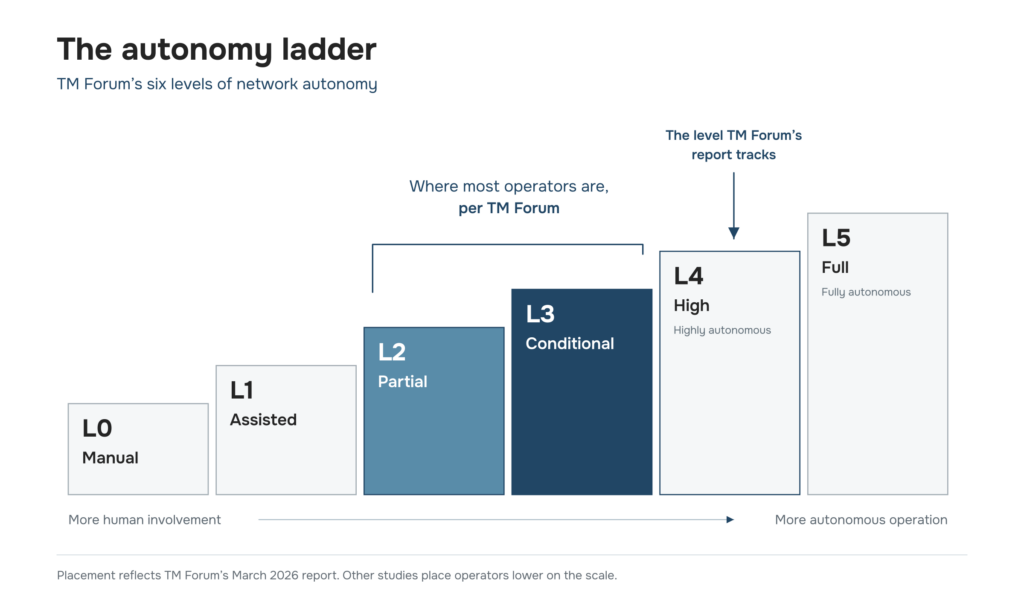
To measure this progression, TM Forum defines six levels of network autonomy, ranging from L0 (Fully Manual) to L5 (Fully Autonomous). Most telecom operators today are considered to be operating between L2 and L3, where AI can assist with analysis, recommendations, and selected automated actions, but humans remain actively involved in oversight and decision-making.
This context helps explain the apparent contradiction between high adoption figures and persistent trust concerns. Telecom operators are clearly investing in and deploying AI agents, but many are doing so within environments where human supervision remains an integral part of the operating model.
Network Autonomy Levels at a Glance
| TM Forum Level | Description | Human Involvement | Typical AI Agent Role |
| L0 | Fully manual operations | Complete human control | No autonomous capabilities |
| L1 | Assisted operations | Humans perform actions with limited AI support | Monitoring and basic recommendations |
| L2 | Partial automation | Humans approve key decisions | Analysis, diagnostics, and workflow assistance |
| L3 | Conditional autonomy | AI performs selected actions under supervision | Automated execution within defined rules |
| L4 | Highly autonomous operations | Minimal human intervention required | Closed-loop operations in specific domains |
| L5 | Fully autonomous operations | No routine human intervention | End-to-end autonomous decision-making and execution |
Why a Wrong Action Costs More Than a Wrong Answer?
When evaluating agentic AI, accuracy is only part of the equation. The larger consideration is the impact of failure.
Agentic AI trust is determined less by model intelligence and more by three factors: what an agent can access, what it is allowed to do, and how its actions are governed and audited.
A chatbot that generates an incorrect response creates an information problem. An AI agent with permission to execute actions creates an operational risk. The difference lies not in the mistake itself, but in the authority granted to the system.
A useful analogy is navigation software. If a navigation app recommends the wrong route, the user can ignore it. If the same system can take control of the steering wheel, the consequences become significantly more serious. The same principle applies to enterprise AI. An incorrect recommendation reviewed by a human may have limited impact. An incorrect action executed automatically can directly affect live systems, customers, or business operations.
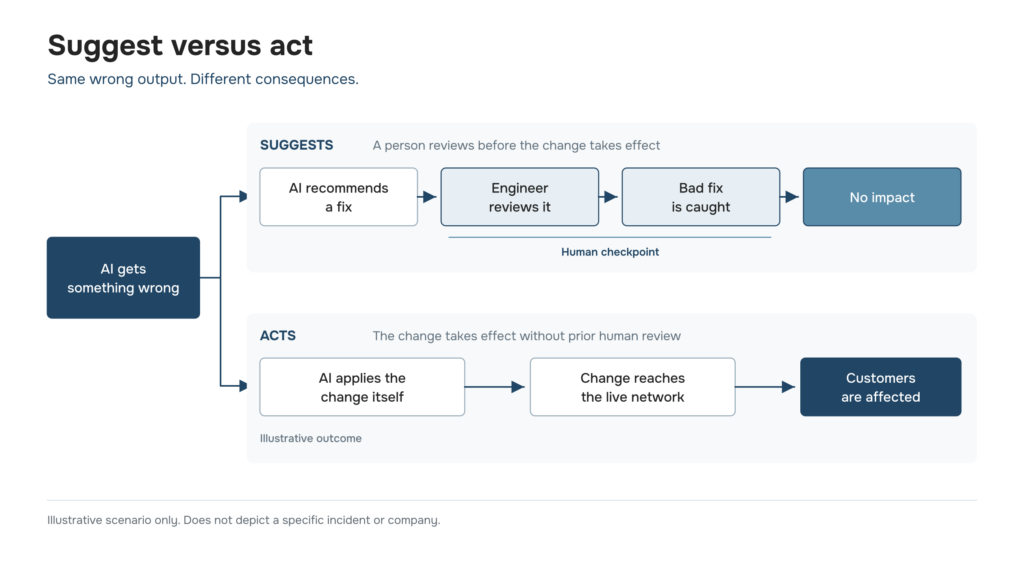
Challenges also remain around domain accuracy. Industry benchmarks have highlighted instances where general-purpose AI models generated incorrect responses on specialized telecom topics, including recommendations that could negatively affect network performance. While performance continues to improve, the findings reinforce an important point: domain expertise alone is not enough to establish trust for autonomous execution.
Perhaps the more important question is not whether an AI agent can make mistakes, but how much authority it has when one occurs.
The clearest lessons often come from outside telecom. Across industries, organizations are discovering that permissions, governance, and review processes ultimately determine the severity of AI-related incidents. Whether an issue originates from an AI agent, a developer tool, or a manual action, excessive access combined with insufficient oversight can significantly increase operational risk.
Conversely, some of the strongest examples of agentic AI success share common characteristics. The problem scope is narrowly defined, objectives are measurable, and success criteria are clearly established. In these environments, AI can deliver meaningful gains in speed, efficiency, and decision-making while operating within well-understood boundaries.
The lesson is straightforward: trust should be built around evidence, controls, and accountability rather than model capability alone.
What Separates Successful Deployments from Stalled Pilots?
Successful agentic AI deployments are rarely defined by the model alone. They are defined by governance, trusted data, human oversight, and the ability to explain every action an agent takes.
When comparing organizations pursuing agentic AI, the difference rarely appears to be the underlying model itself. Instead, success often depends on how AI agents are governed, how closely they are connected to operational data, and where human oversight is introduced.
Despite their differences, these examples point to a common reality: successful deployments are built on strong operational foundations rather than AI capability alone.
Organizations that move beyond pilots can typically answer three critical questions with confidence.
What Is the Agent Allowed to Access?
Every AI agent should operate within clearly defined boundaries.
Access permissions, data entitlements, system connectivity, and action privileges must be explicitly scoped. Leading telecom operators increasingly treat AI agents much like employees, assigning specific responsibilities, approved systems, and access controls.
The objective is simple: an agent should only interact with the information and systems required to perform its designated task.
Where Does Human Review Occur?
Human oversight remains one of the most effective trust mechanisms.
The goal is not to review every action forever, but to identify moments where validation is necessary. High-impact decisions, write operations, customer-facing actions, and production changes may require human approval, while routine low-risk activities can increasingly be automated.
Trust is built by knowing where intervention matters most.
Can Every Decision Be Traced?
Autonomous systems must be observable.
Organizations need visibility into:
- What information the agent used
- Which process or procedure it followed
- What decision it made
- What actions were executed
- What outcomes resulted
Without this auditability, it becomes difficult to establish accountability, investigate issues, or improve future performance.
The Real Foundation of Trust
These controls are often viewed as governance requirements, but they are equally trust requirements.
A more powerful model does not automatically provide:
- Access controls
- Approval workflows
- Audit trails
- Accountability mechanisms
- Operational guardrails
Those capabilities must be designed into the architecture surrounding the model.
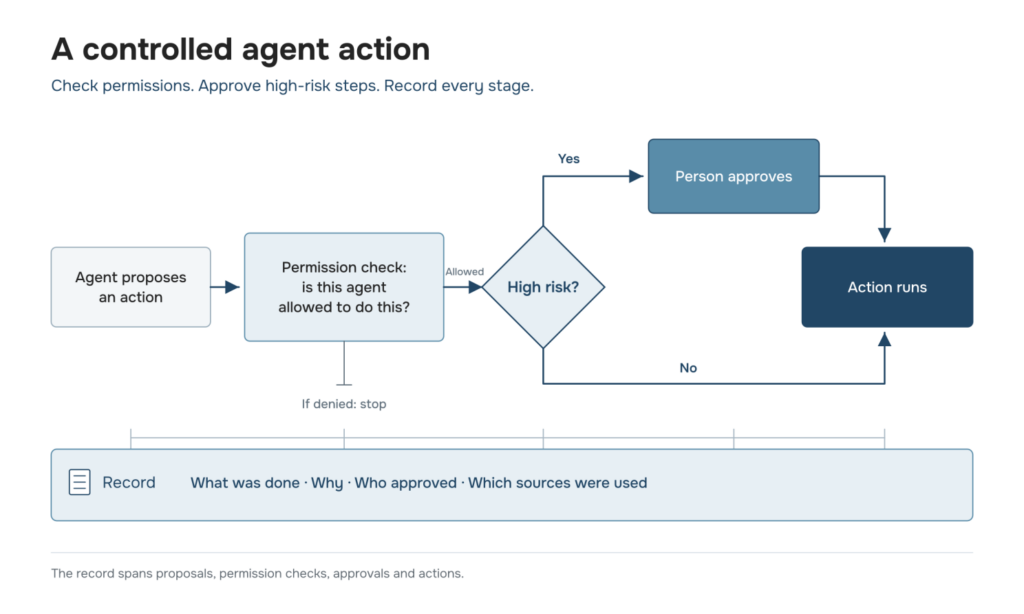
Climbing the Autonomy Ladder Responsibly
The goal is not complete automation everywhere. The goal is building enough evidence and operational confidence to allow low-risk tasks to run autonomously while preserving human oversight where mistakes would have meaningful consequences.
That is how organizations climb the autonomy ladder without increasing operational risk at the same pace.
This challenge is precisely what Synapt’s Context Substrate is designed to address.
Organizations cannot trust autonomous agents based solely on model performance. They need controls that govern what agents can access, what actions they can take, and how those actions can be verified. Synapt’s Context Substrate provides this foundation by embedding governance, context, and accountability directly into agent workflows.
For example:
- Context Providers restrict agents to approved domains of knowledge, preventing them from accessing information outside their designated scope.
Procedure Stores maintain version-controlled workflows and can enforce human approval checkpoints before critical actions are executed.
Knowledge Stores attach confidence scores, freshness indicators, and source lineage to information, helping agents make decisions based on trusted context.
Audit Trails capture the knowledge used, procedures followed, decisions made, and actions executed, ensuring every step can be reviewed and explained.
These capabilities align directly with the three questions every organization should ask before granting autonomy to AI agents:
- What is the agent allowed to access and change?
- Which decisions require human approval?
- Can every action be traced, explained, and audited?
The answers to these questions ultimately determine whether an organization can move from experimentation to trusted autonomy.
While the examples in this article come from telecom, the lesson applies across industries. Whether the risk is a network outage, a corrupted customer database, an incorrect financial transaction, or thousands of customers receiving the wrong invoice, the challenge remains the same: balancing autonomy with accountability.
The organizations that succeed with agentic AI will not be those that deploy the most agents. They will be those that build the governance, visibility, and trust frameworks needed to allow agents to act safely at scale.
FAQ's
While adoption is increasing, most operators are still cautious about allowing agents to make autonomous decisions in production environments. The hesitation stems from operational risk, governance concerns, and the potential impact of incorrect actions on live services.
Deploying an AI agent means it is available to perform a task. Trusting it means allowing it to take actions without human approval. Many organizations have crossed the first threshold but are still working toward the second.
Advisory agents help diagnose issues and recommend actions while keeping humans in control of the final decision. This allows organizations to demonstrate reliability and build confidence before moving to higher levels of automation.
Trust typically depends on three factors: Without these controls, organizations may struggle to safely scale autonomous operations.
A common approach is to evaluate the cost of being wrong. High-impact decisions involving customers, production systems, security, compliance, or financial transactions often retain human oversight, while repetitive, low-risk tasks are increasingly automated.
The difference is often not the model itself. Successful deployments are usually supported by strong governance, clear permissions, high-quality contextual data, approval workflows, and comprehensive audit trails that help establish trust and accountability.
Telecom enterprises can trust AI agents when autonomy is backed by clear permissions, human approval checkpoints for high-risk actions, and complete auditability. Trust is built by knowing what an agent can access, what it is allowed to do, and being able to trace every decision it makes. Synapt Context Substrate enables this by providing controlled access to enterprise knowledge, governed workflows, confidence-scored context, and end-to-end audit trails, helping telecom operators safely scale autonomous AI while maintaining accountability and compliance.

Subscribe to our newsletter
Insights on making enterprise AI actually work - straight to your inbox.
Subscribe to our newsletter
Insights on making enterprise AI actually work - straight to your inbox.