Across telecom and digital service industries, address data has become a critical operational and regulatory dependency. From E911 compliance and emergency response readiness to service fulfilment and dispatch planning, accurate address validation underpins both customer safety and business performance. Yet most organisations still rely on fragmented systems and manual workflows built for a slower, less complex operational reality.
Legacy validation tools flag mismatches, but they fail to answer the questions operations leaders care about: Which addresses are truly valid? Where is human intervention required? And how can errors be resolved in real time without slowing fulfilment?
This is no longer just a data quality issue—it is an order-to-dispatch intelligence gap. Telecom providers maintain multiple address sources, county-level databases, and regulatory systems such as E911, yet lack an integrated, intelligent mechanism to reconcile them at scale. As order volumes grow and fulfilment timelines shrink, traditional validation approaches collapse under manual effort, delayed resolution, and downstream operational risk.
What the industry needs is a shift from manual verification to AI-driven address intelligence—where automation doesn’t just validate addresses, but contextualises discrepancies, recommends corrections, and accelerates decisions with confidence.
Enterprises managing large-scale service orders face four persistent challenges in address validation:
Data inconsistency: Frequent mismatches between internal systems (such as DCRIS) and E911 databases lead to failed orders and rework.
Fragmented databases: County-specific address sources require agents to check multiple systems, increasing processing time and cost.
Manual dependency: Human-led validation slows order creation, strains workforce capacity, and introduces variability.
Lack of real-time visibility: Without live validation and tracking, errors surface late—impacting dispatch planning, equipment estimation, and customer experience.
For telecom operations teams, these gaps directly affect fulfilment speed, regulatory compliance, and service reliability—turning address validation into a bottleneck rather than an enabler.
Prodapt partnered with a leading telecom provider to redesign address validation as an AI-led, human-in-the-loop intelligence workflow. The objective was clear: reduce errors at the source, automate resolution wherever possible, and provide operational teams with real-time confidence in address data.
The result was a Practical GenAI solution that transformed address validation from a manual checkpoint into a continuous, intelligent layer embedded across the order lifecycle.
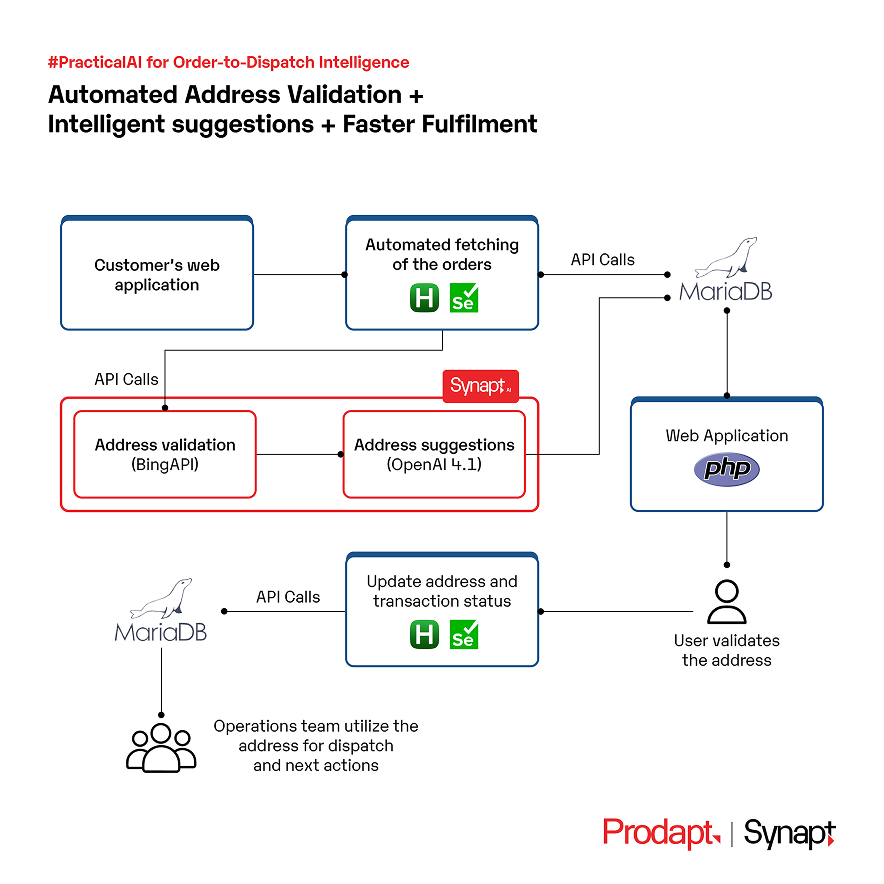
The solution was built on a modular, automation-first architecture designed for scale, accuracy, and regulatory assurance.
1. Automated Order Ingestion & Data Foundation
Orders are automatically fetched from the customer’s business web application using a Python-based bot and stored in a centralised MariaDB repository. This ensures a single source of truth for validation, tracking, and reporting.
2. Real-Time Address Validation
Each address is validated against authoritative E911 data via the Bing Address API and cross-referenced against internal DCRIS records. This automated validation eliminates most manual checks upfront.
3. GenAI-Powered Address Suggestions
When discrepancies arise, large language models generate up to five intelligent address suggestions per order. These suggestions are validated against E911 standards, ensuring both accuracy and compliance—moving resolution from guesswork to guided intelligence.
4. Human-in-the-Loop Confirmation
A lightweight web application enables users to review and confirm AI-suggested addresses. This human oversight layer preserves operational trust while dramatically reducing effort.
5. Unified Order Lifecycle & Auto-Allocation
A unified lifecycle system brings together validation, tracking, and reporting. An auto-allocation agent interface allows operations teams to manage exceptions, track resolution, and plan dispatch actions efficiently.
6. Real-Time Error Resolution
Live error queues surface validation failures instantly, enabling rapid resolution and preventing downstream delays in fulfilment and dispatch.
90% reduction in address validation errors, driven by AI-powered automation
4+ FTE savings, through reduced manual intervention
50% faster order processing, enabled by real-time validation and auto-allocation
30% increase in agent productivity, shifting focus to higher-value tasks
25% improvement in customer satisfaction, through faster and more reliable service fulfilment
Beyond efficiency, the solution restored trust in address data—critical for E911 readiness and operational confidence.
When address intelligence breaks down, the impact ripples across the organisation. Orders stall, dispatch planning falters, compliance risk rises, and customer trust erodes. In contrast, when address validation becomes intelligent and proactive, it unlocks speed, accuracy, and resilience across the entire order-to-dispatch chain.
As service providers scale operations in increasingly regulated and time-sensitive environments, address intelligence becomes not just an operational necessity but also a competitive advantage.
The convergence of GenAI, automation, and human oversight marks a turning point in how enterprises manage operational data quality. What began as manual validation is evolving into a self-improving intelligence layer—one that learns from every exception and continuously raises accuracy.
Want to explore how GenAI can modernize your order-to-dispatch operations? Let’s talk.


Deliver measurable outcomes for your business with #PracticalAI. Let’s talk!