Across the fibre and broadband landscape, service providers are facing a familiar squeeze: faster activation expectations, tighter SLA regimes, and zero tolerance for avoidable rework — while legacy delivery models still depend heavily on manual triage, spreadsheet prioritisation, and fragmented views of network and order health. When the installation journey breaks, it doesn’t just create operational noise; it becomes a measurable CX cost. McKinsey notes that most service providers saw widespread dissatisfaction with the broadband installation process, driving service cancellations and an average call rate of 0.6 calls per customer per month, which is well above industry norms — a reminder that installation failures quickly ripple into contact centre load and churn risk.
Even a single RFT (Right-First-Time) miss can trigger a chain reaction that includes repeat truck rolls, missed SLAs, penalties, and customer frustration. Cross-industry field service benchmarks show that when issues aren’t resolved on the first visit, the total resolution cost averages ~44% higher than the cost per work order, as repeat visits and additional labour accumulate quickly.
As demand grows and network rollout accelerates, service-delivery blind spots have become one of the biggest hidden drivers of customer churn and operational waste. In a high-velocity business where every failed installation erodes customer confidence and profitability, service providers can no longer rely on manual judgment to “figure it out during dispatch.”
A leading fibre operator managing nationwide provisioning wasn’t held back by data scarcity, but by the inability to convert that data into real-time, risk-aware intelligence. This blind spot drove avoidable failures, inflated costs, and eroded customer satisfaction.
1. RFT Failures Fueling Customer Churn
Without early warning signals, teams couldn’t spot high-risk installations. Delayed activations, repeat visits, and poor first-time experiences drove customers to cancel and churn.
2. Frequent SLA Breaches and Penalties
Order desks operated blindly, unable to identify jeopardy before it hit. SLA violations triggered auto-compensation, penalties, and unnecessary escalations—hurting both margins and customer confidence.
3. Costly, Inefficient Truck Rolls
Engineers were dispatched without visibility into order complexity or network maturity. This led to wasted trips, multiple revisits, and inefficient field productivity—rapidly ballooning operational costs.
4. Reactive Ops Due to Fragmented Systems
Critical signals lived in isolated systems—network logs in one place, customer data in another, workflow details elsewhere. Without a unified intelligence layer, teams responded to failures rather than preventing them, increasing MTTR and operational load.
The organization needed a next-generation service-delivery platform that infused predictive intelligence and next-best-action decisioning into the daily workflow of order-desk teams.
Prodapt engineered an ML-driven jeopardy management platform that brings together network data, operational signals, and customer context to proactively identify and mitigate RFT (Right-First-Time) risks before they escalate. The system blends automated prediction with human-in-the-loop decision-making to ensure both accuracy and operational adoption.
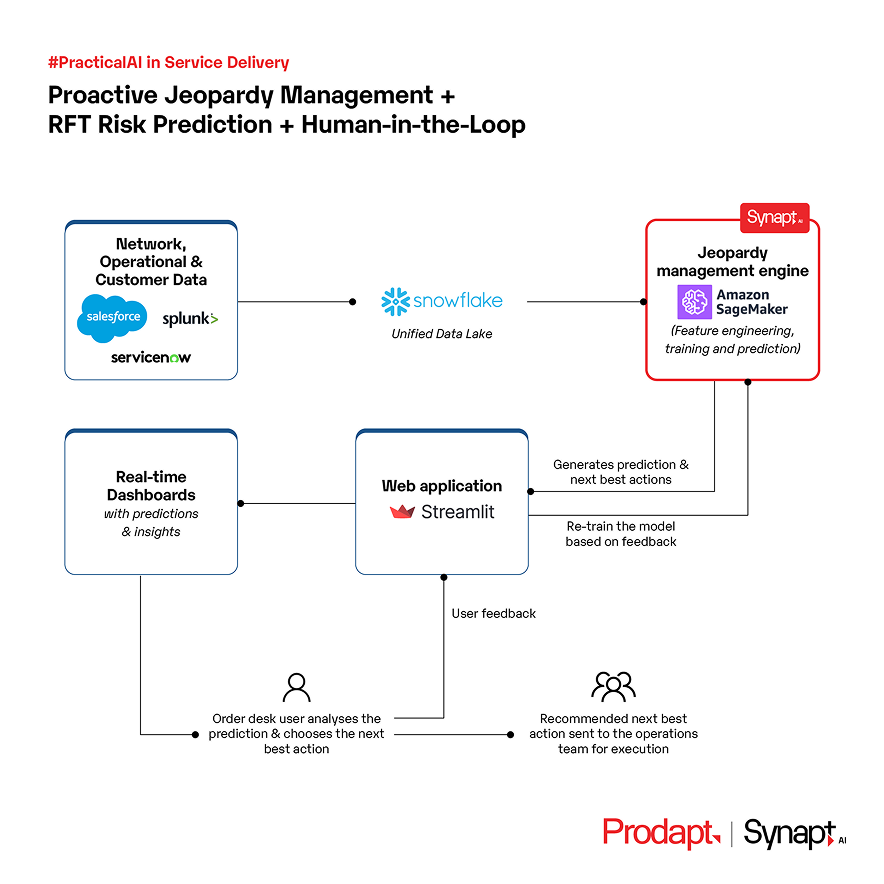
1. Data Capture & Harmonisation
Network, operational, and customer data from CRM, ticketing, and observability systems flow in through APIs and event-driven pipelines. AWS-native services (Lambda, Step Functions, EventBridge, and EC2 connectors) standardise the data and land it in a Snowflake unified data lake. This creates a single source of truth covering RFT history, orders, SLAs, truck rolls, complaints, and network KPIs.
2. Risk Feature Engineering at City/Postcode Level
Once the data is unified, Snowflake and Snowpark pipelines transform raw records into risk-ready features. The system models network maturity at city and postcode resolution by combining historical RFT outcomes, capacity signals, connectivity history, appointment behaviour, and local complaint density. This produces granular, location-specific risk profiles for every new or in-flight order.
3. ML Prediction & Governance Layer
With features in place, Amazon SageMaker trains and deploys models predicting RFT failure likelihood, expected resolution cycle time, and churn or penalty exposure. MLflow manages experiment tracking, model versioning, and governance. The result is a production-grade ML stack that is auditable, measurable, and consistent across regions and service types.
4. Next-Best-Action Intelligence
Predictions alone don’t reduce truck rolls — decisions do. A recommendation layer translates predictions into operational actions. It maps risk types to targeted interventions, such as rebooking appointments, optimising engineer dispatch, or proactive customer communication. This turns predictions into actionable steps that prevent failures before they occur.
5. Human-in-the-Loop Decisioning
To ensure real-world control and accountability, AI recommendations are delivered through a Streamlit-based web application used by order desk and jeopardy teams. Human-in-the-loop decisioning ensures that teams can validate the AI’s proposed next-best action using local context and operational constraints. This increases trust, reduces risky automation, and creates a structured feedback stream that strengthens model precision over time.
6. Real-Time Dashboards & Closed-Loop Learning
Live dashboards track RFT risk levels, SLA adherence, network health, and action outcomes. As actual results come in (RFT pass/fail, SLA breach status, customer impact), the system feeds them back into Snowflake as fresh labels. This closed-loop process continuously improves model accuracy and recommendation effectiveness.
Value delivered:
Truck roll optimisation: Reduced unnecessary and repeat dispatches by ~48%, cutting field OPEX and resource waste.
RFT uplift: Improved Right-First-Time by ~20%, lowering failures and stabilising service quality.
Penalty prevention: Reduced SLA breaches, penalties, and auto-compensation through proactive risk mitigation.
Churn protection: Improved reliability and service assurance, reducing customer cancellations tied to unexpected RFT outcomes.
Talk to our AI experts to explore how city/postcode risk models, real-time dashboards, and human-in-the-loop next-best actions can reduce truck rolls, protect SLAs, and improve RFT at scale.


Deliver measurable outcomes for your business with #PracticalAI. Let’s talk!