For telecom and network service providers, field dispatch is where customer experience, operational cost, and service reliability collide. Every technician visit carries high stakes—fuel, time, labour, customer expectations—and when that visit turns non-productive, the impact ripples across margins, SLAs, and brand trust.
Despite investments in modern OSS, workforce management tools, and analytics platforms, Non-Productive Dispatch (NPD) remains stubbornly high across the industry. Failed visits due to customer no-shows, site access issues, incorrect prerequisites, or misaligned technician skills continue to erode operational efficiency.
The paradox is striking while backend systems have become data-rich, dispatch decisions are still made with fragmented signals and limited foresight. Alerts arrive too late. Patterns are identified retrospectively. And AI, when present, often resides in dashboards rather than being embedded in real-time dispatch decisions.
As field operations scale and service complexity increases, reactive dispatch models cannot keep pace.
The leading network communications provider featured in this case study faced challenges common across the telecom industry:
High NPD rates driven by appointment cancellations, access constraints, and incomplete pre-dispatch checks
Imbalanced technician workloads, resulting in overtime for some teams and underutilisation for others
Delayed identification of “no-access” scenarios, discovered only after technicians reached customer sites
Static planning models that failed to adapt to real-time changes in customer behaviour, weather, or network conditions
Although large volumes of data were available—from CRM systems, technician notes, network telemetry, and historical dispatch outcomes—these signals remained siloed. Dispatch planning relied heavily on manual rules and historical averages, limiting the ability to anticipate failures.
The result: higher operational costs, missed first-time resolutions, frustrated technicians, and poor customer experiences.
To break this cycle, Prodapt engineered an AI-driven dispatch intelligence platform powered by Synapt AI, purpose-built for large-scale telecom field operations.
Instead of analysing dispatch failures after the fact, the solution embedded intelligence upstream in the dispatch lifecycle—predicting risk, explaining outcomes, and enabling proactive intervention before a technician was ever sent.
The objective was clear: move from reactive dispatch execution to predictive, explainable, and optimised operations.
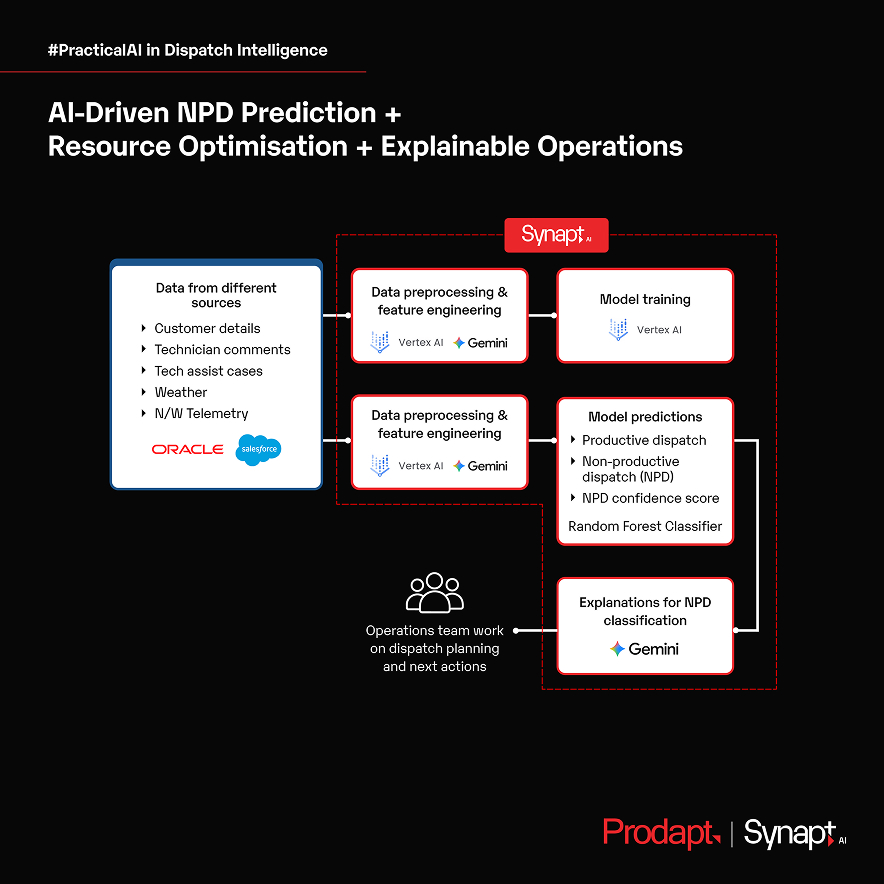
The solution was built on a modular, AI-native architecture designed for real-time decision support.
1. Multi-Source Data Ingestion
Dispatch intelligence begins with unified data ingestion from multiple enterprise systems, including:
Customer details and appointment history
Technician comments and field notes
Network telemetry and service status
Weather data and site constraints
Tech-assist and escalation records
This data foundation ensured dispatch decisions were informed by both historical patterns and live operational context.
2. Feature Engineering & Model Training
Using Vertex AI, data was pre-processed and enriched through advanced feature engineering. Signals such as cancellation patterns, access risk indicators, technician availability, and service complexity were derived and continuously refined.
A Random Forest classifier was trained to categorise upcoming dispatches as:
Productive dispatch
Non-productive dispatch (NPD)
NPD confidence score for prioritisation
This allowed operations teams to focus attention where risk was highest.
3. Predictive Dispatch Classification
Before dispatch execution, the model evaluated each appointment to predict the likelihood of non-productivity. High-risk cases were flagged early, enabling proactive actions such as customer confirmation, rescheduling, or reassignment.
4. Explainable Operations with GenAI
Predictions alone are not enough in regulated, high-impact operations. Using Gemini, the platform generated human-readable explanations for each NPD classification—clearly outlining why a dispatch was considered risky.
This explainability built trust with operations teams and ensured AI recommendations could be acted upon confidently.
5. Human-in-the-Loop Operations
Predictions and explanations were surfaced directly to dispatch planners and operations teams, enabling informed decisions on scheduling, workload balancing, and next-best actions.
By embedding AI into day-to-day dispatch workflows, the provider achieved tangible outcomes:
20–30% reduction in truck rolls, avoiding unnecessary dispatches
Lower technician overtime, driven by balanced workload distribution
Fewer installation disruptions, with access issues resolved pre-dispatch
Reduced operational costs through more intelligent forecasting and resource allocation
Improved customer satisfaction, enabled by higher first-time resolution rates
When non-productive dispatch goes unaddressed, its impact compounds—technicians lose trust in planning systems, customers lose confidence in service reliability, and operational costs spiral.
AI-driven dispatch intelligence reverses this trend. By connecting predictive models, explainable AI, and human decision-making, enterprises gain visibility, agility, and control across field operations.
The result is not just fewer failed visits—but a fundamentally more innovative way to operate at scale.
As telecom networks evolve and customer expectations rise, the future of field operations lies in AI-native, explainable, and adaptive dispatch models that learn continuously and act in real time.
At Prodapt, our AI-native squads are helping telecom providers reimagine dispatch—not as logistics, but as a strategic capability powered by predictive intelligence.
Looking to reduce NPD, optimise technician utilisation, and transform field operations with Practical AI? Talk to our experts to explore how AI-driven dispatch intelligence can turn every dispatch into a confident decision.
NA


Deliver measurable outcomes for your business with #PracticalAI. Let’s talk!