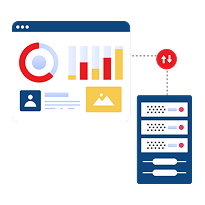
Business Intelligence and Reporting tools have transformed how organizations interpret data, moving from basic reporting to advanced predictive insights. These tools empower businesses to uncover hidden patterns, forecast trends, and make data-driven decisions with confidence. In this blog, we explore the evolution of BI analytics, core capabilities of modern tools, leading platforms, and how businesses can integrate intelligence into their workflows for maximum impact.
The journey of BI analytics has progressed through distinct stages—descriptive, diagnostic, predictive, and prescriptive. Descriptive analytics focuses on summarizing historical data to understand what happened, often through dashboards and reports. Diagnostic analytics digs deeper into why events occurred by identifying correlations and anomalies. Predictive analytics takes a forward-looking approach, leveraging statistical models and machine learning (ML) to forecast future trends. Finally, prescriptive analytics recommends optimal actions based on predictive insights, enabling businesses to make proactive decisions. The integration of artificial intelligence (AI) and ML has accelerated this evolution, allowing BI tools to automate complex analyses and deliver real-time intelligence. AI-driven BI tools now incorporate natural language processing (NLP) for intuitive querying, anomaly detection for identifying outliers, and automated insights that highlight key trends without manual intervention. This shift from reactive reporting to proactive intelligence has redefined how businesses leverage data.
Modern BI analytics tools offer a suite of powerful features designed to simplify data exploration and enhance decision-making. Data discovery and visualization are foundational, enabling users to explore datasets through interactive dashboards, heatmaps, and geospatial analysis. Platforms like ThoughtSpot and Google Looker excel in transforming raw data into intuitive visual narratives. Predictive modeling and forecast engines are another critical capability, allowing businesses to anticipate market shifts, customer behavior, and operational risks. Tools like IBM SPSS and TIBCO Statistica provide advanced statistical modeling, while Alteryx streamlines predictive workflows with drag-and-drop automation. Embedded natural-language Q&A is revolutionizing accessibility, letting non-technical users query data using everyday language. ThoughtSpot’s search-driven analytics and Looker’s AI-powered insights exemplify this trend, making BI more inclusive and actionable across teams.
Several leading BI analytics platforms stand out for their unique strengths. ThoughtSpot combines AI-powered search with intuitive visualizations, enabling users to uncover insights without complex queries. IBM SPSS is a powerhouse for statistical analysis, ideal for researchers and data scientists requiring advanced predictive modeling. TIBCO Statistica specializes in big data analytics, offering robust machine learning and real-time decision support. Alteryx bridges the gap between data prep and predictive analytics, automating workflows for faster insights. Google Looker (now part of Google Cloud) excels in embedded analytics, integrating seamlessly with enterprise applications for unified reporting. Each platform caters to different needs—whether it’s self-service analytics, enterprise-grade modeling, or cloud-based intelligence. Choosing the right tool depends on an organization’s data maturity, use cases, and technical expertise.
The true power of BI analytics lies in embedding intelligence into everyday workflows. Automated insights and anomaly detection reduce manual effort by flagging unusual trends, such as sudden drops in sales or spikes in customer churn. These features enable teams to act swiftly, minimizing risks and capitalizing on opportunities. Alerting and real-time decision support take this further by delivering instant notifications when key metrics deviate from expectations. For instance, supply chain managers can receive alerts about potential delays, while sales teams get real-time updates on pipeline changes. This dynamic approach ensures that businesses stay agile in fast-moving markets.
BI analytics tools drive tangible business value across industries. In churn prediction, companies analyze customer behavior to identify at-risk accounts and implement retention strategies. Sales forecasting leverages historical data and market trends to predict revenue, optimize quotas, and align resources effectively. Supply chain optimization benefits from predictive analytics by anticipating demand fluctuations, reducing inventory costs, and improving logistics efficiency. The ROI of these applications is measurable—organizations report higher operational efficiency, increased revenue, and reduced costs by embedding analytics into their decision-making processes. Success stories highlight companies that reduced customer churn by 20% using predictive models or improved inventory turnover by 30% through demand forecasting. These metrics underscore the transformative potential of BI intelligence tools when implemented strategically.
Implementing BI analytics and AI requires a structured approach. Data readiness is the first step—ensuring clean, structured, and accessible data is crucial for accurate modeling. Feature engineering, the process of selecting and transforming variables, enhances model performance by refining input data. Skill development is equally important, as teams need training in data literacy, statistical analysis, and tool-specific functionalities. Establishing governance frameworks ensures data security, compliance, and ethical AI usage, fostering trust in analytics outputs. A phased adoption strategy—starting with descriptive analytics, then progressing to predictive and prescriptive models—helps organizations build confidence and scale intelligence initiatives effectively. Partnering with vendors for tailored solutions and leveraging cloud-based platforms can accelerate deployment.
Business Intelligence and Reporting tools have evolved from simple reporting systems to AI-driven decision engines. By harnessing predictive modeling, automated insights, and real-time analytics, businesses can unlock deeper intelligence and stay ahead of the competition. Whether through ThoughtSpot’s search-driven analytics, IBM SPSS’s statistical prowess, or Alteryx’s workflow automation, organizations have powerful options to embed data-driven decision-making into their operations. The future of BI lies in seamless integration, where analytics becomes an invisible yet indispensable part of business workflows. Companies that invest in these tools today will be tomorrow’s leaders, turning raw data into strategic advantage.


Deliver measurable outcomes for your business with #PracticalAI. Let’s talk!