
For telcos, the contact centre is the frontline of customer experience and the single most significant determinant of NPS. Every IVR interaction, agent conversation, escalation, and resolution attempt directly shapes how customers perceive the brand. Yet most organisations still rely on post-interaction surveys and periodic NPS reports to understand how those experiences performed.
Traditional NPS dashboards capture what customers felt, but not why. The most valuable signals—tone shifts, emotional escalation, unresolved intent, agent behaviour—are buried inside call recordings and free-text feedback. Analysed manually or not at all, these signals surface too late to influence outcomes.
This is widening the CX intelligence gap. As contact centres scale, call volumes increase and service scenarios become more complex, legacy NPS programs struggle to keep pace with speed, volume, and context. In an environment where customer loyalty can be lost in a single call, hindsight-driven analysis is no longer enough.
What contact centres need is a shift—from reactive score tracking to real-time experience intelligence—where AI listens continuously, understands context, and translates conversations into action.
Despite years of investment in QA tools and CX platforms, contact centre teams face four persistent challenges:
Fragmented experience signals: Voice recordings, IVR logs, surveys, and CRM notes live in disconnected systems, preventing a unified view of customer experience.
Manual NPS interpretation: Text-heavy survey responses and call audits require human review, slowing analysis and introducing inconsistency.
Delayed issue detection: Experience risks surface only after NPS drops, escalations rise, or churn signals appear.
Generic remediation: Without clarity on root causes, training and process fixes remain broad, failing to address specific drivers of dissatisfaction.
The result is uneven agent performance, longer handling times, repeat calls, rising escalations, and declining customer confidence—directly impacting NPS, First Call Resolution (FCR), and operational efficiency.
To address these challenges, Prodapt engineered an AI-driven voice and feedback intelligence pipeline using SynaptGPT, purpose-built for contact centre CX transformation.
Rather than treating NPS as a standalone metric, the solution connects customer conversations, sentiment, and operational context into a single intelligence layer. AI listens to every interaction, understands experience drivers at scale, and enables teams to act while the conversation still matters. These shifts transform contact centres from reactive cost centres into proactive experience engines.
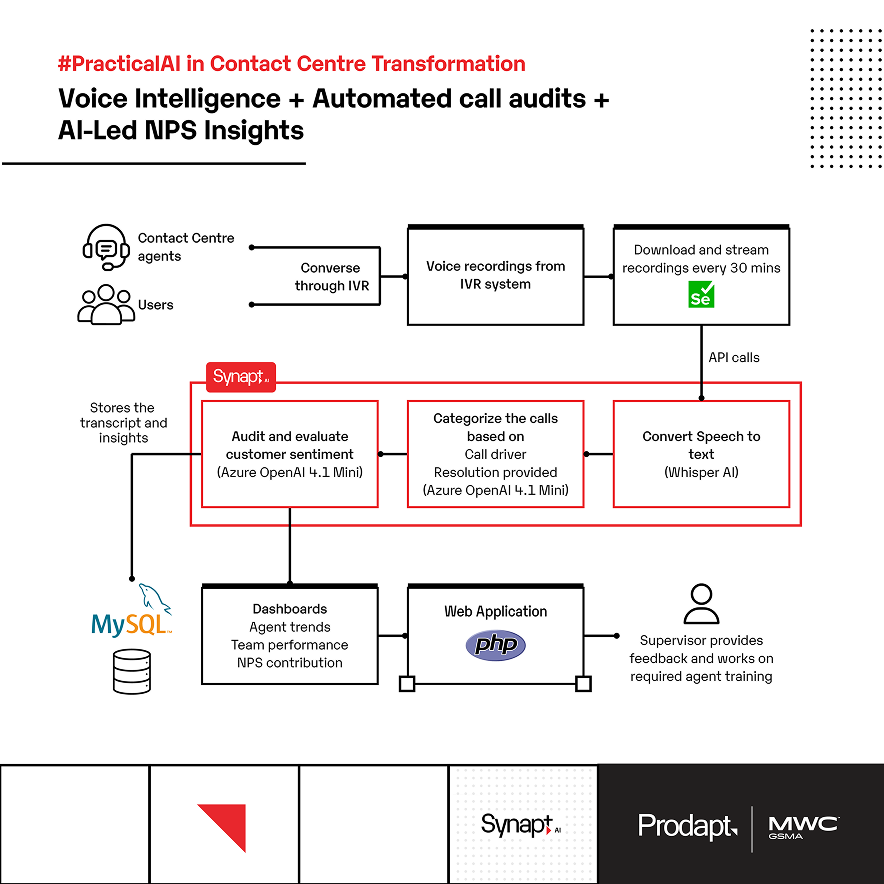
The platform is powered by a modular, AI-native architecture designed for high-volume, real-time contact centre data.
1. Continuous Voice & Feedback Ingestion
Voice recordings from IVR systems are automatically captured and streamed at regular intervals. Survey responses and agent context are collected through a structured web interface, ensuring consistency across unstructured and semi-structured inputs.
2. Speech-to-Text & Interaction Enrichment
Using Whisper AI, call recordings are converted into accurate transcripts. Each interaction is enriched with metadata, including call drivers, resolution indicators, agent details, and timestamps, creating a unified analytical foundation.
3. AI-Led Call Categorisation & Sentiment Auditing
Powered by Azure OpenAI, conversations are categorised by intent, resolution outcome, and experience impact. Sentiment analysis goes beyond positive or negative labels, detecting emotional intensity, escalation risk, and friction points that directly influence NPS.
4. Topic Modelling & Anomaly Detection
Advanced topic modelling clusters recurring call drivers—such as billing confusion, service outages, or provisioning delays—highlighting systemic CX issues. Anomaly detection continuously monitors for deviations, surfacing sudden spikes in complaints, agent outliers, or emerging experience risks in near-real time.
5. Insight Summarisation & Operational Action
An AI-led summarisation layer converts high-volume transcripts and feedback into concise, actionable insights. These insights feed dashboards and a web application, enabling supervisors to translate customer signals directly into targeted agent coaching, training programs, and process improvements.
All transcripts and insights are securely stored, creating a feedback loop that continuously improves accuracy and relevance.
By embedding intelligence directly into daily contact centre operations, organisations achieved measurable outcomes:
15–20% uplift in NPS, driven by faster, insight-led interventions
50% reduction in NPS and feedback analysis time, eliminating manual effort
Improved agent performance, supported by precise, data-backed coaching
When contact centre experience signals go unseen, the impact ripples across the enterprise. Agents struggle without feedback, supervisors react too late, and customers lose trust. In contrast, AI-driven experience intelligence creates alignment—connecting frontline conversations to CX strategy, operations, and outcomes.
As customer expectations continue to rise, the cost of delayed insight will only grow.
NPS is not disappearing—but it is being redefined.
The convergence of GenAI, voice intelligence, and real-time analytics marks a turning point for contact centres. What began as post-call scoring is evolving into a living intelligence layer—one that listens continuously, explains experience drivers, and enables action at scale.
At Prodapt, our AI-native teams are helping contact centres evolve from reactive support functions into experience-led differentiators.
Looking to move beyond NPS scores and gain real-time visibility into what truly drives contact centre CX? Talk to our AI experts to explore how AI-driven experience intelligence can turn every conversation into action.


Deliver measurable outcomes for your business with #PracticalAI. Let’s talk!