TL;DR
- Every enterprise AI stack needs three layers: compute (solved by cloud providers), data (in place at most enterprises), and operational intelligence (almost universally absent).
- 83% of enterprises are building agentic AI; only 11% are shipping it. The gap is not the model or the data — it is the missing third layer.
- Operational intelligence is the governed layer between data systems and AI agents — encoding policies, procedures, compliance constraints, and institutional knowledge in a queryable, current form.
- Without it, agents hallucinate — not because the model is wrong, but because it was never given what it needed to be right.
- The question is no longer “which model?” — it is “what sits between your data and your agents?”
Most enterprise AI teams believe their stack is ready: compute from the cloud, a capable foundation model, and years of investment in data. It sounds complete. It isn’t.
83% of enterprises are building agentic AI. Only 11% are shipping it. The gap is not the model, the cloud provider, or the data volume. It is a layer that almost no enterprise has built.
This article names all three layers every enterprise AI stack needs, explains why the third — operational intelligence — is almost universally absent, and shows what it takes to build it.
Ask any enterprise AI team what their stack looks like, and you will hear a version of the same answer.
Cloud infrastructure. A foundation model — GPT-4, Claude, Gemini, or an open-source alternative. A data platform. Maybe a vector database. A few agents built on top.
It sounds complete. It isn’t.
There are three layers every enterprise AI stack needs to move from pilot to production. Most enterprises have two. The third — the one that actually determines whether AI agents work in the real world is almost universally absent.
What is operational intelligence?
Operational intelligence is the governed layer that sits between an enterprise’s data systems and its AI agents. It encodes the policies, procedures, compliance constraints, and institutional knowledge that define how the business actually runs — and makes that knowledge accessible, current, and queryable for every agent that needs it. It is not a database, a RAG pipeline, or a prompt with documents pasted in. It is the structured context layer that determines whether agents act correctly, explainably, and in compliance with the rules that govern the enterprise.
What Does the Compute Layer Do in an Enterprise AI Stack?
The cloud providers solved this. AWS, Azure, and Google Cloud have made enterprise-grade compute accessible, scalable, and increasingly cost-efficient. GPU capacity that once required years of capital planning is now provisioned in minutes.
This layer is not the problem. If anything, compute abundance has created a false sense of readiness — enterprises assume that because the infrastructure is in place, the AI is ready to work.
It isn’t. Compute is necessary but nowhere near sufficient.
Is Enterprise Data Enough to Make AI Agents Work?
The second layer is the data platform — the warehouses, lakes, pipelines, and databases that enterprises have spent the last decade building. Snowflake, Databricks, BigQuery. Years of investment in ETL, schema design, and data governance.
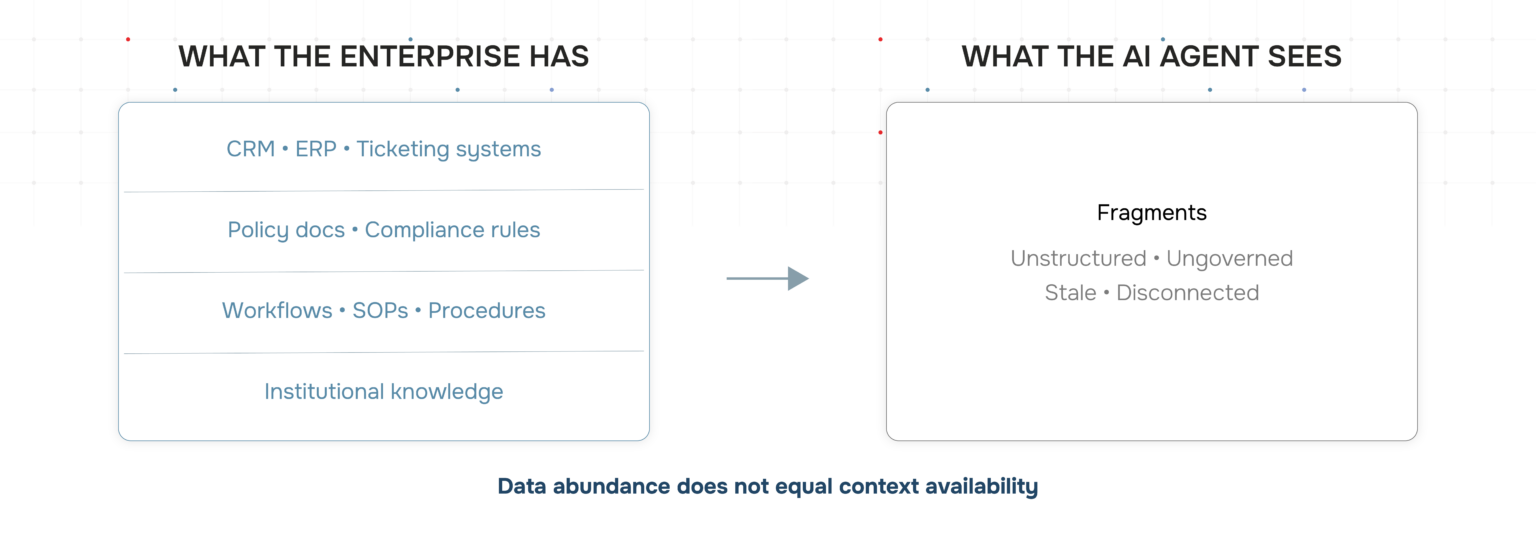
This layer is also largely in place. Enterprises have more data than they have ever had. The average large enterprise holds petabytes of operational data across CRM systems, ERP platforms, ticketing tools, policy repositories, and communication records.
And yet 83% of enterprises are building agentic AI while only 11% are shipping it. The data is there. The agents are not working.
Because data is not the same as context.
What Is the Operational Intelligence Layer and Why Is It Missing?
Here is where every enterprise AI stack quietly breaks down.
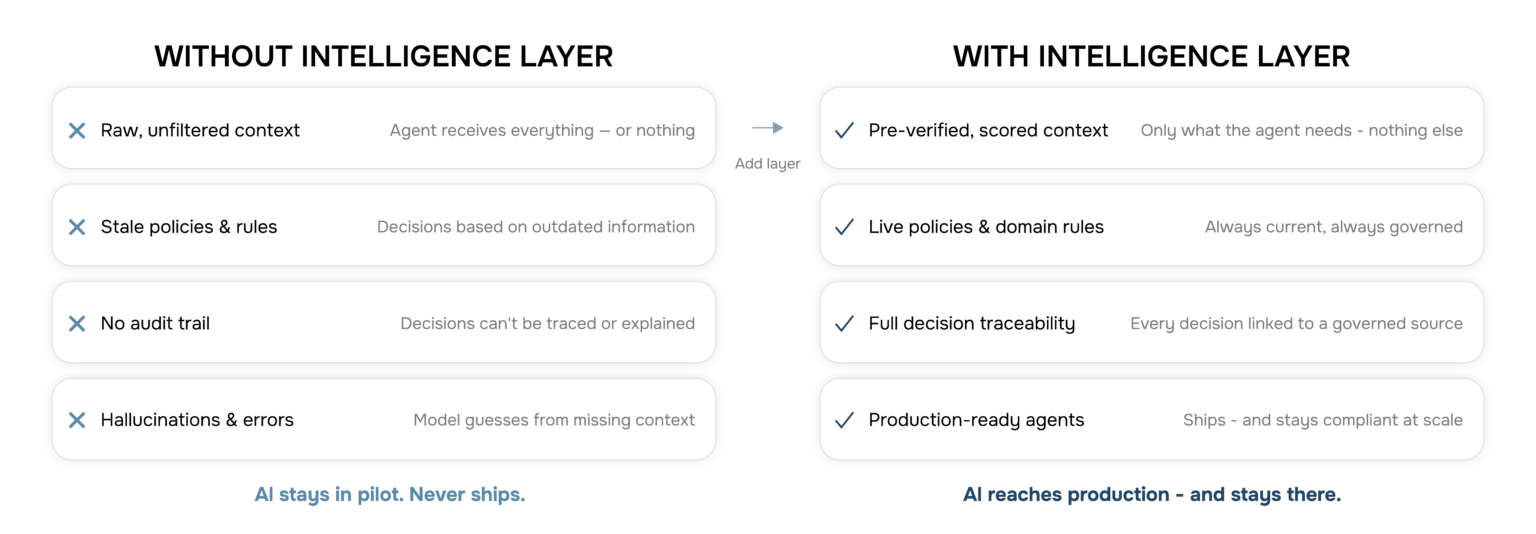
An AI agent deployed in a regulated industry does not just need data. It needs to know which data is up to date. It needs to determine which policies apply to this customer in this region under this scenario. It needs access to the workflows that govern decision-making — not as static documents buried in a SharePoint folder, but as live, queryable, governed knowledge that updates as the business changes.
This is operational intelligence. And it is not a database. It is not a RAG pipeline. It is not a prompt with a few policy documents pasted in.
Operational intelligence is the layer that sits between an enterprise’s fragmented data systems and the AI agents that need to act on them. It encodes the policies, procedures, compliance constraints, and domain knowledge that define how the business actually runs — and makes that knowledge accessible, current, and governed for every agent that needs it.
Without this layer, agents hallucinate — not because the model is wrong, but because the model was never given what it needed to be right. They give customers outdated policy information. They approve requests that should have been blocked. They make decisions that cannot be explained to a regulator.
The enterprise has the data. The agent just cannot see it.
Why is this layer hard to build
The reason operational intelligence does not exist in most enterprise stacks is not neglect. It is genuine complexity.
Enterprise knowledge is not tidy. Policies conflict across regions. Procedures change faster than documentation. Compliance rules interact in ways that require domain expertise to navigate. The knowledge that experienced humans carry — the institutional understanding of how things actually work — has never been formally encoded anywhere.
Building this layer means solving problems that are simultaneously technical, organisational, and domain-specific. It requires a governance model, a retrieval architecture, a confidence scoring mechanism, and a continuous update pipeline. It requires understanding the business deeply enough to know what the agents need to know.
This is why most enterprises skip it. They build the agent first and assume the context problem will solve itself. It does not.
Why Is Operational Intelligence Hard to Build?
The enterprise AI conversation has been dominated by model selection for three years. Which foundation model? Which version? Which benchmark?
The right question is different: what sits between your data and your agents?
Compute is solved. Data is abundant. The enterprises that win the next five years will not have the best models. They will have the best operational intelligence layer beneath them.
That is the layer most enterprises are missing. And it is the only one that determines whether AI moves from demo to production.
Frequently Asked Questions
What are the three layers an enterprise AI stack needs?
Compute, data, and operational intelligence. The first two are commonly in place. Operational intelligence — the governed layer that encodes policies, procedures, and domain knowledge for AI agents — is the layer most enterprises are missing.
What is operational intelligence in enterprise AI?
Operational intelligence is the layer that sits between an enterprise’s fragmented data systems and its AI agents. It encodes the policies, procedures, compliance constraints, and domain knowledge that define how the business actually runs, and makes that knowledge accessible, current, and governed for every agent that needs it.
Why do enterprise AI agents fail in production?
Most agent failures trace back to the absence of operational intelligence — not model quality. Agents hallucinate, give outdated information, or make unexplainable decisions because they were never given the governed context they need. Having data is not the same as having context.
Why are 83% of enterprises building agentic AI but only 11% shipping it?
The gap is the missing operational intelligence layer. Enterprises have compute and data, but agents cannot act reliably without governed knowledge — up-to-date policies, decision procedures, and compliance constraints — encoded in a queryable layer beneath them.
What makes operational intelligence different from a RAG pipeline or a database?
A database stores structured records. A RAG pipeline retrieves document chunks. Operational intelligence is a governed layer that encodes how the business actually runs — policies that conflict across regions, procedures that change faster than documentation, and the institutional knowledge experienced humans carry — and makes it queryable, current, and traceable for AI agents
What infrastructure question should enterprises ask about AI?
Not “which foundation model?” but “what sits between your data and your agents?” Enterprises that answer this by building a governed operational intelligence layer are the ones that move AI from demo to production.

Subscribe to our newsletter
Insights on making enterprise AI actually work - straight to your inbox.
Subscribe to our newsletter
Insights on making enterprise AI actually work - straight to your inbox.
Free Interactive Assessment
Is your Enterprise AI-Ready?
Get your readiness score across data, governance, and context infrastructure — in about 3 minutes.

Your Readiness Score
-
Data & context readiness
-
Governance & sovereignty
-
Agent infrastructure maturity