TL;DR
- Fibre network civil packs are still assembled by hand — a slow, error-prone process that bottlenecks every build programme.
- Synapt’s Context Substrate automates the entire journey from raw field survey form to construction-ready GIS output.
- The agent doesn’t follow hardcoded rules — it queries the substrate at every step, making the workflow configurable, auditable, and adaptable without touching a single line of code.
- Route detection handles any geometry — arcs, S-bends, sharp corners, loops, and branching multi-segment runs.
- A task that consumed hours of an engineer’s day now completes in minutes, with ~95% route-length accuracy and 90% less manual intervention.
What Is a Civil Pack, and Why Is It a Bottleneck in Fibre Network Builds?
A civil pack is the construction-ready document assembled from a field survey — containing the proposed duct route drawn in the GIS, start and end chambers, duct type, surface type, run length, and the required map views. It is the instruction set a build crew works from.
Every fibre build begins in the field. A surveyor walks a street, decides where new duct and chambers should go, and records it on a field survey form. On that form is a map snippet with the proposed duct route drawn by hand, alongside the structural details — the start and end chambers, the duct type, the surface type, and the run length.
Turning that survey into something a construction crew can actually build from is heavy manual work. A design engineer must read the form, interpret the sketch, re-draw the proposed route as a real feature in the GIS, pull the right map views, and assemble a polished civil pack. Done by hand it is slow, repetitive, and error prone. Across thousands of forms, it becomes a serious bottleneck between survey and spade-in-the-ground.
The goal is simple to state: take a field survey form in, and produce a finished, construction-ready civil pack out — with the proposed route placed accurately in the GIS, automatically.
Why Can’t Standard Automation Tools Handle Civil Pack Generation?
Standard automation fails here for three reasons: the route exists only as a hand-drawn sketch on a map image, every operator fills forms differently, and the output tolerates essentially zero error.
The route lives in a picture, not in data. The proposed duct is pixels drawn on a map — not a stored geometry — and real routes curve, bend, and branch in ways no fixed template can anticipate.
Every operator does it differently. Forms vary in layout and convention across teams and regions. Hardcoding one set of rules creates a brittle tool that breaks the moment the process evolves.
The output must be precise and trustworthy. A duct placed in the wrong location, or disconnected from its chambers, is worse than no automation at all. Margin for error here is essentially zero.
How Does Synapt’s Context Substrate Automate Civil Pack Creation?
Synapt treats the workflow as knowledge-driven rather than code-driven: the organization’s operating procedure lives in the Context Substrate, and a deliberately generic agent queries it at every step to decide what to do next.
The Synapt AI – Operational Intelligence Layer is the knowledge system that governs how a civil pack is produced — a versioned repository of operational rules, standards, and procedures. It defines which survey fields to extract, how GIS data should be interpreted, which map layers and extents to use, and how the final pack should be assembled. The workflow agent contains no fixed domain knowledge of its own; instead, it consults the Operational Intelligence Layer at each step and executes the instructions it receives.
Three principles define this approach.
Configured, not coded. The rules live inside the procedure stored in Synapt. To change behavior — add a field, swap a layer, adjust the layout — you edit the procedure and re-ingest it. No software change, no redeployment required.
Every step is substrate-driven. As the agent moves through the pipeline, it issues a live query to Synapt at each stage, making the orchestration fully transparent and auditable.
Knowledge stays in one place. Domain rules are versioned and owned by the people who understand the process — not buried in code that only developers can change.
How Does the Automated Workflow Work?
The pipeline runs across five sequential steps — understand the task, read the survey, detect the drawn route, place it in the GIS, and build the pack — with each step guided live by the substrate.
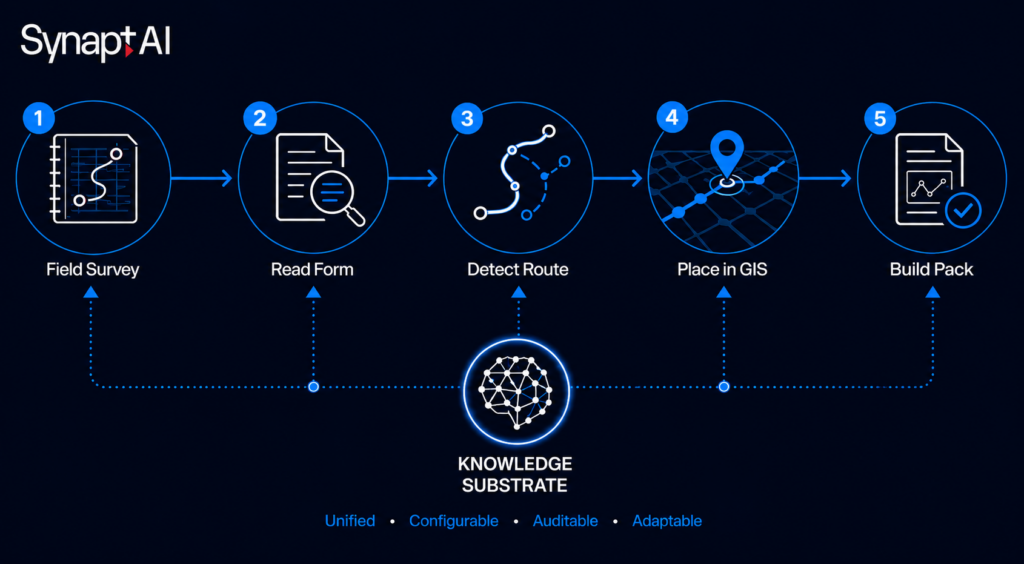
Step 1 — Understand the task
The agent queries Synapt for the operating procedure and the categories of work it covers, establishing the full context before anything is processed.
Step 2 — Read the survey
The agent ingests the form — spreadsheet or PDF — and extracts all structured details. Extraction is hybrid: pattern rules and a language model work together, and the agent reads the map image as well as the text, because critical information often lives only in the sketch itself.
Step 3 — Detect the drawn route
This is the technical centerpiece of the entire workflow. The agent isolates the drawn duct by colour, repairs small breaks in the line, removes look-alike clutter, reduces the result to its centerline, and traces it — handling any geometry: arcs, S-bends, sharp corners, loops, and multi-segment runs that branch at junctions. It reproduces what was actually drawn rather than matching a fixed catalogue of templates.
Step 4 — Place it accurately in the GIS
The traced route is anchored to the real-world coordinates of its two end chambers. Every point along the curve is transformed into the GIS coordinate system — so the shape is reproduced exactly, not approximated — then snapped cleanly onto the existing network and written as a genuine new feature.
Step 5 — Build the pack
The agent renders the required map views and assembles the civil pack to the template Synapt specifies, producing a document ready for the build team without any manual finishing.
What Are the Business Benefits of Automating Civil Pack Design?
Automation delivers measurable gains across four dimensions: speed, accuracy and consistency, adaptability, and trust.
Speed. A task that previously consumed a significant portion of an engineer’s working day is reduced to a short automated run.
≈96% faster — a process that traditionally requires around 150 minutes of manual effort can be completed in approximately 6 minutes through automation (illustrative benchmark).
Accuracy and consistency. The route is reconstructed faithfully, connected correctly every time, and the civil pack always follows the approved template.
~95% route-length accuracy and 90% less manual intervention across the automated workflow, demonstrating highly reliable pack generation with minimal human input (illustrative figures).
Adaptability. Because the rules live in Synapt rather than in code, the same agent can serve different processes and evolving standards without any re-engineering. When requirements change, the procedure changes — not the software.
Zero code edits are required to adapt the workflow when a process, survey form, business rule, or output template changes, enabling rapid operational updates without software redevelopment.
Trust and transparency. Each step acts on retrievable, versioned organizational knowledge. The automation is fully explainable rather than a black box — every decision can be traced back to the procedure that instructed it.
How Does Agentic AI Improve Operational Efficiency in Telecom?
Agentic AI improves telecom operational efficiency by executing the judgement-heavy steps between systems — reading the input, applying the operating procedure, and writing the result into the system of record — rather than recommending what a human should do next. The gain comes from removing handoffs and re-keying, not from a faster model.
Agentic AI in telecom is AI that takes bounded actions inside operational systems — GIS, OSS, BSS, inventory, ticketing — under governed procedures, instead of only producing an analysis a human then has to act on.
The distinction matters because most “AI in telecom” spend to date has produced recommendations, not completed work. An engineer still opens the GIS, still re-keys the fields, still assembles the pack. The queue does not move. Efficiency arrives only when the agent completes the loop and the record it writes is trustworthy enough that nobody re-checks it by hand.
Where the efficiency actually comes from?
| Telecom operation | Manual process today | What a governed agent does instead | Source of the efficiency gain |
| Fibre civil pack design | Engineer reads survey form, re-draws route in GIS, pulls map views, assembles pack | Extracts form fields, detects the drawn route, places it in GIS, renders the pack to template | Removes the read-interpret-redraw handoff entirely |
| Field survey / as-built capture | Field data re-keyed from forms and photos into inventory | Reads structured and image-based inputs, writes validated records to inventory | Eliminates double entry and transcription error |
| Fault triage and remediation | AI flags an anomaly; engineer reads the SOP, decides, executes | Agent retrieves the current SOP, acts within its permitted boundary, escalates the rest | Closes the recommend-to-act gap that leaves fixes queued |
| Service order fallout | Analyst reconciles mismatches across OSS/BSS and CRM by hand | Agent applies the reconciliation rules held in the substrate and resolves or routes | Removes per-case rule lookup and manual reconciliation |
| Design and config compliance | Peer review against standards documents | Agent checks output against versioned standards before submission | Shifts compliance from after-the-fact review to inline |
| Procedure change rollout | Update docs, retrain teams, patch scripts, redeploy | Update the procedure in the substrate; the agent follows it immediately | No software change, no redeployment cycle |
Rows beyond fibre civil pack design describe the pattern this workflow demonstrates, not separately benchmarked deployments.
Not all “AI in operations” delivers the same ceiling
| Level | What it does | What the human still does | Efficiency ceiling |
| Analytical AI | Detects anomalies, predicts failures, scores risk | Interprets the output and decides the action | Faster detection; execution time unchanged |
| Assistive AI | Drafts, summarises, answers questions about procedure | Verifies, then performs every action | Reduced reading time; the queue still moves at human speed |
| Agentic AI (ungoverned) | Takes actions across connected systems | Reviews every action, because none are provably in-policy | Review cost replaces execution cost |
| Agentic AI (governed) | Takes actions bounded by versioned procedure, with a traceable decision record | Handles exceptions and escalations only | Work completes without a human in the default path |
The fourth row is the only one where cost per transaction genuinely falls, and it depends on conditions that sit beneath the agent rather than inside it. Governed operations require four things in place: procedures encoded as executable constraints rather than documents; a defined boundary for what agents are allowed to do once connected; knowledge that stays current, since procedures go stale silently while the agent keeps acting confidently; and a decision trail an auditor can follow. Where those are missing, agentic pilots stall — which is a large part of why only 11% reach production across enterprises generally, and why telco AI stalls before deployment rather than during it.
This is what the civil pack workflow demonstrates in miniature. The agent carries no fibre expertise of its own; the operating procedure lives in Synapt AI’s Operational Intelligence Layer, a governed context substrate that is model-agnostic and spans legacy OSS/BSS and operational systems without migration. Change the procedure and the behaviour changes — which is the property that lets one pattern serve many telecom operations rather than one.
What Other Workflows Can This Knowledge-Driven Approach Automate?
Any document-to-action workflow where an expert reads a form, applies domain rules, and produces a standardized output is a candidate — the civil pack use case is one instance of a much broader pattern.
The civil pack use case demonstrates a pattern that extends well beyond fibre network design. The substrate captures the expertise once. The agent applies it consistently at scale, across any volume of work, without degradation.
The knowledge — not the code — is the product. And once that knowledge is in the substrate, it is available to every process that needs it.
FAQ's
A civil pack is the construction document that tells a build team exactly what to build and where — including the duct route, chamber locations, surface types, and map views. It bridges the gap between a surveyor’s field sketch and an actual construction crew. Without it, no spade goes into the ground.
Because the core input — the proposed duct route — exists as a hand-drawn sketch on a map image, not as structured data. Standard rule-based automation requires structured inputs. Synapt’s approach reads the image directly, detects the geometry of the drawn route, and reconstructs it accurately in the GIS regardless of its shape or complexity.
Route-length accuracy is approximately 95% based on illustrative figures from the workflow. The Agentic AI reconstructs the drawn geometry faithfully — handling arcs, S-bends, sharp corners, loops, and branching runs — and anchors the result to the real-world coordinates of the end chambers rather than approximating the shape.
Yes. Any workflow where an expert reads a form, applies domain knowledge, and produces a standardized output follows the same pattern. The Synapt Context Substrate captures that expertise once, and a generic agent applies it at scale — making the approach transferable across industries and use cases without rebuilding the system each time.
It means that when a business process changes — a new field is added to a form, a GIS layer is updated, a pack template is revised — the change is made inside the procedure stored in Synapt, not in the software itself. No developer involvement, no redeployment, no downtime. The updated procedure is re-ingested and the agent follows it immediately.


Subscribe to our newsletter
Insights on making enterprise AI actually work - straight to your inbox.
Subscribe to our newsletter
Insights on making enterprise AI actually work - straight to your inbox.
Free Interactive Assessment
Is your Enterprise AI-Ready?
Get your readiness score across data, governance, and context infrastructure — in about 3 minutes.

Your Readiness Score
-
Data & context readiness
-
Governance & sovereignty
-
Agent infrastructure maturity
![Small Models vs. Large Models: Choosing the Right AI Strategy for the Enterprise [A Deep-Dive Study]](https://www.synapt.ai/wp-content/uploads/2026/07/ChatGPT-Image-Aug-7-2026-02_30_54-PM.png)